Qlik Error Code 9000: Troubleshooting Guide
Urgent guide to understanding qlik error code 9000, diagnosing causes, and applying fast fixes. Learn with a clear diagnostic flow, step-by-step repairs, and prevention tips from Why Error Code.


qlik error code 9000 typically signals a critical failure in a data load or script that prevents dashboards from rendering. It often stems from syntax errors, missing fields, or incompatible data sources. The quickest fix is to verify data connections, correct the script, and re-run the load. If issues persist, consult logs and contact support. This urgent problem demands a precise, targeted approach.
What Qlik Error Code 9000 Means
qlik error code 9000 is a high-priority sign that a data load or visualization attempt failed. In practice, it points to problems in the loading script, data model, or a source connection that prevents the application from producing usable dashboards. For developers and IT pros, treating 9000 as a show-stopper means prioritizing quick isolation of the root cause, validating data sources, and restoring normal operation with minimal downtime. In the context of Why Error Code, this error is a signal to move from guesswork to a structured diagnosis that targets the exact failing step in the data pipeline. Errors of this type often occur after changes to data schemas, new connectors, or updates to the data model. As such, you should assume urgency and proceed with a disciplined checklist to get back to a green load.
Quick Fixes You Can Try Immediately
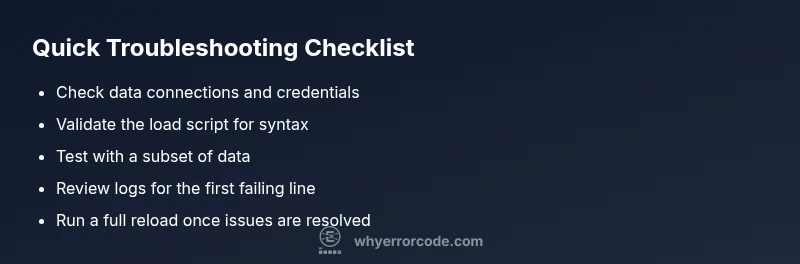
- Check data connections and credentials for all sources used in the load script. A broken connection is a common trigger for qlik error code 9000.
- Inspect the load script for syntax issues: missing commas, mismatched quotes, or invalid field references can halt the data pipeline.
- Validate field names and data types against the data source; rename or map fields if needed to align with the script expectations.
- Run a partial reload with a reduced dataset to isolate the failing step without waiting for a full rebuild.
- Clear cache or refresh the app in a controlled environment to rule out stale metadata causing the error.
- Review the error logs and trace files; look for stack traces pointing to a specific script line or data source.
- If the issue persists, reproduce the problem in a development environment and contact support with the exact error trace for faster resolution.
Diagnostic Flow: Symptoms, Causes, and Fixes
Symptom: The dashboard fails to load and displays qlik error code 9000 during a data load. Causes:
- high: Script syntax error or invalid field reference
- medium: Incompatible or missing data source or credentials
- low: Data model corruption or memory pressure Fixes:
- easy: Run a targeted reload with a reduced dataset to locate the failing step.
- easy: Validate and fix syntax and field references in the load script.
- medium: Verify data sources are accessible and credentials are current; reduce load size if needed to bypass memory constraints.
- hard: Rebuild or adjust the data model to remove structural corruption and revalidate associations.
Step-by-Step Fix: Most Common Cause
- Open the load script and run a quick syntax check to catch missing commas or quotes.
- Verify every field name in the script matches the data source exactly.
- Confirm all data sources are reachable with valid credentials.
- Test with a minimal dataset to verify the core load path works.
- Incrementally reintroduce data sources, validating results at each step.
- Review logs for the first explicit error line and address that issue before a full reload. Tip: Always backup your app before major edits and run tests in a staging environment before production.
Other Possible Causes and How to Address Them
Beyond the most common script error, qlik error code 9000 can arise from data source changes that alter schema, minor differences in data types, or changes in regional settings affecting date formats. Another contributor is memory pressure on the server during large reloads. Address these by standardizing data formats, updating data models to reflect source changes, and scheduling large reloads during low-usage windows. If you’re using third-party connectors, ensure driver versions are compatible with your Qlik Sense/QLIK platform.
Practical Tips, Safety Warnings, and When to Call a Pro
- Safety: Do not deploy risky schema changes directly to production without testing; use a staging environment to validate fixes.
- Urgency: If a production dashboard is down during business hours, treat the incident as high priority and follow the diagnostic flow immediately.
- Escalation: If logs reveal a server-side memory or license constraint, contact your admin or vendor support with the full error trace and environment details.
- Cost awareness: Expect potential repair costs to involve data source reconfiguration or development time; plan for a 2–6 hour window depending on complexity.
Key Prevention Tips: Avoid a Reoccurrence of qlik error code 9000
- Establish a robust change-control process for data sources and scripts.
- Maintain versioned scripts and data model diagrams to speed up rollback.
- Use staged reloads and automated tests to catch syntax or schema issues early.
- Regularly monitor logs after updates or new data sources to catch 9000-type errors before dashboards are impacted.
Steps
Estimated time: 25-50 minutes
- 1
Validate Script and Field References
Open the load script and verify that every field name matches the data source exactly. Look for typos, reserved words, or mismatched data types that can trigger a 9000 error. Use the script editor's syntax highlighting to catch issues before running the reload.
Tip: Enable line-by-line debugging or a dry-run to isolate the exact line causing the failure. - 2
Test Data Source Connectivity
Check connectivity to every data source used in the script. Validate credentials, network access, and any firewalls that could block the connection during the load. If a source is intermittently failing, consider temporarily masking it to confirm the rest of the pipeline works.
Tip: Try a direct query from the data source client to rule out external factors. - 3
Run Partial Load
Perform a partial reload with a subset of the dataset to identify which portion of the data triggers the error. This narrows down the failing table, field, or transformation without rebuilding the entire model.
Tip: Record the dataset used in the partial load to replay the exact conditions later. - 4
Review Data Model and Associations
Examine the data model for incorrect associations or circular references that can surface under load. Ensure foreign keys align across tables and that synthetic keys are handled properly.
Tip: Use the data model viewer to visualize relationships and quickly spot anomalies. - 5
Check Logs and Error Messages
Lift the verbosity of the logs around the time of the failure. Analyze stack traces and timestamps to pinpoint the failing step. Correlate messages with your recent changes to isolate the root cause.
Tip: Export the log segment for shareable diagnostics when contacting support. - 6
Execute Final Reload and Validate
After applying fixes, run a complete reload and validate outputs visually and against expected data. Confirm that dashboards render without error and that data aligns with source expectations.
Tip: Document the exact steps taken for future reference and audits.
Diagnosis: Error code 9000 appears during data load or dashboard refresh
Possible Causes
- highScript syntax error or invalid field reference
- mediumIncompatible or missing data source
- lowData model corruption or excessive memory usage
Fixes
- easyRun a targeted reload with the data model viewer to pinpoint the failing step
- easyReview and fix syntax and field references in the load script
- mediumVerify all data sources are accessible and credentials valid; reduce data load if needed
Frequently Asked Questions
What does qlik error code 9000 mean?
qLlik error code 9000 indicates a critical failure in the data load or scripting process that prevents dashboards from rendering. It usually points to syntax errors, missing fields, or an inaccessible data source. Treat this as an urgent issue and follow a structured diagnostic flow.
Qlik error 9000 means a critical load or script failure. Start by checking syntax and data sources, then run a targeted reload.
How do I fix qlik error code 9000 quickly?
Begin with quick checks: verify data connections, validate script syntax, and test with a smaller dataset. If the error persists, enable detailed logs and perform a partial reload to isolate the fault, then apply the appropriate fix.
Quickly fix 9000 by checking connections, script syntax, and starting with a small data subset before full reloads.
Can data source changes cause 9000?
Yes. Changes to data schemas or credentials can trigger qlik error code 9000. Update the load script accordingly and verify each source remains accessible during the process.
Yes. If a data source changes, update your script and recheck access during reloads.
Why would 9000 appear only on a specific app?
An app-specific mismatch—such as a unique data source or a localized script—can cause 9000 in that project. Compare the problematic app with healthy ones to spot differences in data sources or model definitions.
The issue may be isolated to that app due to a unique data source or script in it.
Is there a way to prevent 9000 in the future?
Yes. Implement change control, test changes in a staging environment, and use incremental reloads. Maintain versioned scripts and monitor logs to catch issues before they impact users.
Yes—use staging tests, versioned scripts, and proactive monitoring to prevent future 9000 errors.
When should I contact support for 9000?
If you cannot identify the root cause after structured debugging, or if the issue recurs in production, contact support with the error trace, environment details, and a summary of attempted fixes.
If debugging stalls or it recurs, reach out with the logs and steps you tried.
Watch Video
Top Takeaways
- Prioritize script syntax and data source checks first
- Use partial reloads to rapidly isolate the failing step
- Verify data model relationships to prevent cascading failures
- Document fixes and test in staging before production