What error code indicates a permanent ban? Explained
Is there a universal error code for permanent bans? This guide explains why no single code exists, how platforms signal bans, and how to design ban signals in API for clarity and fair appeals.


What the term permanent ban means in error handling
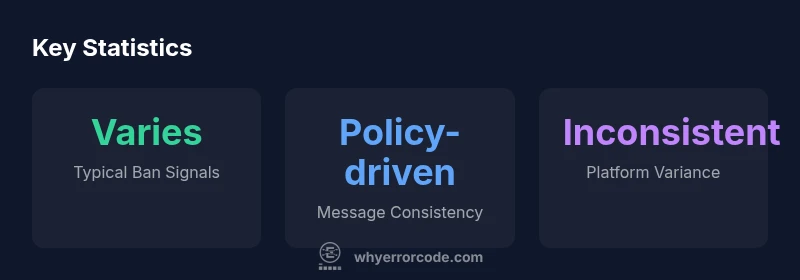
Permanent bans are policy-driven outcomes rather than universal error codes. This section explains how teams interpret the phrase "what error code is a permanent ban" within error handling, why a single numeric code cannot capture every case, and how to build reliable ban signals into APIs. In practice, you signal a ban through a combination of HTTP responses, payload fields, and documented policies, so developers and users understand the situation without ambiguity. When you encounter the question what error code is a permanent ban, interpret it as a contextual signal rather than a universal code.
In many systems, the presence of a ban is recorded in server-side policy data, while the client sees a denial with a code and a message. This separation allows teams to evolve ban policies without altering core error semantics. For developers, the takeaway is to design error payloads that explain the reason for denial (policy violation, age of account, or security risk) and provide a clear path for users to learn how to appeal or restore access.
To strengthen resilience, pair a code with a human-friendly message and a structured ban object in the response payload. This reduces ambiguity for both developers integrating the API and users experiencing the ban. If you want to test how your system communicates a permanent ban, simulate various policy violations in staging and verify that the responses align with your documented signals.
Is there a universal error code for permanent bans?
No. There is no global standard that marks a permanent ban with a single numeric code across services. Different platforms define their own signals, and even when HTTP status codes are involved, they are often augmented with contextual messages or internal codes. For web APIs, HTTP 403 (Forbidden) is commonly used to indicate access denial due to policy enforcement, but it does not prove a permanent ban on its own. Some systems use internal codes or textual indicators like "account permanently banned" to convey the finality of the action. This fragmentation means you cannot rely on a single universal code to determine permanence.
The lack of standardization is by design: bans depend on individual policy, jurisdiction, and platform rules. When implementing or consuming an API, you should rely on explicit ban-type fields and policy documentation rather than assuming a universal numeric indicator. In practice, teams should expose a banType (for example, permanent vs. temporary) and, where possible, a banDuration or an appealsLink to guide users.
If you’re designing a system, avoid embedding permanence solely in numeric HTTP codes. Instead, extend your error payload with structured data that clearly communicates the nature and duration of the ban. This approach supports automation, better UX, and fair appeals processes.
Communication patterns by context
Across contexts, the same underlying concept—access denial due to policy enforcement—appears differently:
- Web APIs: The most common direct signal is HTTP 403 Forbidden, often with a response body that includes a code like PERMANENT_BAN and fields such as banType and reason. While 403 is a general signal for access denial, it is not inherently permanent; the accompanying payload determines permanence.
- Gaming platforms: Many systems implement platform-specific codes such as BAN_PERMANENT or textual notices like "your account is permanently banned from this game". These messages are complemented by user dashboards or support portals that explain the ban and offer appeal options.
- Social networks and forums: Messaging tends toward textual statuses (e.g., "Account suspended" or "Permanent ban applied"), sometimes with a link to policy documentation or an appeals process. In these cases, the numeric code is less important than the narrative and the actions the user can take.
The takeaway is that developers should treat bans as policy signals rather than universal codes. Use a consistent API surface—such as banType, reason, and duration—across platforms to enable predictable behavior for clients and tooling.
Designing clear ban signals in your API
A robust ban signaling strategy combines explicit codes, structured payloads, and clear policy documentation. Consider the following best practices:
- Include a banType field with values like permanent or temporary. If possible, provide banDuration for temporary bans and an explicit appealURL for remediation.
- Use a stable errorCode alongside a human-readable message. For example, an errorCode like BAN_DETERMINED or BAN_PERMANENT helps automate error handling while the message informs the user.
- Add a reason field that transmits policy-grounded rationale (e.g., policy_violation, security_risk, fraud_suspected).
- Ensure the response includes a link to the policy and a path to appeal. This improves transparency and user trust.
- Document the exact semantics in your API reference, including how clients should react and what data to expect in error payloads.
- Favor machine-readable payload shapes (JSON) so automated systems can detect permanence and trigger appropriate workflows without parsing free text.
By adopting these conventions, your API will communicate bans clearly, reduce confusion, and support fair resolution processes for users who wish to appeal.
Diagnosing ban signals in development and testing
During development, validate ban signaling with controlled test cases. Steps:
- Define test scenarios for permanent and temporary bans across all supported contexts.
- Verify that responses include banType, reason, and duration, and that the human message aligns with policy.
- Test error payloads in both success and failure paths to ensure no leakage of sensitive information.
- Use feature flags to switch ban signaling behavior in staging to ensure backward compatibility.
- Implement automated tests that assert the presence and consistency of ban fields across API versions.
When testing, also verify that your client SDKs and front-end code handle permanent bans identifiably and gracefully, guiding users toward documented appeal paths.
UX messaging and transparency during a ban
User experience matters when enforcing bans. Clear, respectful language reduces frustration and lowers churn. Recommended practices:
- Display a concise status (e.g., "Account permanently banned for policy violation") and provide a link to the policy.
- Include an appeals path with steps and deadlines where applicable.
- Avoid implying a mistake was made; acknowledge policy reasons and offer next steps.
- Provide a centralized place (dashboard or support portal) where users can review the ban, learn about policies, and submit appeals.
- Localize messages to match user expectations and legal requirements.
Well-crafted ban messages improve trust and reduce escalation to support.
Appeals, reversals, and data retention considerations
Permissible reversals and appeals depend on policy. Important considerations:
- Clarify eligibility criteria for appeal and the time window for review.
- Keep a detailed audit trail of actions, review notes, and final outcomes for accountability.
- Establish data retention policies that balance user rights with platform security and compliance.
- Provide users with an official contact channel and a transparent timeline for decisions.
- Consider temporary suspensions as a reversible action during review when possible to maintain user engagement.
A fair, transparent appeals process helps balance enforcement with user trust and platform safety.