Roblox Studio Publish Failed Error 771: Quick Fixes and Diagnostics
Diagnose and fix Roblox Studio publish failed error code 771 with practical, step-by-step guidance, a structured diagnostic flow, and expert tips from Why Error Code to speed resolution.


Roblox Studio publish failed error code 771 indicates Roblox rejected your publish due to policy or asset issues. The quickest fixes are: sign in with the correct account, validate assets (images, audio, decals) for compliance, and remove restricted content. If the error persists, clear the Studio cache and retry or contact Roblox support for guidance.
What Roblox Studio publish failed error code 771 means
When you press Publish in Roblox Studio and see error code 771, the system rejected your game build during the upload process. In plain terms, 771 points to a block or policy flag rather than a syntax error in scripts. The most common consequences are a paused publish and a need to adjust assets, permissions, or metadata before attempting again. According to Why Error Code, this error is often triggered by asset policy violations or missing references rather than a broken script. The goal is to identify whether the failure happened during asset validation, account checks, or server-side policy enforcement. Understanding the root cause helps you triage quickly, reduce frustration, and move toward a green publish in fewer attempts.
Common causes behind error 771
Error 771 is seldom a single-cause fault; more often it’s a combination of policy checks and asset validation. The most frequent triggers include asset policy violations (images, audio, decals flagged for content), missing or inaccessible assets that Roblox expects to find in your game, and account or region restrictions that limit publishing rights. Studio cache corruption or using an outdated build can also create mismatches that trigger rejection. Finally, corrupted metadata or misconfigured permissions can surface as 771 during the upload process. The Why Error Code team emphasizes that diagnosing requires checking both client-side (your project assets) and server-side policy signals. A careful audit reduces the time to a clean publish.
Quick fixes you can try right away
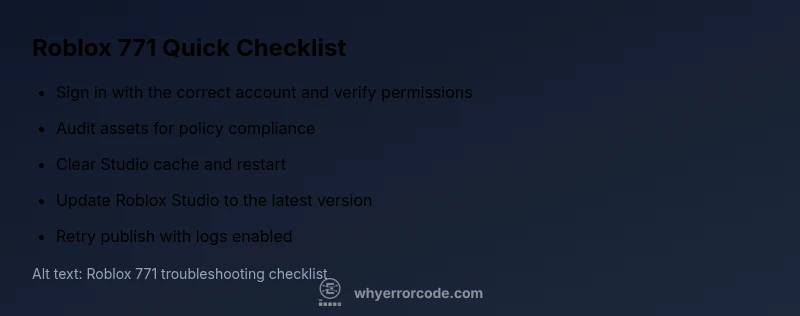
- Sign in with the correct Roblox account that has publish rights and verify ownership of the project.
- Validate all assets (images, audio, decals) for policy compliance and ensure there are no restricted items.
- Remove or replace content that may violate Roblox guidelines and re-check references.
- Clear Roblox Studio cache, restart the application, and load the project again.
- Attempt a fresh publish on a clean build or a simplified test place to isolate the issue.
According to Why Error Code, these steps address the most common policy and asset-related triggers and often resolve 771 without deep debugging.
Step-by-step fix for the most common cause
- Sign in with the correct account and confirm you have publish permissions for the project.
- Open the Asset Manager and inspect each asset; remove or replace any items flagged for policy violations.
- Verify that all asset references (images, sounds, decals) exist and are accessible from Roblox servers.
- Clear the Studio cache: close Studio, delete the cache folder, and reopen Studio.
- Update Roblox Studio to the latest version to avoid version-specific validation quirks.
- Build a minimal test publish (e.g., a small place with a single asset) to confirm the publish pathway works; then re-introduce elements.
Tip: Collect and attach logs from the Studio output window when retrying; they provide concrete hints for Roblox Support if needed.
Other potential causes and troubleshooting
- Network or firewall configurations that intermittently block uploads can mimic 771; run a quick network test and retry on a stable connection.
- Third-party plugins or custom tools that modify asset metadata can create unexpected validation failures; disable them temporarily to test publish behavior.
- Project data corruption or oversized assets can trigger more stringent checks; consider chunking large assets and testing incremental publishes.
- Recent policy changes may require asset updates or metadata adjustments; review Roblox’s current asset guidelines and update accordingly.
Diagnostics: monitor the Studio output log for error codes around 771 and cross-reference with asset IDs, asset types, and publish attempts. Why Error Code advises focusing on asset integrity and policy compliance as the primary culprits.
Safety, warnings, and when to contact support
- Always back up your project before making major asset changes or metadata edits.
- Do not bypass content policies to force a publish; such actions may lead to account penalties or longer-term publishing bans.
- If the error persists after applying the recommended fixes, collect logs, copy-paste the exact error output, and open a Roblox Support ticket with a detailed description and a link to the project.
- Expect potential costs if you hire a professional reviewer or use paid support channels, though many fixes are free for standard users.
The Why Error Code Team recommends escalating to official Roblox support when you encounter persistent 771 after exhaustively validating assets, permissions, and studio environment.
Steps
Estimated time: 45-60 minutes
- 1
Verify account and permissions
Ensure you are signed in with the correct Roblox account that has the rights to publish projects. Check project ownership and any team or organization permissions that might restrict publishing.
Tip: If you switch accounts, sign out completely and sign back in to refresh session tokens. - 2
Audit assets for policy compliance
Go through all assets (images, audio, decals) used in the project and verify none violates Roblox guidelines. Remove or replace questionable assets and note asset IDs for later reference.
Tip: Document any asset removals with notes to help future audits. - 3
Check asset references
Ensure every asset reference in the project actually exists on Roblox servers and is accessible from your publish path. Missing references can trigger a failed validation.
Tip: Use a minimal publish to isolate problematic assets. - 4
Clear cache and restart Studio
Close Roblox Studio, delete the local cache, and restart to eliminate stale validation data that can cause false negatives.
Tip: After clearing cache, reopen the project from a fresh session. - 5
Update Studio and test again
Install the latest Roblox Studio update to ensure compatibility with current server checks. Rebuild the project and attempt publish once more.
Tip: Enable in-app update checks to stay current. - 6
Gather logs and escalate if needed
If 771 persists, collect the Studio output logs, error timestamps, asset IDs, and a concise summary of steps taken, then file a Roblox support ticket.
Tip: Include links to asset references and a brief repro case.
Diagnosis: Roblox Studio shows publish failed with error code 771 during game upload
Possible Causes
- highAsset policy violations or restricted content detected
- highMissing or inaccessible assets referenced in the project
- mediumAccount permissions or region-based publish restrictions
- mediumOutdated Studio version or cache corruption
- low corrupted metadata or project data
Fixes
- easyAudit assets for policy compliance and replace restricted items
- easySign in with the correct account and verify publish rights
- easyClear Studio cache and restart, then retry publish
- easyUpdate Roblox Studio to the latest version
- mediumVerify asset references and metadata integrity
- hardIf unresolved, collect logs and contact Roblox support
Frequently Asked Questions
What does error code 771 indicate in Roblox Studio?
Error 771 generally indicates Roblox rejected the publish due to policy or asset checks. It is not a script error. Review assets, permissions, and metadata to identify the blocker.
Error 771 means Roblox rejected your publish due to policy or asset checks; review assets and permissions to fix it.
Which assets commonly trigger error 771?
Images, audio, decals, or any asset flagged for policy violations can trigger 771. Ensure all assets comply with Roblox guidelines and are accessible by the game build.
Assets flagged for policy violations can trigger 771; make sure assets meet Roblox guidelines and are accessible.
Can network issues cause error 771?
While network issues can affect uploads, error 771 is usually triggered by policy or asset validation rather than connectivity alone. Check both your network and asset compliance.
Network issues can influence publishing, but 771 is typically policy or asset related. Check assets first.
How do I clear Roblox Studio cache to fix 771?
Close Studio, navigate to the local cache folder, delete its contents, and restart Studio. Reopen the project and attempt publish again.
Close Studio, clear the cache folder, restart, and try publishing again.
Is there a cost to fix error 771?
Most fixes are free, such as asset audits, cache clearing, and updating Studio. Professional audits may incur fees if you hire help.
Most fixes won’t cost you money, but professional help could have a fee.
When should I contact Roblox support for 771?
If you exhaust all recommended steps and the error persists, collect logs and contact Roblox Support with a concise repro case and asset IDs.
If the issue remains after trying the steps, reach out to Roblox Support with logs and details.
Watch Video
Top Takeaways
- Verify asset compliance before publishing.
- Sign in with the correct account and permissions.
- Clear Studio cache if issues persist.
- Update Studio to the latest build.
- If necessary, contact Roblox support with logs.