Difference Between Status Code 401 and 402
Explore the difference between status code 401 and 402, their meanings, typical use cases, and how to handle them in clients and APIs. A practical guide by Why Error Code for developers, IT pros, and troubleshooters.


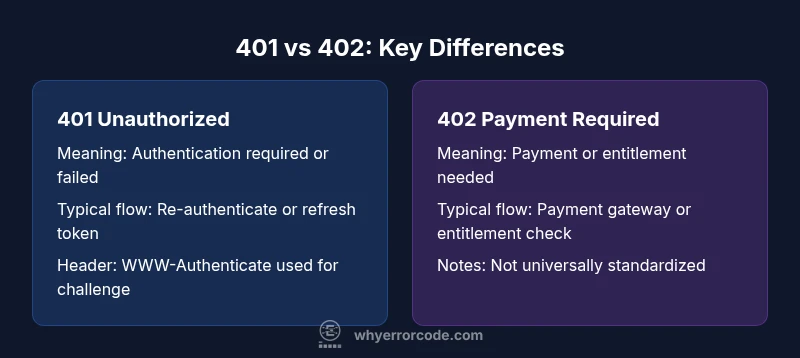
The difference between status code 401 and 402 is rooted in intent: 401 Unauthorized signals that authentication is required or has failed, while 402 Payment Required indicates that payment is needed to access the resource. In practice, 401 prompts re-authentication, and 402 signals a payment flow or entitlement check. Because 402 is rarely used, API docs often steer developers toward standard flows or custom error payloads instead.
Understanding the difference between status code 401 and 402: Core meanings and context
In the world of HTTP and API design, status codes provide a compact language for clients to understand what went wrong. The difference between status code 401 and 402 is subtle but significant: 401 Unauthorized means the request lacks valid authentication credentials, or the credentials presented are not accepted. In contrast, 402 Payment Required is a reserved code indicating that payment is required to access the requested resource. While 401 is a common, actively used signal across web apps and APIs, 402 is largely unused and often left for future standardization or vendor-specific implementations. When you design or consume an API, the distinction matters for client UX, security controls, and how the system routes users toward the next step.
From a practical perspective, treat 401 as a gate that must be crossed with valid authentication, and treat 402 as a signal that a payment or entitlement step must be completed before access is granted. This aligns with how most developers implement authentication flows and license checks in modern services. As you read this guide, keep the exact phrase “difference between status code 401 and 402” in mind—it's the foundational split between authentication failures and payment-enforced access.
In 2026, the Why Error Code team observes that teams rely heavily on 401 for login and token-refresh scenarios, while 402 remains a theoretical option that only some APIs apply. The practical takeaway is to design clear error payloads and documented flows around these codes so clients can respond deterministically.
The Core Difference: Authentication vs Payment
The distinction between 401 and 402 is all about intent. A 401 signals that the user has not proven their identity, or the server cannot verify credentials presented in the request. When a 401 is appropriate, servers typically include a WWW-Authenticate header that describes a challenge, inviting the client to re-authenticate. A 402, on the other hand, communicates that the requested action requires payment or an active entitlement. Because there is no universal payment signal standard, the exact behavior depends on the API (e.g., redirecting to a checkout, presenting a payment flow, or surfacing a clear error payload with next steps). In most real-world APIs, 401 is the default authentication failure signal, while 402 is reserved for future use or specialized paid-resource scenarios.
When to Expect a 401 Unauthorized
A 401 Unauthorized appears when credentials are missing, invalid, or considered insufficient for the requested resource. Common patterns include: invalid tokens, expired sessions, or absent Authorization headers. Clients should prompt the user to re-authenticate or refresh tokens; servers should provide a clear WWW-Authenticate header showing the required scheme. For RESTful services, a 401 often implies that the user should attempt login again, obtain a new token, or grant consent for a refreshed session. Because this signaling is well-supported across libraries, you’ll see 401 frequently in OAuth flows, API backends, and services that enforce strict identity checks.
When to Expect a 402 Payment Required
402 Payment Required remains a rarely used status code with a murkier place in modern APIs. When it appears, it signals that access depends on a payment, license, or entitlement that hasn’t been satisfied. In practice, you may see 402 accompanied by a redirect to a payment gateway, a subscription check, or a license-verification step. Since there is no universal standard, many developers opt for alternative signaling, such as 403 Forbidden with a detailed error payload explaining the payment obligation or a 402 with API-specific semantics. If you do choose to implement 402, document the flow clearly so clients know exactly what to do next.
Practical Scenarios and Examples
Consider a streaming API that offers premium content behind a paywall. A user who hasn’t subscribed or paid might receive a 402 when attempting to start playback. The API could then respond with a structured payload outlining the required action (e.g., “payment_required”: true, “amount_due”: 9.99, “currency”: “USD”) and a link to complete the payment. For an application requiring login, a 401 might be emitted if the user’s token is invalid or missing. In that case, the body should explicitly describe the failure, offer a token-refresh URL, and suggest re-authentication. These concrete examples illustrate how the two codes function in real workflows and why choosing the right one matters for UX and automation.
How Clients and APIs Should Respond
From an API design perspective, you should keep a consistent error payload structure regardless of the status code. When a 401 is returned, include a WWW-Authenticate header and a payload that helps clients recover (e.g., error_code: 401, message: 'Invalid token', retry_after: 30). For 402, if you implement it, provide explicit guidance in the response body and possibly a redirect or action URL for payment. Clients should handle 401 by redirecting users to login or refreshing tokens, and handle 402 by initiating the payment flow or displaying entitlement status. Documentation is critical to avoid ambiguity across teams and client libraries.
Security Implications and Best Practices
Security considerations for 401 include protecting against credential stuffing and excessive retry attempts. Implement rate limiting, monitor auth failures, and ensure proper token scopes. For 402, the security focus shifts to safeguarding payment data, ensuring PCI-compliant flows, and validating entitlements without exposing sensitive information. Always avoid leaking sensitive account data in error responses. Use clear, machine-readable payloads (error_code, message,
Common Pitfalls and Misconceptions
A frequent misconception is that 402 is obsolete or never used; in reality, it remains defined but underutilized. Some teams misinterpret 401 as a generic “not authorized” signal when the problem is actually an expired session; others use 403 for all permission-related cases, which obscures whether authentication or authorization failed. Another pitfall is failing to document the exact next steps for clients, leading to confused users and brittle integrations. Finally, relying on browser defaults for non-success codes without implementing consistent error payloads can degrade interoperability.
Historical Context and Industry Adoption
Historically, 401 has been the primary signal for authentication failures across the web and APIs. 402, defined in the HTTP specification, has seen limited adoption due to complexity around payment flows and licensing. Some industries—such as digital content, SaaS with tiered access, or enterprise license models—employ 402 in a controlled, server-defined way. The broader ecosystem often prefers 403 with a detailed error object or a dedicated payment-forwarding path rather than repurposing 402. As APIs evolve, teams often prefer explicit, well-documented signals over relying on a rarely used code.
Designing APIs with Clear Error Signaling
To build resilient APIs around the difference between status code 401 and 402, start with a stable error payload schema (e.g., { code: 401, message: 'Invalid token',
Key Takeaways for Developers and Teams
The difference between status code 401 and 402 is a core design decision that shapes user experience, security, and API reliability. Use 401 to indicate authentication problems and prompt re-authentication; deploy 402 only when a payment or entitlement barrier exists and you have a clear flow. Favor explicit error payloads and well-documented flows over opaque status codes. By doing so, you enable robust client implementations and smoother operator tooling.
Comparison
| Feature | 401 Unauthorized | 402 Payment Required |
|---|---|---|
| Meaning | Authentication is required or credentials are invalid | Payment is required to access the resource (reserved for future use) |
| Prerequisites | Valid credentials/token, or an active session | Payment method, entitlement, or license check in place |
| Typical Use Case | Login flows, token refresh, invalid credentials | Paywall, license enforcement, premium content access |
| Headers/Payload | WWW-Authenticate header used to signal challenge | No universal header; API-specific signaling or payloads |
| Client Handling | Trigger re-authentication or token refresh | Trigger payment flow or entitlement check (if implemented) |
| Caching Behavior | Typically non-cacheable due to authentication sensitivity | Depends on implementation; usually non-cacheable until payment succeeds |
| Security Implications | Credential leakage risk; enforce rate limiting and logs | Payment data must be protected; follow PCI or equivalent controls |
| Industry Adoption | Widely used across web apps and APIs | Used in niche paid-access APIs; not universally standardized |
Advantages
- Clear separation of authentication and payment signaling for API design
- Helps developers implement precise client-side error handling
- Encourages robust retry and UX flows when enough context is provided
- Guides monitoring and alerting on failed requests
Negatives
- 402 is rarely implemented, leading to confusion or misinterpretation
- Some intermediaries may ignore unknown codes, reducing effectiveness
- No universal standard for 402 means vendor-specific semantics and maintenance burden
401 is the practical default for auth failures; 402 should be used only with documented payment requirements.
Choose 401 for authentication failures and clearly document the next steps for re-authentication. Use 402 only when you have a well-defined payment or entitlement flow and customer-facing guidance.
Frequently Asked Questions
What does 401 Unauthorized mean and when should I respond?
A 401 means authentication failed or is missing. Clients should re-authenticate or refresh tokens, and servers should provide a WWW-Authenticate header detailing the required scheme. Use clear payloads to guide remediation.
A 401 means authentication failed or is missing; prompt a re-auth or token refresh and provide guidance in the response.
What is 402 Payment Required and is it used in practice?
402 is defined but rarely used in modern APIs. When implemented, it signals that payment or entitlement is required to proceed and is typically accompanied by a payment flow or billing steps.
402 is defined but not commonly used; it signals payment is required and should trigger a payment flow if implemented.
Can 401 be used to indicate insufficient permissions (like 403)?
No. 401 specifically relates to authentication. A 403 indicates that authentication succeeded but the client is not authorized to access the resource. Distinguish both in your API design and error payloads.
401 is for authentication failures; 403 is for insufficient permissions after authentication.
How should clients handle a 401 vs 402 in a REST API?
Handle 401 by triggering login or token refresh flows; handle 402 by initiating or guiding through the payment or entitlement process, if you implement it. Always provide a clear, machine-readable payload.
Handle 401 with re-authentication; handle 402 with the payment flow, if implemented, and clear guidance.
Are there security risks signaling payment with 402?
Yes. If you implement 402, ensure payment data is protected and compliant with relevant standards. Avoid leaking sensitive data in error messages and provide secure payment workflow paths.
With 402, protect payment data and document secure flows; avoid exposing sensitive info in errors.
Is 402 widely supported by browsers or proxies?
Not universally. Browsers and intermediaries may not treat 402 distinctly. Rely on API-level error payloads and documented flows rather than browser behavior for guidance.
402 isn’t widely supported by browsers; focus on API documentation and explicit error payloads.
Top Takeaways
- Identify 401 for login/auth failures and trigger re-auth flows
- Reserve 402 for payment-required scenarios with explicit guidance
- Document next actions clearly for clients and automation
- Avoid ambiguous signaling by using structured error payloads
- Test error handling across user roles to ensure correct signaling