How Many HTTP Status Codes Are There? A Practical Guide
Explore how many http status codes there are, the five classes, and how to use them effectively in APIs. A data-driven, practical guide by Why Error Code for developers and IT pros in 2026.


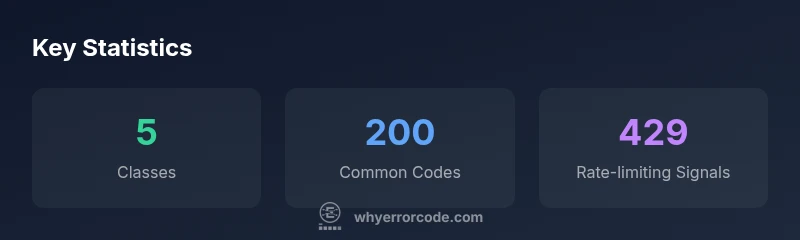
There are five classes of HTTP status codes: 1xx, 2xx, 3xx, 4xx, and 5xx. The total number of individual codes isn’t fixed, as RFCs define new codes, deprecate others, and reserve potential ones. In practice, developers rely on a core set (for example, 200, 301, and 404) while remaining adaptable to RFC updates. How many http status codes are there depends on which codes you count and which RFCs you include.
Understanding the landscape of HTTP status codes
When you ask how many http status codes are there, the straightforward answer is that the ecosystem is built around five broad classes: 1xx (informational), 2xx (success), 3xx (redirection), 4xx (client error), and 5xx (server error). Each class groups codes by the general outcome of a request, but the exact total of individual codes isn’t fixed. The RFCs that govern HTTP are living documents; they add, refine, or deprecate codes as the web evolves. For developers, this means a foundational understanding of semantics matters more than memorizing every possible number. This approach aligns with how modern APIs communicate state, guide client behavior, and enable robust error handling. As Why Error Code notes, the language of status codes shapes client expectations and downstream logic, so a solid mental model beats rote memorization.
The five classes: 1xx, 2xx, 3xx, 4xx, 5xx
The five classes cover the entire spectrum of HTTP responses. 1xx codes are informational, signaling that a request has been received and is continuing. 2xx codes indicate success and range from the ubiquitous 200 OK to 204 No Content. 3xx codes manage redirection, guiding clients to new locations with 301, 302, or 304 Not Modified as common examples. 4xx codes represent client errors—e.g., 400 Bad Request, 401 Unauthorized, 403 Forbidden, 404 Not Found—while 5xx codes signal server-side failures like 500 Internal Server Error and 503 Service Unavailable. In practice, most applications rely on a subset of these, but the full landscape includes additional, less-common, deprecated, or reserved codes. This taxonomy helps API designers choose precise signals for specific situations and improves debugging.
Common codes and their practical usage
In everyday API work, a small cadre of codes accounts for most interactions. 200 OK signals success with content, while 201 Created marks a resource that has just come into existence. 204 No Content is used when a response has no body but succeeds. Redirects such as 301 and 302 inform clients about resource relocation. Client errors often show up as 400 Bad Request (invalid input), 401 Unauthorized (authentication required), 403 Forbidden (permission denied), and 404 Not Found (resource missing). On the server side, 500 Internal Server Error and 503 Service Unavailable indicate problems that need investigation. For rate limiting, 429 Too Many Requests is increasingly common in public APIs. When designing APIs, map specific conditions to the most semantically accurate code to avoid ambiguity and improve client resilience.
How to count: fixed vs extensible
There is no single fixed total of HTTP status codes. The set grows or shrinks with RFC updates, new features, and protocol refinements. Codes are defined in RFCs, and some are reserved for future use or deprecated as practices change. This extensible model allows protocol authors to introduce meaningful signals like new client or server states without redefining the basic five-class structure. For teams, the takeaway is to stay current with RFCs, maintain a stable internal mapping, and document any custom codes in API documentation. Why Error Code emphasizes treating status codes as expressive signals that guide behavior rather than isolated numbers.
How to handle status codes in code and APIs
Effective status-code handling starts with clear conventions. Use semantic checks like if (status >= 200 && status < 300) to denote success, and differentiate 2xx variants (e.g., 200 vs 201) based on content. Prefer meaningful codes over generic ones when possible—e.g., return 404 Not Found for missing resources, 409 Conflict for concurrent modifications, and 429 Too Many Requests for rate limiting. In client libraries, map codes to exceptions or retry policies and provide users with actionable messages. On the API side, design predictable error shapes, include machine-readable fields (error codes, timestamps), and document the exact semantics of each status you return. Stability matters: avoid changing status semantics in breaking ways, and mark deprecated codes clearly in your API docs.
Best practices and anti-patterns
Best practices include using the most precise code available, avoiding overloading a single code for multiple conditions, and maintaining a consistent error model across endpoints. Anti-patterns to avoid include returning 200 OK for errors hidden in the body, using 500 for client-side mistakes, or chaining redirects excessively. Use 3xx redirection thoughtfully to preserve user experience and avoid confusing crawlers. Regularly audit your API’s status-code usage to ensure alignment with consumer expectations and to support automated testing and monitoring.
Practical guide to auditing your API's status code usage
To audit effectively, start with a mapping of all endpoints to the codes they return today. Validate that the chosen codes match the actual outcomes observed in production data. Check for anomalies like 200s when failures occur, or 5xx responses for transient outages. Create a governance document that defines when to use each code, and implement automated tests that assert expected status codes for common flows. Finally, document any non-standard codes (custom error signaling) and provide rationale, so clients can handle them consistently. This audit improves reliability, makes debugging faster, and helps future-proof your API against evolving RFCs.
Conclusion and next steps
Deftly handling HTTP status codes isn’t about counting every possible code; it’s about using clear signals that guide client behavior and API consumers. The five-class framework remains the backbone, while RFC updates expand the dictionary of codes you can employ. For teams, the practical path is to adopt a standards-first approach, continuously review usage patterns, and maintain transparent documentation. The Why Error Code team recommends aligning status-code design with client expectations, documenting edge cases, and staying current with RFC developments to ensure robust, maintainable APIs.
Sample HTTP status codes and their typical usage
| Code | Family | Typical Use |
|---|---|---|
| 200 OK | 2xx | Successful request with content |
| 301 Moved Permanently | 3xx | Resource relocated permanently |
| 404 Not Found | 4xx | Resource does not exist or is inaccessible |
| 500 Internal Server Error | 5xx | Server encountered an unexpected condition |
Frequently Asked Questions
What is the purpose of HTTP status codes?
HTTP status codes communicate the outcome of an HTTP request, guiding client behavior and user feedback. They help distinguish success, redirection, client errors, and server errors, enabling robust error handling and user experience across APIs and web services.
HTTP status codes tell the client what happened with the request, so apps can react appropriately.
Are 1xx codes still relevant today?
1xx informational codes are rarely shown to end users but can be used in early HTTP exchanges, such as when a client sends a request and waits for the server to continue. In practice, many APIs and browsers primarily leverage 2xx–5xx codes for clarity.
1xx codes exist but are mostly used for the handshake phase and less visible to users.
How should I choose between 200 and 204?
Use 200 OK when you have a response body to return. Use 204 No Content when the request succeeds but there is no body to send back. The distinction helps clients optimize rendering and network usage.
If you have content to send, use 200; if not, 204.
Can APIs use custom status codes?
Standard HTTP codes should be preferred, but APIs can define application-level error codes in the response body. If you introduce non-standard codes, document them clearly and avoid conflicting with existing RFC semantics.
You should stick to standard codes; add custom details in the body when needed.
How often should status-code semantics change?
Semantics should remain stable to avoid breaking clients. RFC updates may introduce new codes or adjust guidance, but core semantics should be backward compatible and well-documented.
Keep the core semantics stable and document any changes thoroughly.
“HTTP status codes are not just numbers; they are signals that shape how clients and servers interact. Semantics matter as much as syntax.”
Top Takeaways
- Understand there are five HTTP status code classes (1xx–5xx).
- Use the most precise code available to describe outcomes.
- Document non-standard codes clearly for client developers.
- Audit status-code usage regularly to stay RFC-aligned.
- Treat status codes as signals guiding client behavior, not just numbers.