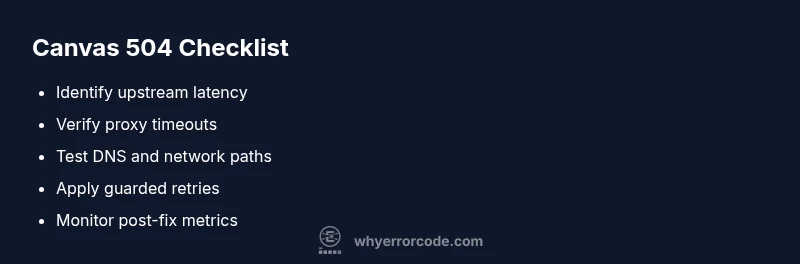
Canvas Error Code 504: Urgent Fix Guide
Urgent guide to canvas error code 504—diagnose causes, apply quick fixes, and prevent gateway timeouts in canvas-based apps. Includes a diagnostic flow, step-by-step repairs, and best practices for developers and IT pros.


Canvas error code 504 describes a gateway timeout: the upstream service didn’t respond quickly enough to a request routed through a proxy or load balancer. In many cases the quickest fix is to retry with a longer timeout, verify upstream service health, and implement a simple retry/backoff strategy.
What canvas error code 504 means in practice
Canvas error code 504 describes a gateway timeout that interrupts the flow of data between your client, the network edge (proxy or load balancer), and an upstream service. In practical terms, your browser or app sends a request and waits for a reply; when the upstream server does not answer within the configured window, the gateway returns 504 to the client. For developers troubleshooting Canvas integrations, a 504 usually signals a problem beyond the immediate client: either the upstream component is slow or temporarily unavailable, or a proxy layer is misconfigured. The urgency is real because a timeout disrupts user workflows, assignment submissions, quiz access, and grade syncing. The most common scenario is a backend operation that takes longer than expected, or a misconfigured reverse proxy that stalls traffic. Before diving in, capture precise timestamps, collect error traces, and confirm whether dependent services were reachable during the incident. According to Why Error Code analysis, 504s are often caused by slow upstream responses or proxy timeout settings that exceed the gateway's tolerance.
Immediate quick fixes you can try now
If you encounter a canvas error code 504, you can often regain partial functionality with quick checks that don’t require code changes. First, try refreshing after a short delay and reattempt the operation to rule out a transient spike. Next, inspect client- and proxy-timeout settings; a modest increase can buy time for the upstream to respond, but avoid elevating timeouts too far. Then verify the health of the upstream API or service the Canvas app talks to—check status dashboards, recent incidents, and error logs. Clear browser caches or refresh tokens if applicable, and test from a different network to rule out local congestion. If you operate a CDN or caching layer, ensure that dynamic requests aren’t being aggressively cached. Finally, implement a basic retry with exponential backoff in your code or configuration to reduce the chance of immediate repeated timeouts. These steps usually cover the majority of 504s without deep changes.
Diagnostic flow: symptom → causes → fixes
Symptom: End users see a Canvas error code 504 when performing a data-heavy operation, or API calls stall at the gateway. Causes (in order of likelihood): high: slow upstream service response or excessive backend workload. high: misconfigured timeout settings on the proxy or load balancer. medium: DNS delays or network congestion between the gateway and upstream. low: resource exhaustion on the upstream server. low: CDN or edge cache misbehavior affecting dynamic requests. Fixes: 1) confirm upstream health and latency; 2) adjust timeouts and retry logic; 3) review proxy configuration and caching rules; 4) verify DNS resolution and network routes; 5) scale upstream resources if necessary; 6) monitor ongoing traffic and set alerts for early signs of timeouts.
Step-by-step fix: most common cause (upstream delay)
- Reproduce the issue in a controlled environment and collect precise timestamps and error traces. 2) Check the upstream service health dashboards and run lightweight health checks (ping, trace, or quick API calls) to measure latency. 3) Inspect proxy or load balancer logs for timeout events and evaluate configured timeouts. 4) Test the upstream URL directly with a simple curl or HTTP client to confirm response times under load. 5) Implement a quick win: increase the gateway timeout and add a guarded retry with exponential backoff in the client. 6) Validate by rerunning the operation under realistic load and monitor for recurring 504s; adjust as needed. Tip: keep a changelog of timeout changes and ensure fallbacks are in place.
Other common causes of 504s in canvas apps
Beyond upstream latency, misconfigurations in the gateway or proxy are a frequent source of canvas error code 504. A stale DNS cache, incorrect routing rules, or certificate handshakes waiting on external services can all trigger gateway timeouts. Network middleboxes that drop long-running connections or aggressive firewall rules can also produce 504s during peak traffic. In some cases, CDN edge nodes fail to fetch fresh data from the origin, causing cascading delays. Finally, a spike in user demand or batch jobs that saturate the backend may push response times beyond the gateway’s timeout window. For each cause, validate the specific layer: origin service, proxy, DNS, CDN, and network.
How to prevent 504s: architecture and code practices
Preventing canvas error code 504 requires a combination of resilient architecture and careful code patterns. Implement generous but bounded timeouts across clients and gateways, with backoff strategies to avoid hammering the upstream. Use circuit breakers to fail fast when downstream dependencies exhibit high latency. Offload long-running tasks to asynchronous queues and use rate limiting to prevent congestion. Design graceful degradation for users when non-critical data is unavailable, and provide meaningful fallback messages. Instrument end-to-end tracing and centralized dashboards so you can spot latency trends before they become errors. Ensure your CDN and caching rules honor data freshness and don’t cache dynamic canvas API responses. Finally, test under load with realistic traffic scenarios and document every change for future incident response.
Safety, costs, and when to call a pro
Canvas error code 504 are usually resolvable without physical hardware work, but they can require coordination across teams. If you’re the sole developer, follow the diagnostic flow and monitor impact; if the issue persists across environments or affects production data, escalate to your network or platform admin. Cost-wise, most fixes involve dev time, logging improvements, and potential backend scaling—precise figures depend on your stack and hosting model. In critical learning environments or enterprise contexts, expect to engage multiple specialists (devops, frontend, backend) and possibly vendor support. Safety note: never bypass security controls or expose credentials while testing, and verify changes first in a staging environment. If you cannot reproduce or the issue recurs under normal load, consider professional assistance.
Steps
Estimated time: 30-60 minutes
- 1
Reproduce and collect data
Reproduce the error in a controlled environment and collect precise timestamps, request URLs, and error IDs. Gather relevant logs from the gateway, proxy, and upstream services to establish a baseline.
Tip: Use a dedicated test account and enable verbose request tracing. - 2
Check timeouts on gateway and client
Review configured timeouts on the proxy/load balancer and client code. Note any discrepancies between layers and consider a temporary, conservative increase to isolate the issue.
Tip: Keep a change log and avoid large, long-term timeout escalations. - 3
Test upstream latency directly
Call the upstream service directly from a controlled environment to measure latency and error rates. Compare to baseline performance and identify whether the upstream is the bottleneck.
Tip: Use lightweight, repeatable test cases to reduce noise. - 4
Validate DNS and network path
Check DNS resolution, routing rules, and network health between gateway and upstream. Look for stale records, TTL issues, or intermittent routing faults.
Tip: Flush DNS caches in the affected environment and verify TTL propagation. - 5
Apply quick fixes and backoff
If upstream latency is the root cause, implement a guarded retry with exponential backoff and a safe timeout window to avoid repeated failures.
Tip: Test with realistic traffic to validate the backoff strategy. - 6
Validate fix and monitor
Rerun the operation under load, monitor latency and error rates, and confirm that 504s no longer occur. Set up alerts for future timeouts.
Tip: Document changes and establish a post-incident review.
Diagnosis: Canvas error code 504 appears when performing operations through a gateway/proxy
Possible Causes
- highSlow upstream service response
- highProxy or gateway timeout settings too aggressive
- mediumDNS resolution delays
- lowNetwork congestion between gateway and upstream
- lowCDN edge-cache delaying dynamic data
Fixes
- easyIncrease relevant timeouts and enable exponential backoff
- easyVerify upstream health and logs, and optimize queries or scripts
- mediumReview proxy rules and caching policies; disable caching for dynamic requests
- mediumCheck DNS and network path; fix routing or propagate updated records
- hardScale upstream resources or optimize load handling
Frequently Asked Questions
What does canvas error code 504 mean and when does it occur?
A 504 indicates a gateway timeout between the Canvas frontend and its backend services or between the gateway and upstream APIs. It means the server didn’t respond quickly enough, often due to slow downstream components or a misconfigured proxy.
A 504 is a gateway timeout between layers; check upstream health and proxy timeouts.
Is a 504 usually a client-side or server-side problem?
504s are typically server-side or network-related, not caused by the end user’s device. The fault usually lies with the upstream service, gateway configuration, or intermediate networks.
Usually server-side or network, not your device. Check upstream and proxies.
What is the quickest way to fix a canvas 504 in practice?
Start with a retry after a brief delay, verify upstream health, and adjust timeouts modestly. If the problem repeats, review proxy rules and caching behavior, then implement guarded retries.
Retry with a delay, check upstream health, adjust timeouts, and review proxies.
Can a CDN or edge cache cause a 504?
Yes. If a CDN edge node is slow to fetch data from origin, it can trigger a gateway timeout. Verify cache rules for dynamic content and purge stale entries if needed.
CDNs can cause 504s if edge nodes are slow or caches stale data.
How long should I test a fix before declaring success?
Test under realistic load for at least one full cycle of typical peak traffic. Monitor latency and error rates for 15–60 minutes after changes, depending on your traffic patterns.
Test under real load for 15 to 60 minutes to confirm stability.
When should I contact professional support?
If the issue persists after applying standard fixes, affects production data, or involves complex network architecture, escalate to your DevOps, platform admin, or vendor support.
Call for persistent or complex issues affecting production.
Watch Video
Top Takeaways
- Identify root cause quickly by testing upstream first.
- Increase timeouts judiciously with backoff.
- Monitor dependencies and logs for early signs.
- Degrade gracefully if data isn’t critical.
- Document fixes for faster incident response.