Daikin UH Error Code: Quick Fixes and Diagnosis
Learn what the Daikin UH error code means, quick fixes to try, diagnostic steps, and when to call a professional. Why Error Code provides practical, actionable guidance to diagnose and resolve UH faults quickly.


UH on a Daikin air conditioner indicates a safety or system fault that halts cooling. The quickest path to relief is a power cycle, verify outdoor airflow and filters, and reset the unit. If the UH code remains after a reset, stop using the AC and contact a qualified technician for a thorough diagnostic. Safety first—do not bypass interlocks or continue running a faulty unit.
What UH Means on Daikin Air Conditioners
According to Why Error Code, the UH error code is Daikin's troubleshooting signal for a safety or system fault. The exact meaning can vary by model and installation, so always consult your user manual for the precise interpretation. In general, UH indicates that the unit has detected an abnormal condition and has entered a protective shutdown to prevent damage. Treat UH as urgent: do not ignore repeated appearances or continued operation without addressing the underlying cause. For this reason, Why Error Code emphasizes a structured approach to diagnosis. Gather details such as your model number, the exact UH display (including any accompanying digits), recent changes in operation, and whether the outdoor unit shows visible issues. Remember: Daikin designs differ by region and product line, so identical codes can map to different root causes. A systematic, model-aware approach is essential, and that is exactly what this guide provides.
Quick Fixes You Can Try Right Now
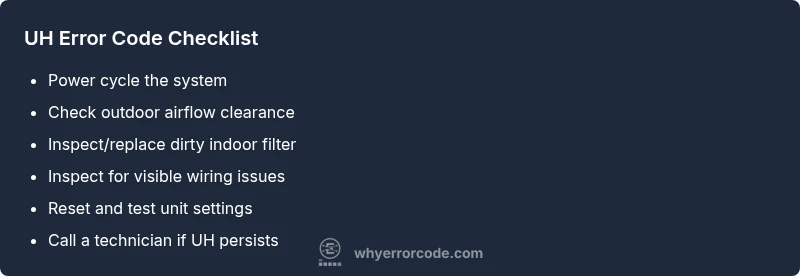
- Power cycle the system: turn off the unit at the breaker for 5–10 minutes, then restore power and recheck the UH display. This resets internal safety timers and can clear transient faults.
- Check indoor air quality paths: inspect and replace dirty or clogged air filters; a restricted indoor path can trigger faults and reduce system diagnostics accuracy.
- Inspect outdoor unit clearance: ensure there is at least 12–24 inches of clearance around the condenser and remove any debris, leaves, or snow that could impede airflow.
- Verify external wiring connections: with power off, inspect the service panel and outdoor unit wiring for obvious loose connections or damaged insulation. Do not touch live components; call a pro if anything looks questionable.
- Attempt a controlled reset via the remote or main control panel if your model supports it. After resetting, observe whether UH reappears or a different code is shown.
- If UH persists after these steps, discontinue use and seek professional service. Don’t attempt refrigerant checks or internal repairs yourself.
Diagnostic Flow: Symptoms, Causes, and Fixes
Symptoms: UH appears on the display, and the AC stops cooling or cycling unexpectedly. The unit may restart briefly before UH returns. Causes (prioritized by likelihood):
- high: Blocked airflow around the outdoor unit or excessive heat buildup, triggering safety protection.
- medium: Sensor fault or degraded control board data that misreports conditions to the compressor.
- low: Electrical supply issue or wiring fault that intermittently disrupts control signals.
Fixes (aligned to causes):
- For airflow/overheat: improve clearance, remove debris, and ensure fans can operate without obstruction; repeat the run test.
- For sensor/control board: perform a clean reset and re-test; if the code persists, a diagnostic inspection of sensors and the main PCB is advised.
- For electrical issues: verify outlet voltage and fuses, and have a professional inspect wiring and connections.
Step-By-Step Diagnostic Guide for the Most Common Cause
These steps focus on the most common UH root: outdoor unit overheating due to airflow restrictions.
- Power down and wait: switch off the circuit breaker and wait 5–10 minutes to discharge capacitors. This is a safe reset point before inspection.
- Inspect outdoor area: look for vegetation, debris, snow, or dust blocking the condenser fins. Clear obstructions with a soft brush or compressed air from a safe distance.
- Clean the condenser: gently remove dust from fins without bending them; use a fin comb if available.
- Check fan operation: ensure the outdoor fan spins freely and isn’t obstructed. Listen for abnormal noises when the unit restarts.
- Recheck airflow: after clearing and cleaning, run the unit on a low cooling setting to see if UH recurs.
- Reset and test: restore power, reset the system via the control panel, and monitor for the display code.
- If UH returns: schedule professional diagnostic service as soon as possible; the issue may involve sensors or the control board.
Other Causes and How to Address Them
- Sensor fault or control board error: If airflow is clear and the code persists, targeted sensor tests or control board inspection may be required. A professional can perform memory checks and recalibration if supported by the model.
- Wiring or power irregularities: Inconsistent voltage, loose connections, or tripped breakers can trigger UH. Have a licensed technician verify supply stability and connectors.
- Refrigerant or pressure-related issues: Low refrigerant or high-pressure alarms can cause protective shutdowns. This typically requires a refrigerant leak check and system recharge by a qualified tech.
- Software/firmware mismatch: Some Daikin models rely on firmware; if available, software updates or a factory reset by a pro might be needed. Do not attempt firmware updates without model-specific guidance.
Safety, Warnings, and When to Call a Professional
- Always shut power off before inspecting outdoor units or electrical connections to avoid shock or injury.
- Do not attempt refrigerant handling, piping repairs, or internal component replacement unless you are a licensed HVAC technician.
- If you smell burning insulation, hear arcing sounds, or see visible damage, stop operation immediately and contact a pro.
- A persistent UH code after basic checks is a strong sign you should schedule professional diagnostics to prevent warranty issues or further damage.
Prevention and Best Practices to Avoid UH Occurrences
- Schedule regular maintenance: annual professional inspections can catch airflow, sensor, and electrical issues before they trigger UH.
- Clean filters monthly during heavy use seasons and replace as recommended by the manufacturer.
- Ensure proper outdoor unit placement: avoid enclosure, shade that reduces airflow, and ensure clearances for heat dissipation.
- Use a compatible, up-to-date remote and control interface: incorrect settings can trigger misreads in some Daikin models.
- Keep records of error codes and incidents: this helps technicians identify recurring patterns and tailor service.
Quick Recap: What to Do If UH Appears and Next Steps
If UH shows up, begin with a controlled power cycle, inspect airflow and filters, and perform a basic reset. If the code returns, document the exact display and any accompanying indicators, then contact a professional for a thorough diagnostic. Early action minimizes potential damage and protects warranty coverage. Why Error Code remains your go-to resource for practical, structured guidance.
Steps
Estimated time: 45-75 minutes
- 1
Power cycle the system
Turn off the circuit breaker and wait 5–10 minutes to allow stored energy to dissipate. Turn the system back on and observe whether UH reappears.
Tip: Label the breaker for easy future access. - 2
Check outdoor airflow
Inspect the condenser area for debris or vegetation. Remove obstructions and rinse gently if needed to restore proper airflow.
Tip: Do not use metal tools on fins; they bend easily. - 3
Inspect indoor filters
Remove and clean or replace dirty filters to restore airflow and accurate system readings.
Tip: Note filter type and replacement interval for future maintenance. - 4
Test control and reset
Use the remote or control panel to reset settings and run a short cooling cycle to see if UH recurs.
Tip: Avoid changing multiple settings at once; test one change at a time. - 5
Check electrical connections
With power off, inspect visible connections at the outdoor unit and service panel for looseness or damage.
Tip: If unsure, do not touch live components; contact a licensed tech. - 6
Call a professional if needed
If UH persists after these steps, schedule professional diagnostic service for a thorough inspection of sensors, motherboard, and refrigerant circuitry.
Tip: Provide the technician with recent codes and timestamps.
Diagnosis: Daikin air conditioner displays UH error code and stops cooling
Possible Causes
- highUnit overheated or outdoor unit airflow blocked
- mediumSensor fault or degraded control board data
- lowElectrical supply issue or wiring fault
Fixes
- easyClear outdoor airflow and ensure fins are unobstructed; perform a safe power cycle and re-test
- easyReset the system and verify sensor readings; check for any displayed secondary codes
- mediumIf UH persists, arrange professional inspection of wiring, sensors, and control boards
Frequently Asked Questions
What does UH mean on a Daikin air conditioner?
UH is a general fault indicator signaling a safety or system issue. The exact cause depends on model and configuration; consult the manual and perform a structured diagnostic.
UH means a safety or system fault. Check the manual and follow a structured diagnostic to identify the cause.
Can I reset UH myself?
You can perform a basic power cycle and reset, but if UH recurs, avoid continuing operation and seek professional diagnostics to prevent damage.
You can reset, but if it comes back, call a technician.
Is UH dangerous to ignore?
While not inherently dangerous, ignoring UH can lead to compressor damage or refrigerant issues. Stop using the unit until a proper diagnosis is complete.
Ignoring UH can cause more damage; stop using the unit and get a professional check.
How much does professional UH repair usually cost?
Costs vary by region and required parts; a professional diagnosis typically involves a service call and potential parts replacement. Exact pricing should be obtained from the technician.
Prices vary; get a diagnostic estimate from the technician.
How can I prevent UH in the future?
Schedule regular maintenance, keep filters clean, ensure outdoor clearance, and avoid unauthorized repairs. Proactive upkeep reduces the chance of UH reoccurrence.
Keep up with maintenance and airflow to reduce UH chances.
Do all UH codes require the same fix?
No. UH codes can have different meanings across Daikin models. Always cross-check with your model’s manual and consult a technician for a definitive diagnosis.
UH meanings vary by model; refer to your manual and get a professional if unsure.
Watch Video
Top Takeaways
- Identify UH as a safety or system fault and act promptly
- Start with power cycling, airflow checks, and a safe reset
- If UH persists, involve a qualified technician
- Regular maintenance reduces the likelihood of UH