Error Code F21 Whirlpool Washer: Troubleshoot and Fix Guide
Diagnose and fix Whirlpool F21 drain errors quickly with our urgent, step-by-step guide. Learn common causes, quick fixes, detailed diagnostics, cost ranges, and when to call a pro.


Error code F21 on a Whirlpool washer signals a drain fault—the machine cannot evacuate water within the allotted time. Most commonly, the drain pump or the impeller is clogged, or the drain hose is kinked. Start with a quick drain check: inspect the pump area, clear debris, and ensure the hose is free of kinks before testing with a new cycle.
What the F21 Drain Code Means for Your Whirlpool Washer
When your Whirlpool washer displays F21, it signals a drainage fault. In practical terms, the machine attempted to drain during a cycle but could not evacuate the water within the allotted diagnostics window. This prevents the cycle from completing and can leave you staring at a full or partially filled tub. The root cause is almost always in the drainage system, not the motor or electronics, though other issues can trigger the code as a secondary fault. Safety note: always unplug the unit before inspecting any internal components and never work with live electricity. In most homes, resolving F21 quickly saves water and prevents a secondary leak or overflow. According to Why Error Code, acting fast reduces the risk of mold and mildew buildup from standing water and minimizes drain-related damage to the pump and hoses. The goal is to restore a clear path for water to exit and verify the pump and hose are functioning correctly. If the code reappears after a basic fix, you’ll need a deeper diagnostic or professional help. This guide will walk you through a structured flow to identify the exact cause and apply the right fix.
Common Causes of F21 in Whirlpool Washers
F21 is most often triggered by issues in the drainage path. Common causes, listed from most to least likely, include a clogged or failing drain pump, a blocked or restricted impeller, a kinked or clogged drain hose, a malfunctioning water level sensor (pressure switch), and, less frequently, a loose or damaged wiring connection or control board fault. Debris from washers, lint, coins, or small clothing items can accumulate in the pump or filter, creating a bottleneck that prevents draining. In high-efficiency models, even small blockages can trigger the fault. Always verify that the tub, pump, and hoses are free of obstruction before assuming a component failure. Why Error Code recommends starting with the simplest checks and escalating to component tests if the fault persists.
Quick Fixes to Try Before You Dig In
Before pulling the unit apart, perform a few safe, low-effort checks. First, unplug the washer and move it to a clean area if possible. Then:
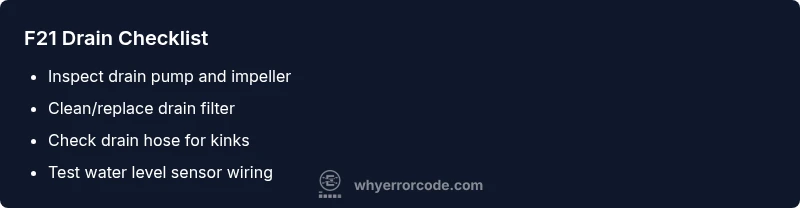
- Inspect and clean the drain pump area and impeller; remove any visible debris.
- Check the drain hose for kinks, blockages, or crimping; straighten or replace as needed.
- Remove and inspect the lint/filter screen; clear any buildup.
- Run a drain or spin cycle to see if water evacuates after these steps. If water still doesn’t drain, proceed to a deeper diagnostic.
- If you’re not comfortable with disassembly, consider a service call. Quick fixes here save time and reduce the risk of further damage.
In-Depth Diagnostic: Draining System Components
The draining system has several components that can cause F21. The drain pump is the heart of the system; if the impeller is jammed or the pump is weak, water won’t evacuate. The drain hose should be free of kinks and blockages; even a slight bend can impede flow. The lint screen and filter trap hair and debris, which can back up the drain path. In some cases, the water level sensor (pressure switch) may misread and extend the drain cycle length, triggering the fault. Wiring harnesses and connectors should be checked for corrosion or loose pins. A systematic test sequence helps you pinpoint the exact point of failure without guessing.
Step-By-Step Repair Focus: Drain Pump and Filter
To address the most common F21 source (drain pump blockage), follow these steps: 1) unplug the washer and disconnect power; 2) access the drain pump area per your model’s service manual; 3) inspect the pump for obstructions and the impeller for spins; 4) clean or replace the filter and pump as needed; 5) reassemble and run a diagnostic cycle; 6) observe for proper draining and confirm there are no leaks. If the pump tests fine but F21 persists, inspect the drain hose path and pressure switch wiring. Always discharge residual water safely before handling parts.
Verifying Functionality After Repair
After any service, it’s essential to verify that drainage works correctly. Reconnect power, select a normal or drain-only cycle, and start the test run. Observe the tub as it fills and then drains; listen for the pump’s operation. If water drains within the cycle time, the issue is resolved. If not, there may be a secondary fault such as a clogged main filter, a faulty pressure sensor, or a wiring problem. Document any persistent symptoms and prepare for further diagnosis or a professional visit.
Costs, Safety, and When to Call a Professional
Costs vary by region and model, but typical drain-pump-related repairs for F21 can range from $150 to $500 total, including parts and labor. If you suspect a failed main board, water inlet, or persistent sensor issue, expect higher costs and a longer service window. Safety is non-negotiable: always unplug before inspecting, avoid contact with water and electrical components, and use insulated tools. If you lack the right tools or the unit is under warranty, it’s prudent to contact a professional to avoid personal injury or further damage.
Proactive Measures to Prevent F21 in the Future
To minimize F21 occurrences, routinely inspect and clean the pump and filter, use the correct detergent type and amount, and avoid overloads that place extra strain on the drain system. Regularly check the drain hose for kinks or crushing, and ensure the washer is level to avoid misreads from the pressure switch. Keeping the drum free of small objects and periodic service checks can reduce the likelihood of F21 recurring.
Quick Reference Diagnostic Flow for F21
SYMPTOM: Washer shows F21 and won’t drain. CAUSES (high to low likelihood): 1) Drain pump clog or failure (high); 2) Kinked or blocked drain hose (medium); 3) Faulty pressure switch (low); 4) Control board/wiring issue (low). FIXES (easy to hard): 1) Clean pump and filter (easy); 2) Straighten/replace drain hose (easy); 3) Check pressure switch wiring (medium); 4) Inspect/replace control board (hard).
Steps
Estimated time: 30-60 minutes
- 1
Power down and access drain area
Unplug the machine, move it to a safe spot, and remove the access panel or front/back cover as your model requires. Safety first: no power, no water exposure. This prepares you for parts inspection.
Tip: Take photos of wiring before disconnecting anything. - 2
Inspect the drain pump and impeller
Locate the drain pump and visually inspect the impeller for obstructions. Rotate the impeller by hand if possible to confirm it spins freely. Remove any debris or lint that could hinder drainage.
Tip: Wear gloves and use a flashlight for a thorough check. - 3
Check the drain hose and filter
Inspect the drain hose for kinks or crushing; straighten or replace if needed. Remove the filter or screen and clear any blockages. Reassemble to ensure a smooth path for water flow.
Tip: Ensure hose connections are tight to prevent leaks. - 4
Test electrical connections
With the unit disassembled, inspect the wiring harness and connectors for corrosion or loose pins. Gently reseat connectors and secure with zip ties if necessary. Do not force any plug or connector.
Tip: Power off and avoid contact with water. Use a multimeter only if you’re trained. - 5
Run a diagnostic cycle
Reconnect power, run a drain or diagnostic cycle, and observe whether water drains properly. If F21 reappears, escalate to a professional or consider pump replacement.
Tip: Document observed behavior to speed up service.
Diagnosis: Washer displays F21 drain code and won't complete cycle
Possible Causes
- highBlocked or faulty drain pump
- mediumClogged or kinked drain hose
- lowFaulty water level sensor/pressure switch
- lowControl board or wiring issue
Fixes
- easyClear debris from pump impeller and filter
- easyUncoil or replace drain hose to remove restrictions
- mediumTest and replace pressure switch wiring if needed
- hardInspect control board connections; replace board if required
Frequently Asked Questions
What does F21 mean on a Whirlpool washer?
F21 indicates a drain fault where the washer cannot drain within the cycle time. It’s usually caused by a clogged pump, blocked filter, or kinked drain hose. Start with the simplest checks and progress to component tests if needed.
F21 is a drain fault—usually a clog or kink in the drain path. Start with the pump and hose, then move to deeper checks if needed.
Can I fix F21 myself?
Yes, many F21 fixes are within a confident DIY routine: unplug, inspect the pump and hose, clean the filter, and run a test cycle. If the fault persists or you encounter wiring work, call a professional.
You can often handle F21 yourself by checking the pump, hose, and filter, then testing. If you’re unsure, seek professional help.
How much does it cost to fix F21?
Repair costs vary by part and region. Typical ranges for drain-related fixes fall roughly between $150 and $500 total, depending on whether the pump, hose, or sensor is replaced.
Most F21 fixes cost between about $150 and $500, depending on the exact part and service call.
Will F21 reset after cleaning?
Sometimes yes. After cleaning and reassembling, run a diagnostic or drain cycle to verify drainage. If the code reappears, there may be an underlying issue requiring further testing.
Sometimes a reset and test cycle clears F21, but persistent codes require deeper checks.
Does warranty cover F21 repairs?
Warranty coverage depends on the model and purchase date. Check your warranty terms or consult the manufacturer’s support to see if F21-related repairs are covered.
Warranty depends on your specific plan. Check terms or contact support for F21 coverage.
Watch Video
Top Takeaways
- Identify F21 as a drain fault early
- Start with pump, filter, and hose checks
- Progress to wiring and control board only if needed
- Document steps and test cycles for service calls
- Know when to call a professional