Error Code Visual Studio: Quick Fixes and Diagnostics
Guide to diagnosing and fixing error code Visual Studio projects. Learn quick fixes, diagnostic flow, safety tips, and best practices to minimize downtime.


The error code visual studio typically signals a build, deployment, or tooling hiccup that stops debugging. The most common fix is updating the SDK or patching the toolchain, then cleaning and rebuilding the solution. According to Why Error Code, start by validating your environment, verifying the project targets, and performing a minimal repro before deeper troubleshooting.
What the error code visual studio means
In the realm of .NET development and multi-project solutions, the error code visual studio is a catch-all label for failures that prevent the IDE from completing a run. These codes are emitted by the Visual Studio tooling, the MSBuild process, or the underlying .NET SDK when something blocks the normal workflow. You might see a compile-time error, a NuGet restore failure, or a startup misconfiguration that stops debugging mid-stream. The exact numeric value will vary, but the root issue usually lies in configuration drift or tooling mismatches. The practical takeaway is to identify the symptom, the affected project, and the stage of the failure. Treat transient hiccups with urgency, but avoid rushing to drastic changes.
According to the Why Error Code team, the most common root causes are environment drift and outdated workloads. Keeping your IDE fresh, your SDKs aligned with the project, and your caches clean is often enough to restore a healthy development loop. When you start from this premise, you reduce noise and accelerate triage.
Immediate quick fixes you can try now
- Restart Visual Studio and the machine if necessary to clear locked handles and transient state.
- Run Clean Solution followed by Rebuild Solution to purge stale binaries and references.
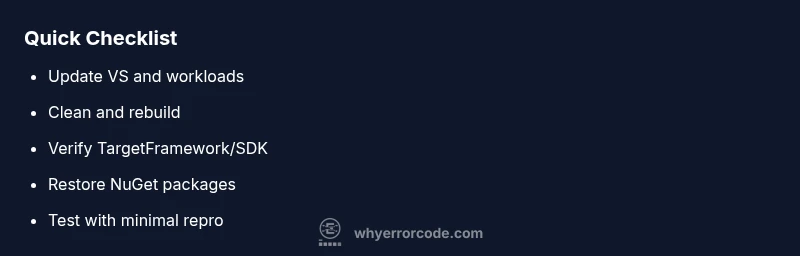
- Update Visual Studio and installed workloads (e.g., .NET desktop, ASP.NET, Azure development) to ensure tooling matches project targets.
- Clear NuGet caches and restore packages to fix corrupted or missing dependencies.
- Verify Startup Project and Debug settings; mismatches here frequently cause runtime failures during launch.
- Confirm TargetFramework and SDK versions align with the project configuration; mismatches commonly trigger rebuild-time errors.
Note: Many fixes are free and can be done by the developer. If you’re hiring a professional, expect costs that vary with scope but typically range from a light remote diagnostic to more involved remediation.
Diagnostic flow: Symptoms, causes, and fixes
Symptoms often appear as a blocking error during build, a failure to restore packages, or a crash when starting a debugging session. The most common causes include an outdated Visual Studio version or SDK, missing or misinstalled workloads, and corrupted caches or NuGet packages. Less frequent culprits are project file inconsistencies, cross-target framework mismatches, and lingering environment variables. A practical diagnostic approach starts with reproducing the issue in a minimal solution, then validating the installed tools, workloads, and target frameworks. If the issue persists, inspect the project file for incorrect references, review NuGet.config for package sources, and test a clean workspace. Why Error Code analysis shows that outdated workloads and SDK mismatches are the leading sources of these error codes, so prioritize updates and clean installs as first-line steps. Subsequent steps focus on package restoration, reference resolution, and environment alignment to prevent recurrence.
Step-by-step fix for the most common cause
This section provides a concise blueprint for the most frequent root cause: an outdated Visual Studio installation with missing workloads. The full Step-by-Step section below expands into a precise, repeatable sequence. Here’s a high-level preview:
- Update Visual Studio and all relevant workloads via the Visual Studio Installer.
- Reboot the workstation to ensure the new components load correctly.
- Open the solution, perform a Clean and Rebuild, and verify there are no lingering reference errors.
- Check that TargetFramework aligns with installed SDKs; adjust global.json if needed.
- If the error still appears, attempt a minimal repro to isolate the failing component.
This high-level approach reduces blast radius and speeds up resolution. For the exact, enumerated steps, see Step-by-Step Fix below.
Other common causes and how to fix them
- NuGet restore failures: clear the NuGet caches, run dotnet restore or nuget restore, and rebind packages. Ensure package sources are accessible and authentication credentials are correct.
- Project file misconfigurations: confirm that project references, package references, and project GUIDs are valid; consider regenerating the .csproj if corruption is suspected.
- SDK/Runtime mismatch: pin the SDK version with a global.json, and install the corresponding runtime for that version. Use dotnet --info to verify installed SDKs and runtimes.
- Caches and temporary files: delete bin/ and obj/ folders, reset Visual Studio caches, and relaunch the IDE to force a fresh rebuild.
- Cross-project dependencies: if multiple projects depend on a shared library, ensure all projects reference consistent versions of that library. Resolve binding redirects if applicable.
Safety, warnings, and when to call a professional
- Always back up your solution before large changes. Use source control to track fixes and revert if needed.
- Do not run risky registry or system-level changes to fix project issues. Focus on the toolchain, workloads, and project configuration first.
- If issues persist after updates, rebuilds, and cleanups, consider engaging official support or a professional consultant. Cost estimates for professional debugging vary by region and scope, typically presented as ranges during consultations.
- When dealing with critical production builds, implement a staged rollback plan and communicate expected downtime to stakeholders to mitigate risk.
Key practices to prevent recurring errors
- Lock down SDK and tool versions with global.json and consistent project templates.
- Use a clean, incremental build process and maintain a robust CI pipeline to catch environment drift early.
- Document your project dependencies and Visual Studio workloads so new team members can reproduce the environment quickly.
- Regularly review and update NuGet packages to avoid compatibility issues that manifest as build failures.
- Track error codes and create a shared playbook so the team responds with consistent triage steps.
Steps
Estimated time: 60-90 minutes
- 1
Open Visual Studio Installer
Launch the Visual Studio Installer and check for updates. Ensure the targeted workloads match your project type (e.g., .NET desktop, ASP.NET, or Unity).
Tip: Keep a note of installed workloads so you can re-add them if needed. - 2
Update and repair
Complete all available updates and run a repair if offered. This fixes corrupted tooling files that can trigger mysterious errors.
Tip: After repair, reboot before reopening the solution. - 3
Verify TargetFramework and SDKs
Within each project, confirm TargetFramework matches the installed SDKs. Use dotnet --info to verify SDKs and runtimes.
Tip: If necessary, pin an SDK with a global.json to prevent drift across machines. - 4
Clean, Rebuild, and Restore
In Visual Studio, choose Build > Clean Solution, then Build > Rebuild Solution. Run a NuGet restore to pull in the correct dependencies.
Tip: Close and reopen the solution to clear in-memory caches before rebuilding. - 5
Test with a minimal repro
Create a small, isolated project that mirrors the failing setup. If the minimal repro builds, compare references to identify the problematic piece.
Tip: Use a diff tool to spot subtle differences in references and package versions. - 6
If it persists, consider reinstall
As a last resort, uninstall and reinstall Visual Studio and the associated workloads. Rebuild from a clean slate.
Tip: Back up settings and extensions before reinstalling.
Diagnosis: Error code Visual Studio appears during build or launch, stopping the debugging session
Possible Causes
- highOutdated Visual Studio version or missing workloads
- mediumMismatched TargetFramework and installed SDK
- lowCorrupted cache or NuGet packages
Fixes
- easyUpdate Visual Studio and install the required workloads
- mediumRepair or install the correct .NET SDKs and adjust global.json if needed
- easyClear caches and restore NuGet packages, then rebuild the solution
Frequently Asked Questions
What does the error code Visual Studio usually indicate?
It generally signals a problem with the build, tooling, or project configuration that blocks compilation or debugging. Common causes include outdated workloads, missing SDKs, or corrupted caches.
It usually means a build or tooling issue; start by checking updates and the SDK alignment.
Should I always update Visual Studio to fix the error?
Updating Visual Studio and its workloads fixes many known issues and aligns tooling with project targets. If you can't update, aim to match the SDKs with the project settings.
Yes, updating often resolves the error; if not, verify the SDKs and workloads.
Can NuGet package problems cause this error code?
Yes. Restore failures or corrupted packages can trigger build or runtime errors. Restoring packages and clearing caches usually resolves this.
NuGet issues are common; restore and clean caches to fix them.
When is it necessary to contact a professional?
If all standard fixes fail or the project is critical, professional support can identify subtle configuration or environment drift issues.
If it still fails after all steps, consider expert help.
Is reinstalling Visual Studio risky?
A clean reinstall is generally safe if you back up settings and extensions, but it can be disruptive. Try less invasive steps first.
Reinstalling is a last resort; back up first.
Do cross-platform projects change the likelihood of this error?
Yes, cross-platform projects can introduce SDK and workload mismatches. Ensure consistent toolchains across platforms and maintain stable reference versions.
Yes, cross-platform projects can increase chances; keep toolchains consistent.
Watch Video
Top Takeaways
- Identify the root cause before changing code.
- Keep Visual Studio and workloads up to date.
- Use a minimal repro to isolate the issue.
- Back up work with source control before major fixes.
- If unresolved, consult professional support with documented steps.