Haier Washer Error Code E4: Repair Guide and Diagnostic Flow
Haier washer error code E4 signals a water level/overflow fault. Learn rapid checks, a proven diagnostic flow, cost ranges, and a step-by-step repair plan to get your washer back to work fast.


Haier washer error code E4 indicates a water-level/overflow fault detected by the control board, usually tied to the pressure switch or its wiring. Start with a quick power reset and inspect the drain path and hoses. If the fault persists, follow the full diagnostic flow and perform the safe quick fixes before deciding on professional service.
What Haier washer error code E4 means in practice
The Haier E4 code is a sign that the washer detected an abnormal water level or overflow condition during operation. When the control board senses an out-of-bounds signal from the pressure sensor or related circuitry, it halts the cycle to prevent flooding or mechanical damage. This is a high-priority fault that users should address promptly to avoid water damage and mold growth. According to Why Error Code, E4 is a common fault pattern tied to sensor and wiring issues rather than a simple door latch problem, so diagnostics should focus on the sensor path and drain/overflow mechanisms.
Earliest action matters: power down the machine, unplug it for 60 seconds, and check for any obvious blockages in the drain or hose connections before testing deeper components. If you hear a buzzing pump or see water not draining, treat it as an urgent situation that requires attention.
Common causes of Haier E4 you should know
"haier washer error code e4" often stems from a faulty water level sensor (pressure switch) or its hose, an obstructed drain path, or damaged wiring between the sensor and the main controller. Less commonly, the control board or a defective door switch can trigger E4 by misreporting water level data. Prioritize the sensor and hose checks, because they are the most likely culprits and have the fastest path to a fix. Why Error Code notes that sensor malfunctions often accompany blockages in the drain line, creating a false overfill signal that triggers E4.
Checklist of likely drivers (ranked by likelihood):
- Pressure switch or hose faults (high)
- Clogged drain pump or filter (medium)
- Wiring/connectors between sensor and board (low)
Quick checks you can do safely right now
- Power cycle the washer to clear transient faults.
- Inspect the pressure switch hose for kinks, cracks, or detachment and re-seat any loose connections.
- Check the drain hose for kinks or blockages and ensure the pump can evacuate water freely.
- If you can access the filter, clean out lint and debris, then run a test cycle with an empty drum.
- Avoid forcing cycles; if you smell burning or see melted plastic, stop immediately and unplug the unit. These steps are low-risk and can resolve many E4 occurrences without tools.
Step-by-step diagnostic flow you should follow next
This section provides a structured approach to confirm the root cause and apply the appropriate fix. Start with the simplest checks (sensor hose and drain path) before testing electrical connections or replacing hardware. If any step requires disassembly beyond basic access panels, proceed with caution or call a professional. The aim is a clear, repeatable path from symptom to solution.
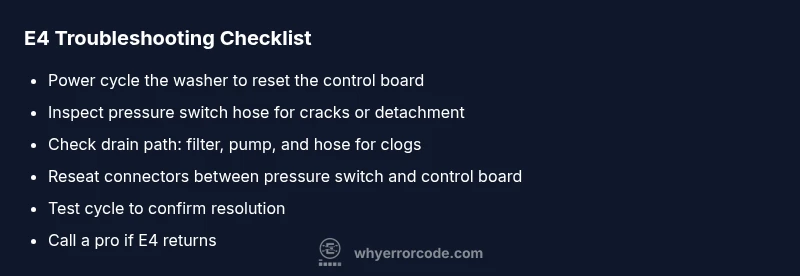
- Inspect pressure switch hose for cracks or disconnection and replace if compromised.
- Test the air chamber and diaphragm for leaks; a faulty diaphragm triggers incorrect pressure readings.
- Confirm the drain path is clear: remove any clogs from the pump, filter, and drain hose.
- Check electrical connectors at the pressure switch and control board for corrosion or loose pins; reseat or replace as needed.
- Run a short diagnostic cycle to observe water fill, level sensing, and draining behavior.
- If E4 persists after the above, escalate to professional service with documented findings.
When to call a professional and what to expect for costs
If the basic checks do not resolve E4, or if you observe water leakage, unusual burning smells, or a non-draining fault during tests, professional service is advised. Costs typically range from part replacement to full module repairs, with service calls generally spanning a broad range. Common costs to expect include:
- Diagnostic visit: $60–$120
- Pressure switch or hose replacement: $40–$130 for parts, plus labor
- Drain pump or filter service: $60–$180 depending on model and accessibility
- Control board or main module replacement: $150–$450 (parts) plus labor Note that final costs vary by region, warranty status, and whether your Haier label is still active. Safety remains paramount; never attempt high-voltage repairs without training.
Prevention and maintenance to minimize E4 recurrence
- Schedule regular drain path checks to prevent clogs from building up.
- Inspect hoses for wear; replace any cracked or stiff hoses promptly.
- Use the recommended detergent and avoid overdosing to reduce residue in sensors and hoses.
- Keep the chassis area clean and dry to prevent moisture affecting the control board related components.
- If your model supports it, run a monthly self-clean cycle to clear minor build-up and keep sensors responsive. These practices reduce the likelihood of E4 and extend the life of your washer.
Steps
Estimated time: 60-90 minutes
- 1
Power down and prepare
Unplug the washer and wait 60 seconds to allow the control board to reset. If you can, disconnect power at the outlet and remove any access panels to locate the pressure switch, hoses, and board. This reduces the risk of shock during inspection.
Tip: Take a photo of wiring before unplugging connectors to aid reassembly. - 2
Inspect pressure switch hose
Trace the hose connected to the pressure switch for cracks, kinks, or detachment from fittings. If you find damage, replace the hose with the correct part for your Haier model.
Tip: Do not twist hoses; keep them straight to avoid kinks when reassembling. - 3
Check the air chamber/diaphragm
Some Haier models use an air chamber or diaphragm in the pressure switch. Look for signs of wear or holes and replace if necessary. A faulty diaphragm can lead to false high/low readings.
Tip: Handle with care; avoid pinching the diaphragm during reassembly. - 4
Test the drain path
Remove the drain hose from the standpipe, check for clogs in the hose, filter, and pump. Clear blockages with a work-friendly tool and verify water flows freely when tested manually.
Tip: Have towels ready; water may spill during testing. - 5
Inspect electrical connections
With the unit unplugged, reseat the pressure switch connector and inspect the board harness for corrosion or bent pins. Damaged connectors can cause intermittent signals that trigger E4.
Tip: Only handle electrical connectors with dry hands. - 6
Run a test cycle
Reconnect power and run a short cycle with no clothes to observe whether the E4 error recurs and to confirm the sensor readings during fill and drain phases.
Tip: If the error reappears, document the exact cycle stage when it occurs. - 7
Decide on next steps
If E4 persists after these checks, contact a technician for advanced diagnostics. Expect a service visit to include a deeper inspection of the control board and sensor circuitry, with cost ranges likely depending on parts.
Tip: Provide the technician with notes from your diagnostics to speed up repair.
Diagnosis: Error code E4 on Haier washer, unclear whether water is level or leaking, cycle may stop mid-way
Possible Causes
- highFaulty water level sensor (pressure switch) or its hose
- mediumBlocked drain pump or clogged drain hose/filter
- lowDamaged wiring between pressure switch and control board
Fixes
- easyReplace or reseat the pressure switch and inspect the sensor hose
- easyClear drain path by cleaning pump/filter and inspecting drain hose
- hardRepair or replace wiring harness or control board as needed
Frequently Asked Questions
What does Haier washer error code E4 mean?
E4 refers to a water level/overflow fault detected by the washer’s control system. It usually points to the pressure switch, its hose, or related wiring. Quick checks and a guided diagnostic flow typically resolve the issue. If unresolved, professional service is advised.
E4 means the washer detected an improper water level. Start with a reset, inspect the pressure switch and hoses, then follow the diagnostic steps if needed.
Can I fix E4 myself without tools?
Yes, many E4 cases begin with simple, no-tool checks: power cycle, inspect pressure switch hose, and clear the drain path. If you encounter wiring or control-board symptoms, stop and call a pro to avoid electric shock or further damage.
Many E4 fixes start with easy checks like resetting and hose inspection; deeper repairs should be left to a professional.
How much does it cost to repair Haier E4?
Costs vary by cause and region. Expect minimal costs for parts and labor if the issue is simple, or higher sums for control-board or module replacements. Service calls typically range from $60–$120, with parts and labor potentially bringing total to $150–$600 depending on the fix.
Service calls usually cost around sixty to a hundred twenty dollars, with parts and labor for more complex fixes potentially higher.
Is E4 covered under warranty?
Warranty coverage depends on your model, purchase date, and service history. If a defect is covered, repairs may be free or discounted. Check your warranty terms and contact Haier support for a formal assessment.
Warranty depends on your purchase and plan; check your terms or contact support for confirmation.
What’s the quickest way to reset the E4 fault?
Unplug the washer for 60 seconds, then plug back in and run a short cycle to see if the E4 fault clears. If it reappears, proceed with the diagnostic flow.
unplug for a minute, replug, and run a test cycle to check if the error clears.
Should I replace the pressure switch or the harness first?
Start with the pressure switch and its hose, since this is the most common cause. If tests show wiring issues, inspect the harness and connectors before replacing the board.
Begin with the sensor and hose; if wiring looks damaged, fix the harness before touching the board.
Watch Video
Top Takeaways
- Identify E4 as a water-level/sensor fault
- Start with power reset and hose/drain checks
- Prioritize pressure switch and wiring diagnostics
- Cost ranges vary by fix; call a pro for hard repairs
- Regular maintenance reduces recurrence