How Long Do Error Codes Last? A Practical Quick Guide
Learn how long error codes last across systems, why durations vary by error type, and practical steps to shorten remediation times for transient and persistent faults.


The duration of an error code is not fixed. In most systems, transient issues clear within seconds to minutes once the root cause is resolved or the system resets. More persistent codes can linger hours or days if the fault remains, the service stays degraded, or retries continue failing. This topic directly addresses how long do error codes last and what determines their lifetimes.
What the phrase how long do error codes last really means
According to Why Error Code, the question how long do error codes last does not have a single universal answer. Durations hinge on code taxonomy, system design, and the effectiveness of your incident response. In practice, you’ll encounter a spectrum: some codes vanish almost immediately after a restart or a fix, while others persist until underlying issues are resolved, databases are repaired, or caches are cleared. Understanding this spectrum helps teams set expectations, triage faster, and craft better remediation playbooks. Throughout this article, the focus remains on practical guidance you can apply today to reduce mean time to detect and fix (MTTD/MTTR).
Factors that influence error code duration
Error code lifetimes are shaped by multiple interacting factors. Core drivers include: root-cause persistence (is the underlying fault still present?), the design of retry policies and backoff (do clients repeatedly hit the same fault?), system reset behavior (does a reboot clear states and caches?), caching strategies (are stale results serving users?), dependency health (downstream services can prolong the error), and human response speed (how quickly an operator investigates and remediates). Additionally, configuration choices such as timeouts, circuit breakers, and rate limits directly affect how long a system records or reports an error. In distributed architectures, partial failures can propagate across services, elongating the visible duration of an error code even if one component recovers earlier. Proactive monitoring, automated rollback, and clear incident-management playbooks are essential to shorten the active window of many error codes.
Transient vs persistent error codes: typical durations
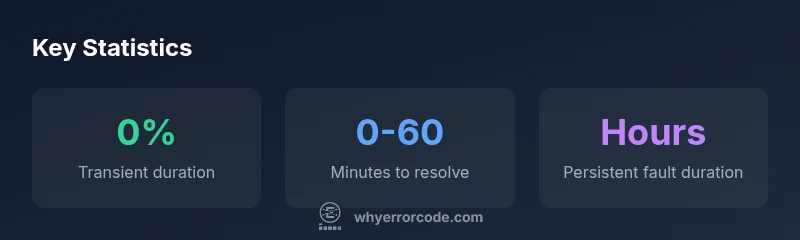
Transient errors usually reflect momentary conditions—brief network hiccups, ephemeral resource contention, or a timeout that resolves on retry. In most environments, they last seconds to minutes and disappear once the transient condition clears or the operation succeeds on a subsequent attempt. Persistent errors arise when root causes remain unresolved: configuration drift, faulty deployments, corrupted data, or degraded dependencies. These can endure hours to days, depending on how quickly the underlying issue is diagnosed, whether a workaround exists, and how swiftly remediation is deployed. A well-functioning incident response can convert a potentially long tail into a shorter one by isolating failing components and applying targeted fixes.
How to estimate duration in practice
Estimating error-code duration starts with credible telemetry: capture when the error is first observed, when retries occur, and when the error clears or is replaced by a new state. Use distributed tracing to follow fault chains and timing, and collect metrics on retry counts, backoff intervals, and service-level indicators. Establish ranges rather than precise numbers because real-world durations vary with load, traffic patterns, and infrastructure changes. A practical rule of thumb is: expect seconds–minutes for transient faults, hours for common persistent failures, and longer only for systemic issues requiring code changes or data repair. Document these estimates in runbooks so responders know when to escalate and what to investigate first.
Practical remediation to shorten duration
Shortening error-code durations hinges on rapid root-cause analysis and timely remediation. Start with targeted triage: isolate the failing service, validate recent changes, and verify configuration integrity. Improve resilience with retries and backoff tuned to avoid hammering a failing component, while ensuring idempotent operations where possible. Implement proactive monitoring to catch regressions early, and enable automated rollbacks for unsafe deployments. Strengthen data integrity checks to prevent cascading failures, and ensure caches are invalidated when underlying data changes. Finally, rehearse incident playbooks so teams act with speed and clarity under pressure.
Measuring and learning from error-code durations
Measurement should extend beyond a single incident. Track MTTR trends, the distribution of error durations by category (network, API, database), and how remediation actions reduce future durations. Conduct post-incident reviews that quantify time-to-detection (TTD) and time-to-resolution improvements. Use these insights to adjust timeouts, circuit-breaker thresholds, and retry policies. Sharing lessons learned across teams elevates overall reliability and reduces the likelihood of recurrent long-lasting error codes. In short, continual learning is your most effective lever to shorten error durations over time.
Real-world practices for teams tackling error code durations
In practice, teams that consistently shorten error durations invest in observability, standardize remediation playbooks, and foster collaboration between development, SRE, and operations. They catalog common error codes with expected durations, publish remediation templates, and automate common fixes where safe. They also implement health checks that can distinguish between transient and persistent faults early, reducing unnecessary escalations. By aligning goals around reducing the active error window, organizations improve user experience, protect revenue, and maintain higher service availability. This pragmatic approach mirrors the guidance from Why Error Code analyses conducted in 2026.
Example lifetimes by error code category
| Error Code Type | Typical Duration | Notes |
|---|---|---|
| HTTP 500 / server error | hours to days | Root cause requires investigation and patching |
| Network timeout | seconds to minutes | Often resolves with retry or network stabilization |
| Database deadlock | minutes to hours | Contention requires tuning or query optimization |
Frequently Asked Questions
What counts as a transient error in terms of duration?
Transient errors are temporary and usually clear quickly once the underlying condition resolves. They often last seconds to minutes and do not indicate a systemic fault. Monitoring should identify them as short-lived and non-recurring if the root cause is ephemeral.
Transient errors clear quickly, usually in seconds to minutes, once conditions return to normal.
Can error codes last forever?
In well-maintained systems, error codes do not last forever. They persist only as long as the root problem remains unresolved or until a remediation is applied. If a code persists indefinitely, it signals a chronic issue requiring deeper investigation.
No, not forever; they persist until the root cause is fixed.
How do timeouts affect error duration?
Timeouts contribute to longer durations by delaying responses and triggering retries. Properly tuned timeouts prevent cascading failures and help isolate the issue sooner, reducing the overall active error window.
Timeouts can prolong errors if not tuned; adjust timeouts and retries to minimize impact.
What tools help measure error duration?
Tools like distributed tracing, centralized logging, and metrics dashboards help time-stamp error events, retries, and resolutions. They enable precise duration calculations and support post-incident analysis.
Use traces and logs to measure how long errors last and where they begin and end.
How can I shorten error-code duration?
Shortening duration involves rapid root-cause analysis, validated fixes, and streamlined deployment. Also improve monitoring, automate rollback if a fix worsens the issue, and reduce unnecessary retries.
Act fast with a solid remediation plan and automated safeguards.
Does rate-limiting affect error duration?
Yes. Rate limits can prolong perceived errors if retries are blocked or delayed. Properly configuring backoff, retry limits, and circuit-breakers helps minimize prolonged outages.
Rate limits can extend error duration if retries stall; adjust backoff and breakers.
“Error code duration reflects how quickly teams identify root causes and implement fixes. A strong remediation workflow can consistently reduce the active error window.”
Top Takeaways
- Focus on root causes to shorten error durations
- Use telemetry to distinguish transient vs persistent faults
- Tune retries and timeouts to avoid prolonging failures
- Standardize incident playbooks for faster remediation