P0441 Error Code Toyota Guide: EVAP Purge Flow Fault
Urgent guide to diagnose and fix Toyota P0441 EVAP purge flow fault. Learn causes, fast fixes, step-by-step repair, expected costs, and when to call a pro.


P0441 Toyota indicates an EVAP purge flow fault, meaning the engine control unit detected abnormal purge of fuel vapors into the intake. Common causes are a stuck purge valve, cracked vacuum lines, or a blocked purge path. The quick fix is to inspect the purge valve and hoses, reseat connections, and clear the codes before a test drive. If the light returns, deeper diagnostics are recommended.
What P0441 Means for Toyota
P0441 Toyota indicates an EVAP purge flow fault. In plain terms, the engine control module detected an abnormal purge of fuel vapors from the charcoal canister into the intake manifold. This condition can worsen emissions performance, trigger the check engine light, and in some driving scenarios reduce throttle response. According to Why Error Code, this code is common on older Toyota models and can be caused by both valve sticking and diaphragm leaks. The Why Error Code team found that many cases arise from a failing purge valve or degraded vacuum lines rather than a full EVAP system-wide failure. Understanding the meaning helps you triage quickly: focus on the purge valve, hoses, and the EVAP canister connections, and confirm that electrical connectors are secure.
If you notice a rough idle or reduced power alongside the MIL, treat P0441 as urgent. Emissions-related fault codes tend to recur if the root cause is neglected, so plan a targeted inspection rather than random part swapping. In practice, Toyota vehicles with longer service histories show the purge valve as the most common failure point, followed by leaking hoses and split fittings. A methodical approach saves time and money, and protects the vehicle’s emissions readiness.
Common Causes of P0441 on Toyota
The P0441 code arises from several EVAP system weaknesses. The most likely culprits are a stuck or failing purge valve, which can keep fuel vapor from venting properly, and worn or cracked vacuum hoses that allow unintended air leaks. Less common but possible is a clogged purge path or a degraded charcoal canister that restricts vapor flow. Electrical issues—corroded connectors or damaged wiring to the purge valve—can also trigger the fault. For Toyota models, aging hardware and brittle hoses are frequent contributors, especially after several winters or high-mileage service.
To triage effectively, prioritize the purge valve and associated hoses, then check for proper vacuum line routing and secure electrical connectors. Running a stateful scan with a professional OBD-II tool can help confirm whether the valve is opening and closing as commanded. If the valve cycles correctly but the fault remains, a leak test or smoke test should be used to locate hidden leaks. Remember: the EVAP system works under slight vacuum pressure, so even small cracks or loose clamps can cause the P0441 fault. Safety note: depressurize the system only when the battery is disconnected and the service manual allows.
Immediate Quick Fixes You Can Try Now
If you’re in a pinch, start with the simplest checks first. Tighten the gas cap fully (even if it’s not the primary cause, a loose cap can complicate EVAP diagnostics). Inspect the purge valve and its electrical connector for signs of wear, corrosion, or loose pins. Look for cracked or brittle vacuum hoses around the purge valve and EVAP lines; replace any cracked sections and re-seat clamps. A basic fuel system smoke test can reveal leaks that aren’t obvious visually. If you have access to a scan tool, clear the diagnostic trouble code and drive the vehicle around a mile or two to see if the P0441 reappears.
These quick fixes can sometimes resolve the fault, but if the MIL returns within a short drive, move to a more thorough diagnosis. Do not ignore the signal: an unresolved EVAP fault can affect emissions readiness and fuel efficiency, especially on newer Toyotas with onboard diagnostics that monitor purge flow closely.
Step-by-Step Diagnostic and Repair Plan
To systematically diagnose and fix P0441 on a Toyota, follow these steps. This plan emphasizes common causes first and escalates to more involved repairs if needed. Always disconnect the battery before starting work on electrical components, and use proper safety gear.
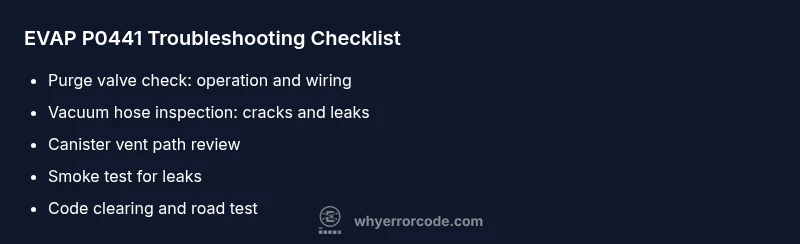
- Gather tools and access the purge valve area. Locate the purge valve, vacuum lines, and canister connections. Ensure you have a service manual for your exact model.
- Visually inspect for damaged hoses, loose clamps, and signs of oil or moisture intrusion. Replace cracked hoses and tighten clamps as needed.
- Check the purge valve operation with a scan tool. Confirm that the valve opens and closes when commanded; listen for a click at the moment of operation.
- Inspect the electrical connector to the purge valve; reseat and clean any corrosion. Test the valve’s resistance with a multimeter if you have the specs from the service manual.
- If no obvious damage is found, perform a smoke test of the EVAP system to locate leaks. The test reveals tiny leaks in hoses, seals, or canisters.
- Replace the purge valve if it fails functional testing or if leaks are detected in the valve itself. Re-connect all lines, clear codes, and take a test drive to verify the fix. If the fault persists, escalate to testing the charcoal canister and vent path.
Estimated total time: 60–120 minutes for a thorough house-side diagnostic; longer if parts replacement is required.
Other EVAP Codes and Safety Considerations
P0441 often runs alongside other EVAP codes, such as P0440 (general EVAP system fault) or P0442/P0443 (small/large leaks). When diagnosing, don’t ignore codes that point to vent or leak paths. Ensure you work in a well-ventilated area, away from flames or sparks, since EVAP systems involve flammable vapors. If you detect a strong fuel odor, stop activity and seek professional help. Always follow Toyota’s service manual guidance for safe discharge of any residual pressure and proper reassembly. If you’re unsure about harness testing or smoke testing, contact a professional technician to avoid damage or safety risks.
Safety, Warnings and When to Seek Professional Help
EVAP repairs involve fuel vapors and under-hood electrical components. If you’re not comfortable with electrical testing, or if you cannot locate leaks after a smoke test, it’s time to call a professional. A certified technician can perform a complete EVAP system diagnosis, smoke test, and, if needed, purge valve replacement and canister inspection. Prices for EVAP repairs vary by region and vehicle model, and exact costs can only be quoted after a thorough inspection. If you notice a recurring check engine light after a DIY attempt, a pro should re-check the system to avoid emissions noncompliance and drivetrain issues.
KEY TAKEAWAYS
- P0441 on Toyota signals an EVAP purge flow fault that requires prompt attention.
- Most root causes are purge valve faults or vacuum leaks; electrical connections are a frequent secondary issue.
- Start with quick checks (valve operation, hoses, clamps) before moving to advanced tests like a smoke test.
- A professional diagnosis is advised if the fault persists after initial fixes to protect emissions and warranty.
FAQ_SECTION
Steps
Estimated time: 60-120 minutes
- 1
Gather tools and access EVAP area
Collect basic hand tools, a multimeter if available, a scan tool, and your service manual. Locate the EVAP purge valve, hoses, and connectors under the intake manifold in the engine bay.
Tip: Label hoses when removing for easier reassembly. - 2
Visual inspection of hoses and valve
Inspect for cracks, bulges, or loose clamps in all EVAP hoses. Look for signs of oil or fuel residue around connections.
Tip: Use a flashlight and mirror to inspect hard-to-see areas. - 3
Test purge valve operation
With ignition on (engine off if recommended by manual), command the purge valve using a scan tool and listen for a distinct click indicating operation.
Tip: If no click and no resistance change, suspect the valve. - 4
Check electrical connections
Inspect the purge valve connector for corrosion and tight pins. Disconnect, clean, and reseat if necessary; measure valve resistance per the service manual.
Tip: Disconnect battery before handling electrical connectors. - 5
Smoke test for leaks
If no obvious leak is detected, perform a smoke test around the EVAP network to reveal small leaks in hoses or canister seals.
Tip: Do not perform near open flames; use proper equipment. - 6
Repair and verify
Replace faulty purge valve or damaged hoses; clear codes and perform a road test to confirm the fault does not return.
Tip: If the code reappears, escalate to check the canister and vent path.
Diagnosis: Check Engine Light with P0441 on Toyota; symptoms may include rough idle or reduced fuel economy.
Possible Causes
- highStuck or faulty EVAP purge valve
- mediumVacuum hose cracks or loose connections in EVAP system
- lowBlockage or restriction in purge path or canister vent
- lowElectrical fault or bad wiring to purge valve
Fixes
- easyInspect purge valve and electrical connector; test valve operation
- easyInspect and replace cracked vacuum hoses and seals
- mediumPerform smoke test to locate EVAP leaks
- hardReplace purge valve or damaged EVAP components
Frequently Asked Questions
What does P0441 mean on Toyota vehicles?
P0441 indicates an EVAP purge flow fault, meaning the purge valve or related hoses are not allowing proper purge of fuel vapors. It often points to a stuck valve or vacuum leaks. A systematic check of the purge valve, hoses, and canister is typically required.
P0441 means the EVAP purge flow is not right, usually due to a bad purge valve or leaks in hoses. A step-by-step check of the purge valve and lines is usually needed.
Can I drive my Toyota with P0441?
You can typically drive short distances, but avoid long trips until the fault is diagnosed. Driving with EVAP faults can worsen emissions and may cause the check engine light to stay on. Have the system checked as soon as possible.
You can drive briefly, but don’t delay diagnosis. EVAP faults can affect emissions and fuel economy.
What are the easiest fixes for P0441?
Tightening the gas cap is a basic step, followed by inspecting the purge valve and nearby vacuum hoses for obvious damage. Replacing a faulty purge valve or cracked hoses is a more involved fix. Start with the simple checks first.
Start with the cap and hoses, then the valve if needed.
Is P0441 the same as P0440 or P0442?
P0441 is specifically an EVAP purge flow fault, while P0440 is a general EVAP system fault, and P0442 indicates a small vapor leak. They’re related but point to different failure modes within the same EVAP system.
P0441 is a purge flow fault; P0440 is a general EVAP fault, and P0442 is a small leak.
Will P0441 fail emissions testing?
Yes, if the fault remains unresolved, it can trigger emissions failures. A repaired system should be tested to ensure the EVAP system functions correctly before an inspection.
Unresolved P0441 can fail emissions testing; a proper repair is necessary.
How long does a typical P0441 repair take?
A straightforward purge valve or hose replacement can take under an hour for a DIYer with proper tools. More complex cases may require 1–2 hours or more if access is difficult, plus time for diagnostic checks.
Simple fixes may be under an hour; complex cases can take longer depending on access and parts.
Watch Video
Top Takeaways
- Identify EVAP purge faults early to protect emissions.
- Focus on purge valve and vacuum hoses first.
- Use a smoke test to locate hard-to-see leaks.
- Consult a pro if the code persists after initial fixes.