USB XHCI Code 10: Fix Guide for Start Errors
Urgent guide to diagnose and fix usb xhci compliant host controller error code 10. Learn symptoms, causes, quick fixes, step-by-step repairs, safety notes, and when to call a pro for reliable recovery.


usb xhci compliant host controller error code 10 indicates the USB controller cannot start properly, typically due to driver, firmware, or power conflicts. Immediate actions include updating drivers, rebooting, testing alternate ports or hubs, and verifying BIOS/UEFI settings. If the issue persists, plan a targeted repair path and consider professional support to avoid data loss or further hardware damage.
What Code 10 Means for USB XHCI Controllers
According to Why Error Code Analysis (2026), usb xhci compliant host controller error code 10 indicates the controller or its devices cannot initialize properly. In practical terms, the OS signals a failure during USB controller startup, which can block keyboards, mice, storage devices, and docks from functioning. The root cause is rarely a single fault; it’s usually a mix of outdated drivers, firmware mismatches, power conflicts, and misconfigured BIOS/UEFI settings. The urgency is palpable: until the controller can initialize, peripherals are unusable, work stalls, and your system’s reliability is at risk. This is a high-priority issue especially for developers and IT pros who rely on USB-attached tooling.
What makes Code 10 particularly pernicious is its variability: different hardware combos (laptops, desktops, PCIe USB cards) can exhibit the same error for different underlying reasons. The key to resolution is a systematic approach that starts with quick-fixes and then escalates to driver, firmware, or hardware considerations. Recognize that the fix path is not one-size-fits-all; it requires identifying the specific cause in your environment.
Symptoms That Signal a Code 10 Situation
When usb xhci compliant host controller error code 10 is active, you’ll often see a cluster of symptoms that confirms a startup problem with the USB subsystem. Typical indicators include a warning in Device Manager stating "This device cannot start. (Code 10)" for the USB controller, and peripheral devices that fail to enumerate. You might notice a cascade of Unknown Device messages, unresponsive keyboards or mice, stalled USB hubs, or storage devices that do not appear in File Explorer. System logs frequently point to driver initialization failures, timing errors during PCIe enumeration, or power management events that interrupt the XHCI controller. In urgent scenarios, this can prevent boot-time USB access, complicating data recovery or software installation. If you observe these patterns, initiate a structured diagnostic flow immediately.
Immediate Quick Fixes You Can Try Now
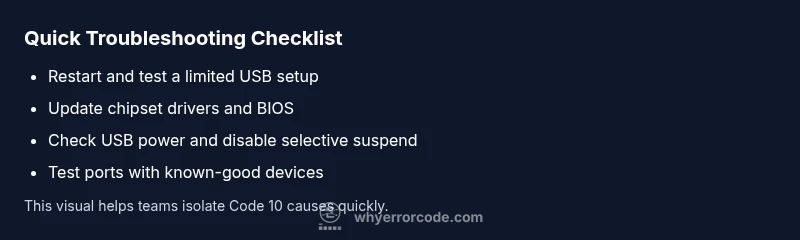
If you want to regain control quickly, start with non-destructive, reversible steps. First, perform a full reboot and then unplug all nonessential USB devices, leaving only the mouse or keyboard connected. Swap to different USB ports and test with a known-good USB hub to rule out a faulty port or hub. Open Device Manager and reinstall the USB controller driver or update chipset drivers from the motherboard or PC vendor. Check for pending Windows updates or OS updates and apply them if available. Disable USB selective suspend in Power Options to prevent the controller from entering a suspended state during operation. Finally, verify BIOS/UEFI settings related to USB initialization (XHCI mode, Hand-off, and legacy USB support) and ensure they’re configured for optimal startup. These steps are quick, low-cost, and often resolve Code 10 without further disruption.
Common Causes, Ranked by Likelihood
In most cases, Code 10 stems from driver and firmware layers rather than outright hardware failure. The following list ranks typical causes from most to least probable:
- High: Outdated or corrupted USB chipset drivers or XHCI drivers that fail to initialize after a system update or driver install.
- Medium: BIOS/UEFI configuration or firmware mismatches that mis-handle XHCI hand-off or USB initialization timing.
- Medium: Power management and USB selective suspend settings that aggressively power down ports during startup.
- Low: Physical hardware fault in the USB controller, motherboard traces, or a faulty PCIe USB expansion card.
- Low: Conflicts with third-party USB hubs or devices that create enumeration storms during startup.
Understanding the typical culprits helps you prioritize fixes and avoid unnecessary hardware replacement.
Step-by-Step Repair Overview
As a next step, pursue a structured repair path that begins with driver and firmware tuning, then moves to BIOS adjustments, and finally to hardware testing if needed. This overview complements the detailed Step-By-Step guide and helps you map out a practical timeline. Remember, always back up critical data before performing firmware or BIOS changes. If you are uncomfortable performing low-level updates, skip to the professional support section to avoid risk.
Other Causes: Less Common Scenarios and Fixes
Beyond the common causes, Code 10 can appear due to less frequent issues such as conflicting third-party drivers, improper PCIe slot configuration, or recent hardware changes (e.g., new USB-C docks). In these cases, rolling back a recent driver, reseating PCIe USB cards, enabling PCIe hot-plug testing, or testing the system with minimal hardware attached can isolate the problem. If the problem persists after all driver updates and BIOS resets, it’s prudent to consider a hardware diagnostic or vendor RMA process.
Safety, Costs, and When to Call a Pro
Safety comes first: power down completely before touching motherboard components, and disconnect power to avoid ESD damage. Regarding costs, DIY fixes (driver updates, BIOS tweaks) are typically free beyond your time investment. If you opt for professional help, expect ranges like $75–$150 per hour for in-house diagnostics, with hardware replacement or BIOS re-flash services potentially ranging higher depending on the region and vendor. Plan for a total repair budget in the low hundreds if hardware replacement is required. When to call a pro: if the issue recurs after driver and BIOS fixes, or if you suspect a hardware fault on the motherboard or USB controller.
Prevention: How to Reduce Recurrence
Adopt proactive maintenance to prevent Code 10 from returning. Keep chipset and USB drivers current, enable automatic BIOS updates if supported by your platform, and maintain a stable power supply to avoid power-related USB resets. Use a single, well-tested USB hub for external devices, and minimize the number of hubs cascaded from a single port. Periodically review BIOS/UEFI settings to ensure XHCI is active and in a compatible hand-off state. Lastly, perform routine driver cleanups after major Windows updates to avoid lingering conflicts that can trigger startup errors.
Steps
Estimated time: 60-120 minutes
- 1
Back up and prepare
Save work, disconnect nonessential USB devices, and gather your motherboard or PCIe USB card details. Note current driver versions and BIOS version. This reduces risk if you need to revert changes.
Tip: Have a spare USB keyboard ready in case you need to interact during reboot. - 2
Update drivers
In Device Manager, right-click the USB controller and choose Update driver. If available, install chipset drivers from the vendor’s website. Reboot and test whether Code 10 persists.
Tip: If Windows can’t find a newer driver, use a clean install of the chipset package. - 3
Check BIOS/UEFI settings
Enter BIOS/UEFI on startup and verify XHCI mode is enabled; ensure USB hand-off is enabled and legacy USB support is configured for compatibility. Save changes and reboot.
Tip: If you recently flashed BIOS, reapply settings after the flash. - 4
Power management adjustments
In Windows Power Options, disable USB selective suspend and set the power plan to High Performance. Apply and restart to test.
Tip: Some laptops may require vendor-specific battery-saving settings to be adjusted. - 5
Test ports and hubs
Try different USB ports and a known-good hub or device to isolate port or device-specific issues. If a single port works, the problem is likely port-level hardware or firmware.
Tip: Document which ports work for future reference. - 6
Hardware diagnostics or replacement
If Code 10 remains after drivers and BIOS, reseat a USB expansion card or consider replacing the card or motherboard USB controller. Verify power delivery to any PCIe card.
Tip: Maintain static-free handling and verify warranty terms before replacement.
Diagnosis: System reports usb xhci compliant host controller error code 10 with devices failing to start
Possible Causes
- highOutdated chipset/USB drivers or corrupted USB controller driver
- mediumBIOS/UEFI misconfiguration or outdated firmware affecting XHCI
- mediumUSB power management or selective suspend causing startup instability
Fixes
- easyUpdate chipset and USB XHCI drivers from OEM or motherboard vendor, then reboot
- mediumUpdate BIOS/UEFI firmware and reset XHCI-related options to defaults
- easyAdjust Windows power settings to disable USB selective suspend and high-performance profile
Frequently Asked Questions
What does USB XHCI Code 10 mean?
Code 10 means the USB XHCI controller failed to start during initialization. This typically points to driver, BIOS, or power issues, rather than a simple plug-and-play fault. A systematic troubleshooting path usually resolves it without hardware replacement.
Code 10 means the USB controller couldn’t start during initialization, usually due to drivers or BIOS settings. A methodical approach can fix it.
Can I fix Code 10 without rebooting or reinstalling Windows?
In many cases you can fix Code 10 without a full OS reinstall by updating drivers, resetting BIOS settings, and adjusting power options. Rebooting is often required after each major change to ensure the new configuration is loaded.
Often you can fix Code 10 without reinstalling Windows by updating drivers and adjusting BIOS and power settings, with reboots after changes.
Should I update BIOS to resolve Code 10?
A BIOS update or a reset of XHCI-related settings can resolve Code 10 if the issue stems from the firmware. Only perform BIOS updates if you have a reliable power source and a recovery plan, as a failed flash can render the computer unbootable.
BIOS updates can fix Code 10, but only if you’re prepared for a potential recovery should something go wrong.
When should I call a professional?
If driver and BIOS adjustments don’t fix Code 10, or if you suspect a hardware fault in the USB controller or motherboard, it’s time to seek professional diagnostics or hardware replacement under warranty.
Call a professional if updates don’t help or you suspect a hardware fault.
Are there safety risks or data loss concerns?
There’s minimal data risk from software fixes, but BIOS and firmware changes carry higher risk. Always back up essential data, use a power supply, and follow vendor guidelines to minimize the chance of data loss or bricking.
Back up data before BIOS updates and follow vendor steps to avoid data loss.
Watch Video
Top Takeaways
- Identify driver or BIOS issues first to fix Code 10 quickly.
- Test ports and hubs to rule out simple hardware faults.
- Follow a safe BIOS/firmware path with backups and power stability.
- Escalate to professional help if hardware faults are suspected.