Hamming Code Error Calculator: Learn, Calculate, and Debug
A comprehensive guide to the hamming code error calculator. Learn how parity bits guard data, see practical examples, and use the interactive calculator to explore single-bit error detection and correction in Hamming codes.


What is a Hamming Code and Why It Matters
A Hamming code is a family of linear error-correcting codes designed to detect and correct single-bit errors in data transmissions or storage. By introducing carefully placed parity bits, it creates redundancy that enables the receiver to locate the erroneous bit and correct it. This concept is foundational in memory systems, data communications, and error protection for embedded devices. According to Why Error Code, understanding these codes helps developers design resilient software and hardware interfaces, especially when reliability matters more than raw throughput. At its core, a Hamming code balances data efficiency with robust error handling, making it a cornerstone of practical coding theory.
Key terms to know include data bits (k), parity bits (r), and total code length (n = k + r). The code’s ability to correct a single bit error hinges on the code distance, which for classic Hamming codes is three. When m bits are transmitted, the code seeks to guarantee that a single-bit flip can be uniquely identified and flipped back to the correct value.
Core Parameters: Data Bits, Parity Bits, and Code Length
In Hamming codes, data bits are the actual information you want to protect, while parity bits are added to detect and correct errors. The total length n of a Hamming code is the sum of data bits k and parity bits r (n = k + r). A crucial design constraint is 2^r >= k + r + 1. This inequality ensures that every possible single-bit error position plus the “no error” condition maps to a unique syndrome, allowing precise error location.
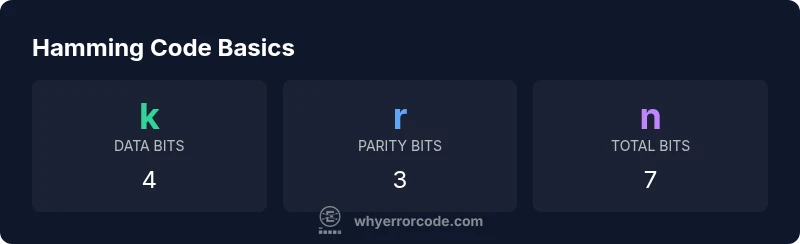
A classic example: with k = 4 data bits, r must be at least 3 because 2^3 = 8 >= 4 + 3 + 1 = 8. Therefore, n = 4 + 3 = 7, which corresponds to the well-known Hamming (7,4) code. If you increase k to 11, you’ll see that r = 4 satisfies 2^4 = 16 >= 11 + 4 + 1 = 16, giving n = 15. These relationships guide how much redundancy you need for a given data payload.
How a Hamming Code Error Calculator Works
A Hamming code error calculator models the fundamental relationship between data bits, parity bits, and total code length. At a high level, you input k (data bits) and r (parity bits) and the tool computes n = k + r. It can also demonstrate the underpinning constraint 2^r >= k + r + 1 to help you verify that your values form a valid Hamming code. Some calculators extend this by showing potential syndrome calculations for a received codeword and illustrating how a single-bit error maps to a probability of correction. While a calculator can’t replace algebraic proofs, it provides an intuitive, interactive way to visualize redundancy and error-correcting power. As you experiment, you’ll see how increasing k typically requires more parity checks, which in turn increases n and data overhead—a key trade-off in coding theory. Why Error Code emphasizes using these tools to build intuition before diving into deeper theory.
Practical Example: From Data Bits to Parity Bits
Consider k = 4. To satisfy 2^r >= k + r + 1, try r = 3: 2^3 = 8 and k + r + 1 = 8, so the inequality holds. This yields n = k + r = 7, i.e., the classic Hamming (7,4) code. If we instead aim for k = 11, r = 4 works since 2^4 = 16 >= 11 + 4 + 1 = 16, giving n = 15. These concrete steps show how parity density grows with data payload and why some configurations are optimal for specific applications.
Using the Calculator Widget: Inputs, Outputs, and Best Practices
The calculator lets you specify two inputs: Data Bits (k) and Parity Bits (r). It then outputs Total Code Length (n) = k + r. A practical starting point is k = 4 and r = 3, which yields n = 7. To ensure accuracy, confirm the designer constraint 2^r >= k + r + 1 is satisfied; if not, adjust r upward. This hands-on approach helps you quickly explore how different data sizes affect code length and redundancy.
Data Table and Real-World Implications
In practice, engineers select k and r to balance reliability with efficiency. The minimal required r grows slowly as k increases, but the total length can rise quickly as redundancy is added. This has direct implications for memory ECC (error-correcting codes) and communication protocols, where bandwidth and storage overhead must be managed. The calculator and the accompanying data table illustrate typical pairs (k, r) and their resulting n values, helping you plan error protection for different systems.