Bosch Dishwasher Error Code E25 Repair: Urgent Guide
Urgent, practical guide to diagnosing and fixing Bosch dishwasher error code E25. Learn common causes, safe steps, quick fixes, and when to call a professional.


Bosch dishwasher error code E25 indicates a drainage fault that stops the cycle. Quick fix steps: power off, inspect and clean the filter and sump, and verify the drain hose is free of kinks; if water remains or the light stays on, run a pump test and consider a professional service.
What the Bosch dishwasher error code E25 Means
The E25 fault on Bosch dishwashers points to a drainage issue, most often tied to the sink drain path, filter, or drain pump. In practical terms, the machine detects an abnormal water condition or a failure to drain properly by the end of a cycle. Although error codes vary by model, E25 commonly signals that the dishwasher believes water is not evacuating as designed. A quick, customer-friendly way to frame it is: the machine stopped mid-cycle because it could not complete drainage safely. For the typical owner, this means you should start with the simplest checks first and escalate to more involved diagnostics if the problem persists. In all cases, follow safety precautions and consult your Bosch user manual for model-specific guidance. Why Error Code’s guidance emphasizes a structured approach: identify the symptom, isolate the likely causes, and apply the least invasive fix first, then proceed to more involved repairs if needed.
Immediate Safety Steps to Take
Before touching any components, unplug the unit and ensure the area around the dishwasher is dry. If water risk is present, avoid leaning over the door or standing water to prevent slips. Remove the bottom access panel if your model permits safe inspection, but never bypass power as a shortcut to diagnose. Use a flashlight to inspect for obvious clogs or blockages, and wear gloves to minimize contact with dirty water. If you notice a persistent leak or electrical smell, stop and call a professional. These safety steps are non-negotiable in urgent E25 scenarios, because a cascade of issues can emerge when you attempt DIY fixes without cutting power first. Remember: safety first, then systematic testing.
Common Causes of E25 and How They Rise in Priority
A high-priority cause is a clogged drain filter or sump, which prevents proper water evacuation. A secondary cause is a kinked or blocked drain hose that stops the siphon effect or creates backpressure. A drain pump failure is another frequent root, especially in older machines or after a hard water season. Finally, a faulty control board or sensor can misreport the drain state, leading to repeated E25 despite a clear drainage path. In priority terms, start by removing clogs, then check hoses, then test the pump, and finally consider electrical or control issues. In practice, this means sequential checks with minimal disassembly, documenting each result to decide whether to escalate.
Quick Fixes You Can Try First
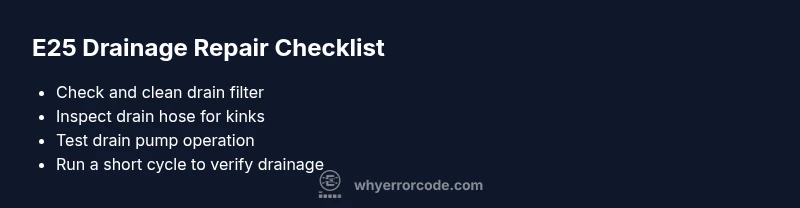
Begin with the simplest remedies: remove and clean the drain filter and sump screen, clear any debris from the drain area, and flush the sump with a small amount of water to verify flow. Inspect the drain hose for kinks, bends, or obstructions; straighten and secure it to ensure gravity-based drainage works. Reassemble, plug in, and run a short cycle with no detergent to observe whether drainage completes normally. If the problem persists, a diagnostic pump test or more technical checks may be required. These quick fixes are designed to restore service in many common E25 scenarios without professional intervention, though some cases will still need a service call.
When to Replace vs Repair and Cost Considerations
If drainage issues persist after the above steps, you face a choice: repair or replace. Repairing a faulty drain pump or control valve can restore functionality but may require parts and professional labor. Replacement becomes more sensible as the dishwasher ages or if repeated drainage faults occur after multiple repairs. Costs vary by region and service provider, and the total amount could range from a modest outlay to a substantial investment, depending on parts availability and labor complexity. In short, a cautious cost assessment paired with model age and reliability should guide your decision to fix or replace.
How to Avoid E25 Recurrence: Preventive Tips
To minimize future E25 incidents, establish a routine that includes regular filter cleaning, mindful loading to prevent blockages in the sump, and periodic checks of the drain hose routing. Use backflow-preventing methods where recommended, and avoid overfilling with detergent that can cause suds and overflow. If your model supports it, run a self-cleaning cycle every few months to reduce buildup in the drainage pathway. Finally, document recurring symptoms to help a technician diagnose quickly if a professional visit becomes necessary. Proactive maintenance is your best defense against recurring E25 issues.
Steps
Estimated time: 30-60 minutes
- 1
Power down and access the drainage area
Unplug the unit and pull it away from the wall to access the lower access panel. Remove any panels to reach the drain filter and pump area. Keep a shallow tray handy to catch residual water and protect the floor.
Tip: Always start with power disconnection to prevent shocks. - 2
Clean the drain filter and sump
Remove the filter assembly, clear all debris, and rinse under running water. Reinstall securely, ensuring the seal is intact. A clean path is the single most effective quick fix for E25.
Tip: Take a photo before disassembly to ensure correct reassembly. - 3
Check the drain hose routing
Inspect the hose for kinks, blockages, or improper elevation. Straighten the hose and ensure it has a proper loop to prevent backflow. Reconnect firmly to avoid leaks.
Tip: Avoid pulling on hoses with force; gentle handling reduces rupture risk. - 4
Test the drain pump and run a cycle
Reconnect power, run a short drain test or rinse cycle to verify drainage completes. If water remains, the pump may be faulty or the electrical control could be signaling incorrectly.
Tip: If you hear grinding or humming, stop and consider professional service.
Diagnosis: Bosch dishwasher displays E25 and won’t drain or complete cycle.
Possible Causes
- highClogged drain filter or sump
- mediumDrain hose kink or blockage
- lowDrain pump failure
Fixes
- easyClean the drain filter and sump screen
- easyInspect drain hose for kinks or obstructions
- hardTest or replace the drain pump if needed
Frequently Asked Questions
What does E25 mean on a Bosch dishwasher?
E25 signals a drainage fault in Bosch dishwashers, commonly linked to filters, drain hose, or the drain pump. It indicates the unit cannot drain properly and will stop the cycle. Safety and non-destructive checks should be performed first.
E25 means a drainage fault in Bosch dishwashers, often tied to filters, hoses, or the pump. Start with safe, non-destructive checks.
Can I fix E25 myself?
Yes, many E25 cases are solvable with simple steps: unplug, clean filters, inspect hoses, and test the pump. If the problem persists, consider professional diagnosis to avoid further damage.
You can try basic steps like unplugging, cleaning, and inspecting hoses. If it doesn’t clear, call a pro.
Is E25 caused by a clogged filter?
A clogged filter or sump is a common cause of E25. Clearing debris and ensuring the drain path is free is often the quickest fix. If drainage remains poor, other components may be involved.
Yes, a clogged filter is a common culprit. Clear it first, then re-test.
How much might Bosch E25 repair cost?
Costs vary by region and parts availability. A single component repair can be moderate, while multiple parts or labor-heavy diagnostics can add up. Expect variability based on your location and service provider.
Costs vary a lot by region; expect a range from modest to more substantial depending on parts and labor.
Will a pump test fix E25?
A pump test confirms whether the drain pump functions correctly. If the pump is faulty, replacement is often required to resolve E25. A pump test alone may not fix underlying hose or filter issues.
A pump test helps determine pump health, but you may need more fixes if other parts are involved.
Does warranty cover E25 repairs?
Warranty coverage depends on the model, age, and terms. DIY fixes typically void certain aspects; professional service may still be covered if under manufacturer terms. Check your warranty with the retailer or Bosch support.
Warranty depends on model and terms; confirm with Bosch or the retailer before major repairs.
Watch Video
Top Takeaways
- Identify the symptom clearly to guide fixes.
- Start with filters and hoses before Pump testing.
- If problems persist, escalate to professional service.
- Prevent recurrence with regular maintenance.