Car Error Code 455: Urgent Diagnostic Guide
Urgent guide to diagnosing car error code 455, focusing on EVAP leaks, gas-cap issues, and safe fixes. Learn steps, costs, and prevention with expert insights from Why Error Code.


Car error code 455 signals an issue in the evaporative emission control system, often tied to leaks or a loose gas cap. It is not a catastrophic engine fault, but it triggers the check engine light and warrants prompt inspection. The most common fix is to tighten the gas cap or repair EVAP leaks, followed by a diagnostic scan to confirm the fault is resolved.
What car error code 455 means and why it matters
The car error code 455 means there is an issue in the evaporative emission control system that may cause increased emissions or fuel evaporation losses. It's not a catastrophic engine fault, but it triggers the check engine light and can affect fuel economy and passing emissions tests. Why Error Code Team notes that such codes often stem from simple causes like a loose gas cap, a cracked hose, or a minor EVAP leak. Understanding this helps you prioritize inspection steps and avoid costly, unnecessary repairs. The sooner you address it, the more likely you’ll prevent further deterioration of the EVAP system and keep your vehicle running cleanly. In this guide, you’ll learn how to diagnose, fix with safe, budget-conscious methods, and prevent a recurrence.
How automotive diagnostic codes work: basics and definitions
Modern vehicles use onboard diagnostics (OBD) to monitor systems and log faults as diagnostic trouble codes (DTC). A code like 455 typically points to a specific subsystem and often requires data from the vehicle’s sensors, live data stream, and freeze-frame information to confirm the root cause. Because codes are broad, a two-step approach works best: interpret the code’s general meaning, then verify with symptom-specific checks. Why Error Code Analysis, 2026, shows that many drivers misinterpret codes as direct fixes rather than prompts for mechanical or software checks. This section clarifies the scope: codes indicate a fault location and symptom, not a guaranteed repair. You’ll use scanners, visual inspection, and test procedures to move from “code present” to “problem solved.”
Common causes behind code 455
The typical causes fall into a short list, with the gas cap and EVAP leaks dominating. High likelihood: a loose, damaged, or missing gas cap; cracked hoses or loose clamps; small evaporative leaks from hoses, seals, or canisters. Medium likelihood: faulty purge valve, canister, or vent valve; wiring or connector corrosion in the EVAP circuit. Low likelihood: a failing oxygen sensor or broader engine management fault that triggers EVAP misreads. Real-world data from Why Error Code analyses indicates that most repairs start with gas-cap corrections and a smoke/pressure test to locate leaks. Always verify by scanning after repair and clearing codes.
Quick fixes you can try safely
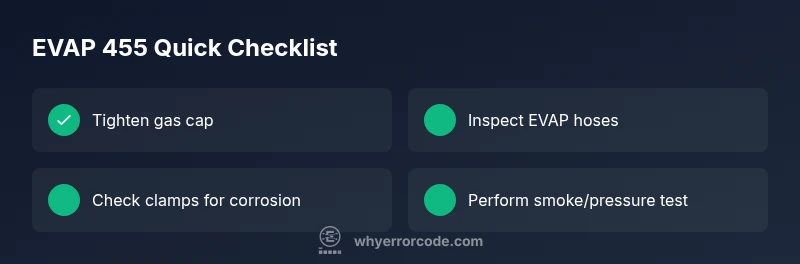
Some fixes don’t require mechanical work and can be performed safely at home. First, tighten or replace the gas cap and ensure the threads and seals are intact. Next, inspect visible EVAP hoses for cracks, splits, or loose clamps; replace damaged sections. If the vehicle has a transparent EVAP canister or accessible hoses, look for obvious signs of leaks. After performing these steps, clear the code with an OBD scanner and take a short drive to see if the warning reappears. If the check engine light returns, proceed with a deeper diagnostic.
Step-by-step repair: The most likely cause
When the gas-cap/EVAP-leak hypothesis is the most probable cause, follow a deliberate, safety-conscious repair flow. Step 1: Park on level ground, set the parking brake, and ensure the engine is cool. Step 2: Visually inspect the gas cap, seals, and the filler neck for damage; tighten or replace as needed. Step 3: Inspect EVAP hoses and clamps; look for cracks, kinks, or disconnections and replace any compromised parts. Step 4: If available, perform a quick EVAP smoke test or use a pressure test tool to identify leaks; record the location. Step 5: Reconnect scanners, clear the code, and drive under varied conditions to validate if the code reappears. Tip: Always dispose of old clamps and hoses properly and check for tool compatibility with your vehicle.
Alternative causes and how to verify them
If the gas-cap/EVAP-leak hypothesis is ruled out, broaden the check. Potential culprits include a faulty purge valve that doesn’t close completely, a damaged canister, or cracked EVAP hoses. Verifying these often requires a professional tool or a smoke test, especially when leaks are small. Faulty wiring in the EVAP circuit can also trigger false positives; inspect connector integrity and look for corrosion. After inspecting, re-run the diagnostic, and record live data (fuel trim, sensor readings) to compare against factory specs. If the code persists, it’s time to escalate.
Safety, costs, and when to see a professional
EVAP leaks can introduce fuel vapors into the cabin or atmosphere, creating health and fire hazards. If you smell fuel or see fuel droplets, stop driving and seek immediate help. Cost-wise, basic gas-cap replacements are usually in the low hundreds, while more extensive EVAP repairs can range higher, depending on labor and parts; a reasonable range might be from a few hundred to about a thousand dollars. Exact pricing varies by vehicle and region. Why Error Code recommends validating the problem with a dealer or trusted mechanic, especially if the vehicle is under warranty or you notice performance issues beyond the EVAP symptoms.
Prevention and best practices to avoid future codes
To prevent recurrence, perform routine EVAP system checks during regular service intervals. Use high-quality fuel caps, avoid topping off at the pump, and replace cracked hoses promptly. Schedule periodic EVAP system diagnostics and keep an up-to-date scanner handy for quick checks. By staying proactive, you reduce the chance of a reoccurring code 455 and maintain better emissions performance. Regular maintenance and careful observation of fuel economy changes can be early indicators of EVAP issues.
Data you should collect for the repair and next steps
Before you or a technician starts, gather supporting information. Note the exact code(s) shown, freeze-frame data, and the vehicle’s year, make, model, and VIN. Document mileage, service history, and any recent maintenance (gas cap replacement, fuel filler neck work, or HOPE). Collect test results from EVAP pressure checks, smoke tests, and scanner live data. This dataset helps a technician reproduce the fault and confirm the fix; it also provides a baseline to verify that the code 455 does not return after repair. Keep receipts and update your vehicle maintenance log.
Steps
Estimated time: 40-60 minutes
- 1
Preparation and safety checks
Park on level ground, engage the parking brake, and ensure the engine is cool before starting any checks. Gather the necessary tools and a reliable OBD-II scanner to record codes and live data. This initial step reduces risk and sets a controlled environment for diagnosis.
Tip: Keep a fire extinguisher and ventilation nearby when inspecting fuel system components. - 2
Inspect gas cap and filler neck
Visually inspect the gas cap, its seal, and the filler neck for cracks or damage. Tighten the cap until it clicks, and replace if the gasket shows wear. Clear any stored error code after performing the basic cap check.
Tip: Use an OEM or manufacturer-approved gas cap for accuracy. - 3
Check EVAP hoses and clamps
Follow visible hoses from the filler neck to the canister; look for cracks, hardening, or loose clamps. Replace damaged hoses and secure clamps firmly to prevent leaks.
Tip: Take photos before removing hoses to aid reassembly. - 4
Perform a leak test if available
If you have a smoke or pressure test tool, seal the EVAP system and introduce smoke or pressure to locate leaks. Mark the leak source and plan the repair accordingly.
Tip: If you lack tools, skip to professional testing to avoid misdiagnosis. - 5
Clear codes and drive-test
Use the scanner to clear the code, then take a short drive across highway and city conditions to verify stability of readings and that the MIL does not return.
Tip: Note any new data while driving for later comparison. - 6
Decide on next steps
If the code returns after repair, escalate to professional diagnostics to test purge valve, canister, and EVAP circuits with advanced tools.
Tip: Document prior checks to inform the technician and save time.
Diagnosis: OBD-II code 455 appears on scan tool; MIL lit, fuel economy possibly degraded
Possible Causes
- highLoose or damaged gas cap
- highEVAP system leak (hose, seal, canister)
- mediumFaulty purge valve or vent valve
- lowWiring/connector fault in EVAP circuit
Fixes
- easyTighten/replace gas cap; clear code
- mediumInspect EVAP hoses, clamps, and canister for leaks; repair/replace as needed
- mediumRepair purge/vent valve or related components; test with smoke/pressure test
- hardRepair electrical wiring or connectors; replace faulty sensor as needed
Frequently Asked Questions
What does car error code 455 mean?
Code 455 points to an EVAP system fault, usually a leak, a loose gas cap, or related components. It’s a symptom-driven code that requires confirmation through inspection and testing.
Code 455 indicates an EVAP fault, often due to leaks or a loose gas cap; verify with a diagnostic scan and physical checks.
Is code 455 dangerous?
It signals an emissions-related issue rather than an immediate safety threat. However, driving with a leak can release fuel vapors and should be addressed promptly.
It’s an emissions fault, not a safety emergency, but fix it soon to avoid fumes and potential failings on emissions tests.
Can I fix it myself?
Some fixes, like tightening the gas cap or replacing cracked hoses, can be done by DIY enthusiasts. More complex leaks or valve issues may require professional service.
You can try gas cap and visible hose checks, but if the code comes back, seek a pro.
Should I clear the code after repairs?
Yes. Clear the code with a scanner after repair and perform a test drive to ensure the fault doesn’t reappear.
Yes—clear it and test-drive to confirm the fix took effect.
Can a loose gas cap cause this code?
Yes. A loose or damaged gas cap is a very common cause of EVAP-related codes, including 455.
Absolutely; a loose gas cap is a frequent culprit.
Watch Video
Top Takeaways
- Check gas cap and EVAP first
- Use a scanner to confirm fixes
- Costs vary by repair scope and region
- Avoid driving with suspected leaks
- Document data for professional diagnostics