What Does Error Code P0455 Mean? Urgent EVAP Large Leak Guide
Discover what P0455 means, why it demands urgent attention, likely EVAP leak causes, and fast fixes. From gas caps to purge valves, get a practical, step-by-step plan from Why Error Code.


What does error code p0455 mean? It means the vehicle’s EVAP (evaporative emissions) system detected a large leak. This code points to a leak that can affect fuel economy and emissions performance. Common culprits include a loose or faulty gas cap, cracked hoses, or a defective purge valve. Treat it as urgent: get the system inspected promptly to prevent more damage.
What P0455 Means in Plain Language
If you’re asking what does error code p0455 mean, the answer is simple: your vehicle’s EVAP system has detected a large leak in the evaporative emissions plumbing. The EVAP system traps fuel vapors from the fuel tank and routes them to the engine to be burned cleanly. When the ECU sets P0455, it means the leak threshold was exceeded, often triggering the check engine light. This is not something to ignore: a persistent large leak can worsen fuel economy, raise emissions, and may lead to longer-term damage if the leak worsens. In many vehicles, you’ll notice a slight fuel odor and possibly reduced miles per gallon. Early diagnosis and repair can prevent more expensive fixes later.
According to Why Error Code, the P0455 code is a symptom, not a single part failure. Your approach should combine quick, safe checks with a plan for precise locating of the leak. Minor issues like a loose gas cap can be fixed in minutes and cost little, but more serious leaks demand professional diagnosis. The Why Error Code team emphasizes urgency because EVAP leaks can worsen with driving, potentially escalating to more costly repairs if ignored.
Why This Code Demands Urgent Attention
P0455 is classified as a large EVAP leak. Left unresolved, it can degrade fuel economy, increase emissions, and trigger regulatory inspection failures in some regions. In addition, a significant leak may indicate a failing EVAP component that could worsen with road debris, heat, or vibration. Treating P0455 promptly reduces risk and can limit repair costs overall. The early signs, such as a lingering fuel odor or a consistently rising fuel trim, should push you to diagnose the issue quickly. Why Error Code notes that many drivers save time and money by starting with a gas cap check, then moving to hose inspection and a professional smoke test if needed.
Symptoms and Early Checks
Typical symptoms of P0455 include the check engine light (MIL) illumination, a noticeable fuel odor, reduced fuel economy, and possibly poor engine performance or rough idle. Early checks are low-cost and quick:
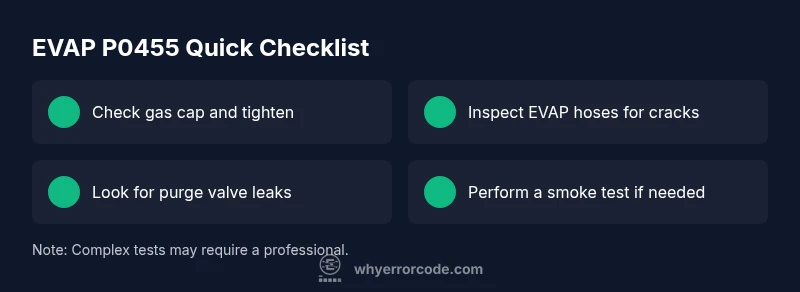
- Tighten or replace the gas cap and ensure it clicks fully.
- Visually inspect accessible EVAP hoses for cracks, splits, or disconnections.
- Look for signs of leaking fuel around the EVAP system and fuel filler neck.
- If the vehicle has vacuum lines, ensure they’re not damaged and nothing is obstructing the purge valve.
If you still see the code after these checks, you should proceed to a more thorough diagnostic like a smoke test to pinpoint leaks that aren’t visible. The goal is to locate the leak location without unnecessary part swaps.
Most Likely Causes, Ordered by Likelihood
P0455 is most often caused by a simple, fixable issue, followed by progressively less likely problems. The ranking below reflects typical scenarios observed in modern vehicles:
- Gas cap issue or improper resealing – high likelihood. A loose or damaged cap is the most common cause and is usually inexpensive to fix.
- Damaged EVAP hoses or loose connections – medium likelihood. Cracked hoses or poor connections can cause sizable leaks.
- Faulty purge valve or canister leak – medium likelihood. A defective purge valve can allow vacuum leaks that trigger P0455.
- Cracked EVAP canister or large line leak – low likelihood. Can occur, especially in older vehicles or after impact damage.
Understanding these possibilities helps you decide where to start and whether to seek professional help early. The EVAP system is sealed and complex; sometimes the leak is only detectable with a smoke test or specialized equipment. Professional technicians can perform this safely and quickly.
Quick Fixes You Can Try Safely (First Steps)
These initial steps address the most common and easy fixes before moving to more complex repairs:
- Verify the gas cap: remove, inspect the seal, reattach, and tighten until it clicks. If the cap is damaged, replace it.
- Inspect visible EVAP hoses and connections for cracks or disconnections. Replace damaged hoses and reseal joints.
- Check the filler neck area for cracks or residue that suggests a leak around the cap.
- Reset the onboard diagnostics after performing fixes and drive normally to see if the code returns.
If the code recurs after these steps, it’s time for more advanced diagnostics, as hidden leaks or component failures are likely.
In-Depth Repair Paths and When to Replace Components
For leaks that aren’t visible, a smoke test is the most reliable method to locate evanescent leaks in the EVAP system. If a hose is cracked, replace it. For a faulty purge valve or vent valve, replacement is often straightforward but can vary by model. Canister leaks are less common but serious; if the canister shows signs of damage or cracking, replacement is typically required. Cost ranges vary by vehicle, but you can expect parts to cost anywhere from a modest amount for a cap to several hundred dollars for hoses or valves, plus labor. In many cases, a targeted component replacement resolves P0455 without needing a full EVAP system overhaul. Always validate the fix with a fresh scan to confirm the code clears and the system holds a seal under test conditions.
Safety Warnings and When to Call a Pro
Working around fuel systems carries risk: fuel vapors are flammable and fumes can irritate eyes and lungs. Always work in a well-ventilated area, away from ignition sources, and disconnect the battery only if required by the service procedure. If you smell gasoline, hear hissing around the EVAP area, or see fuel pooling, stop and call a professional. For complex repairs such as canister replacement, purge valve replacement, or performing high-pressure smoke testing, professional service is strongly recommended. Some vehicles also require dealer-level tooling to reset codes correctly and verify the system holds a seal after repair.
How to Validate Repair and Prevent Recurrence
After performing repairs, run a full diagnostic to clear the code and perform road testing to verify the EVAP system is holding pressure. Monitor for future emissions-related codes and schedule regular EVAP system inspections during routine maintenance. Preventive steps include ensuring the fuel system remains clean and intact, replacing worn hoses before they fail, and avoiding aggressive driving that can disturb hose connections. Documentation of the repair should be kept for future servicing and potential warranty claims.
Steps
Estimated time: 60-120 minutes
- 1
Verify gas cap integrity
Remove the gas cap and inspect the gasket for cracks. Reinstall firmly until you hear multiple clicks. If the cap is damaged, replace it with an OEM-style cap to ensure a proper seal.
Tip: Carry a spare cap for quick roadside testing. - 2
Inspect EVAP hoses and connections
Check accessible hoses for signs of cracking, stiffness, or disconnections. Reconnect loose fittings and replace any damaged hoses. Ensure all clamps are tight and seating is proper.
Tip: Work with the engine off and cool to avoid burns. - 3
Conduct a smoke test (if available)
A smoke machine can reveal leaks not visible to the eye. Introduce smoke into the EVAP system and watch for smoke escaping from the leaks.
Tip: If you don’t own a smoke tester, have a professional perform this test. - 4
Replace faulty components
If the purge valve, canister, or hoses show damage, replace the faulty part. Use OEM or equivalent high-quality parts compatible with your vehicle.
Tip: Record part numbers and vin for accurate replacement. - 5
Reset codes and test drive
After repairs, clear the codes with an OBD-II scanner and take a moderate drive. If the MIL returns, a recheck is required.
Tip: Avoid hard acceleration on the first test drive. - 6
Verify system integrity
Re-scan the system to ensure P0455 does not reappear and monitor fuel trim behavior over multiple driving scenarios.
Tip: Document any reoccurring symptoms for future service.
Diagnosis: Check engine light with P0455; EVAP system large leak detected
Possible Causes
- highLoose or missing gas cap
- mediumDamaged EVAP hoses or connections
- mediumFaulty purge valve or canister leak
- lowCracked EVAP canister or severe line leak
Fixes
- easyTighten or replace gas cap
- easyInspect hoses for cracks; replace damaged lines
- mediumReplace purge valve or repair canister leak
- hardPerform smoke test to locate hard-to-see leaks; replace EVAP components as needed
Frequently Asked Questions
What does P0455 mean exactly?
P0455 signifies a large EVAP leak in the evaporative emissions system. It means the leak is larger than a threshold the PCM can tolerate, triggering the check engine light. Most fixes involve a gas cap check, hose inspection, or component replacement.
P0455 means a large EVAP leak detected in the emissions system. The fix usually starts with the gas cap and moves to hoses or valves.
Is P0455 dangerous to drive with?
Driving with P0455 is not typically unsafe for short trips, but it can worsen fuel economy and increase emissions. Prolonged driving may cause more serious damage to the EVAP system or fuel system components.
It's not usually dangerous to drive short distances, but it’s best to repair it soon to avoid emissions issues and costlier repairs.
Can I fix P0455 myself?
You can perform quick checks like the gas cap and visible hoses. More complex issues, such as canister or purge valve leaks, often require professional tools and expertise for safe, accurate repair.
Some fixes are doable at home, but for major EVAP components, a pro is recommended.
How much does a P0455 repair cost?
Repair costs vary by vehicle and part. Gas caps are inexpensive, while hoses and purge valves can run from a modest amount up to several hundred dollars for parts plus labor. A comprehensive repair may total several hundred dollars depending on the leak location.
Costs vary: small gas-cap fixes are cheap; canister or valve replacements can be several hundred dollars with labor.
How do I reset the code after repair?
Use an OBD-II scanner to clear codes and then drive normally to confirm the repair. If the light returns, re-diagnose for hidden leaks or re-check components.
Clear the codes with a scanner and take a test drive to confirm the fix.
Watch Video
Top Takeaways
- Investigate gas cap first—often the culprit
- Use a smoke test to locate hard-to-see leaks
- Purge valve and canister failures are common next suspects
- Always verify repair with a fresh scan