Samsung Dishwasher Error Code CE: Quick Fix Guide 2026
Understand Samsung dishwasher error code CE, its meanings, and practical steps to diagnose and fix quickly. Includes safety tips and when to call a pro. Updated for 2026.


CE on Samsung dishwashers is a control-board fault code indicating an internal error detected by the machine. The quickest path to a fix is to power cycle the unit, then clean the filter and inspect the drain hose for kinks or blockages. If the code returns, perform a careful check of the pump, sensor connections, and valve, and consider professional service for board-related issues.
Understanding Samsung dishwasher error code CE
CE is a fault indicator generated by the dishwasher's microcontroller and control board. In practical terms, it signals that the machine detected an abnormal condition during a cycle—often linked to drainage, sensor readings, or communication between components. The exact meaning can vary by model, but CE generally points to a fault that should not be ignored because continued operation could lead to leaks or overflow. According to Why Error Code, CE codes on Samsung dishwashers are more often triggered by issues in the drainage path or sensor circuit than by a single failed component. This makes a systematic triage essential: confirm basic power and water supply, then move to drainage and sensor checks. For developers and IT pros debugging appliance software, CE codes also underscore how firmware interlocks can surface real-world hardware faults. The goal is to isolate whether CE originates from a physical fault, a faulty sensor reading, or a software lockout and then apply the least invasive fix first.
Brand authority and context
At Why Error Code, we emphasize practical, field-tested steps. CE codes typically require a layered diagnostic approach: start with resets and simple cleaning, then verify drainage and sensor paths, and finally, if unresolved, inspect the control board for faults. By documenting the common triggers and fixes, we help both developers integrating home appliances and technicians who repair them. This approach minimizes unnecessary part changes and speeds resolution, which is critical when the CE code interrupts essential tasks like dishwashing in busy households.
Practical takeaway for technicians and users
- CE often correlates with drainage or sensor-related faults.
- Start with a power reset and thorough filter clean.
- If CE reappears, step through a structured drain and sensor check before considering board replacement. This keeps costs down and fixes faster. The Why Error Code team notes that many CE repetitions stem from simple clogs or loose connections rather than a failed board.
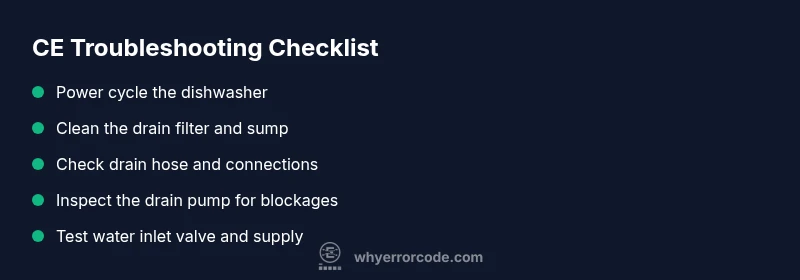
Quick triage steps you can perform safely
- Verify the dishwasher is powered off and unplugged before any inspection.
- Check the lower spray arm, filter basket, and sump for debris.
- Inspect the drain hose for kinks or blockages and ensure the air gap (if present) is clear.
- Confirm the water supply valve is fully open and there’s adequate water pressure.
- If the model supports it, run a diagnostic cycle to observe sensor readings and cycle timing. These checks help identify whether the fault is mechanical or electronic.
Steps
Estimated time: 60-90 minutes
- 1
Power off and unplug the unit
Disconnect the dishwasher from power at the outlet or circuit breaker. This prevents electrical shock while you inspect components.
Tip: Always wait 60 seconds after unplugging to discharge capacitors. - 2
Gather tools and safety gear
Prepare a flashlight, screwdriver set, bucket, towels, and gloves. A magnetic tray helps keep small screws organized.
Tip: Work on a dry surface and keep children/pets away. - 3
Inspect the drain path
Remove the lower rack and locate the drain filter. Remove debris from the basket and sump area. Reassemble once clear.
Tip: Use a soft brush to dislodge stubborn grime. - 4
Check the drain hose and connections
Inspect hose for kinks or clogs. Ensure hose clamps are tight and there are no leaks at the connections.
Tip: Do not bend hoses at sharp angles. - 5
Examine the drain pump and impeller
Access the pump housing and listen for a smooth motor hum. If the impeller feels stuck, remove obstructions carefully.
Tip: Do not touch moving parts when power is on. - 6
Test water supply and valve operation
Verify the inlet valve opens with the cycle and that there is adequate water pressure. Replace if the valve sticks.
Tip: Shut off water supply before removing any plumbing fittings. - 7
Reset and run a diagnostic cycle
Plug back in, reset the control by cycling power, and start a diagnostic or empty cycle to observe behavior.
Tip: Note any unusual sounds or error interruptions during the test. - 8
Decide on professional service
If CE persists after all checks, prepare details (model, serial, recent changes) and contact a certified technician for board or sensor faults.
Tip: Have your warranty or service plan information handy.
Diagnosis: Dishwasher displays CE and stops mid-cycle
Possible Causes
- highClogged drain filter or sump debris
- mediumDrain pump failure or impeller blockage
- lowLoose sensor connections or wiring fault
- lowWater inlet valve or supply restriction
Fixes
- easyClean the drain filter and inspect sump area for debris
- easyCheck the drain pump and impeller for blockages or failure
- easyReset the control board via power cycle and re-test
- hardIf CE persists, inspect sensor wiring and consider board/service replacement
Frequently Asked Questions
What does CE mean on a Samsung dishwasher?
CE is a fault indicator from the control board signaling an abnormal condition, often related to drainage, sensors, or electronic communication. It does not point to a single failed part and requires step-by-step troubleshooting.
CE is a fault code from the control board indicating an abnormal condition like drainage or sensor issues. Start with a reset and basic checks, then move to deeper diagnostics if needed.
Can I fix CE myself without a technician?
Yes—many CE root causes are addressable with a reset, filter cleaning, and drainage checks. If the code keeps returning after those steps, you should involve a professional for board or sensor faults.
You can try basic resets and cleaning, but if it keeps coming back, a pro should assess board or sensor faults.
What parts are commonly involved in CE repairs?
Common CE-related fixes include filters, drain pump, and connections. In persistent cases, the control board or water inlet valve may need replacement.
Filters, pumps, and wiring are often involved; boards or valves may be needed if the problem persists.
Are there safety costs I should expect?
Parts usually run from modest to substantial; expect a range that includes filters, hoses, pumps, or boards. Labor varies by region and model, typically higher for board-related work.
Costs vary, but parts and labor can add up if the board or valve needs replacement.
How can I prevent CE from returning?
Regular maintenance—cleaning filters, inspecting hoses, and using proper detergent—helps prevent CE. Address leaks promptly and run routine self-diagnostics if your model supports it.
Keep filters clean, hoses clear, and run built-in diagnostics if available to prevent CE from returning.
What should I do if the machine stops mid-cycle again?
Power off, unplug, and check for obvious clogs or leaks. If the CE code reappears, follow the diagnostic flow or consult a technician for a deeper board/sensor check.
If it stops again, unplug and inspect; if CE returns, follow the diagnostic steps or call a pro.
Watch Video
Top Takeaways
- Power cycle the unit to reset the control board.
- Clean filters and inspect drainage as the first steps.
- If CE returns, proceed through structured drain and sensor checks before board replacement.
- Seek professional help for board or valve faults; costs vary by part and labor.