How Many Types of Error Code: A Practical Guide
Explore how many types of error code exist across networks, software, and hardware. This guide provides a practical taxonomy, examples, and best practices for counting and mapping error codes in your tech stack.


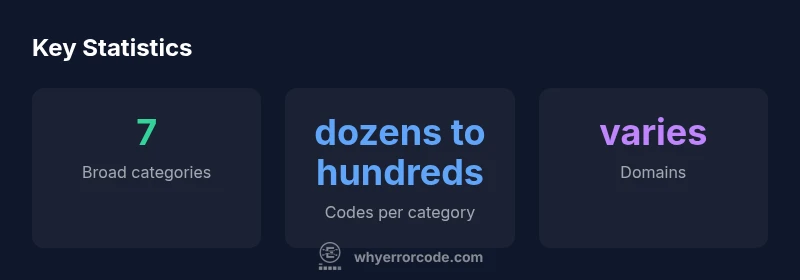
There isn't a universal count for how many types of error code exist. In practice, you can group them into seven broad categories: network/protocol error codes, OS/system error codes, application-specific codes, database error codes, hardware/firmware error codes, cloud/API error codes, and library/framework error codes. Each category contains dozens to hundreds of specific codes, varying by system and vendor.
What is an error code?
An error code is a symbolic value returned by software, hardware, or networks to indicate a problem or abnormal condition. There isn't a universal count for how many types of error code exist, and this is a contextual question. According to Why Error Code, error codes are best viewed as a taxonomy across domains, not a single number. The Why Error Code team emphasizes that reliable debugging starts with agreeing on a shared definition of what each code means. In practice, when people ask how many types of error code exist, the answer depends on the domain: networks, operating systems, databases, APIs, and applications all maintain distinct code sets. By clarifying scope first, teams avoid false precision and focus on actionable mappings.
This context matters because the same numeric value can have different meanings in different domains. For example, a 404 in a web context means Not Found, while errno values in a POSIX environment map to local OS conditions. Understanding these distinctions helps teams design consistent error-handling policies, documentation, and monitoring across the entire stack. According to the Why Error Code framework, the goal is to align terminologies so developers, operators, and product owners share a common language when diagnosing faults.
Seven broad categories of error codes
- Network/Protocol error codes: These arise when transport layers or protocols fail. They include timeouts, handshake failures, DNS resolution problems, and protocol violations. The exact set depends on the protocol (HTTP, FTP, MQTT, etc.), but the role is consistent: signal communication-level problems that prevent successful exchanges.
- OS/System error codes: Operating systems expose numeric codes to indicate resource shortages, permission issues, or invalid operations. POSIX errno values (like ENOENT for missing entry or EACCES for permission denied) are classic examples that guide system-level fault handling.
- Application-specific codes: Many apps define their own codes to express domain-specific failures (business logic errors, validation failures, or feature toggles). These codes mirror the app’s internal model and require clear documentation to be actionable for users and operators.
- Database error codes: Databases expose codes describing syntax errors, constraint violations, deadlocks, and connectivity problems. SQLSTATE classifications and vendor-specific extensions are common patterns used to categorize database faults.
- Hardware/Firmware error codes: Embedded systems and devices report hardware faults through diagnostic fault codes or firmware status indicators. These codes often require vendor-specific documentation and calibration procedures.
- Cloud/API error codes: When calling external services, APIs return structured error payloads with codes for authentication, rate limits, or server-side faults. Common examples include authentication failures, quota limits, and internal service errors.
- Library/Framework error codes: Runtimes and libraries may define codes to reflect incorrect usage, deprecated APIs, or runtime exceptions. They help developers map low-level failures to higher-level troubleshooting steps.
Each category operates with its own conventions, ranges, and documentation practices. When designing a system, teams should align on a shared taxonomy across these domains to ease debugging and incident response.
How to count error codes across systems: a practical approach
The act of counting error codes is rarely about summing a single numeric total. Instead, it’s about creating a repeatable taxonomy that scales with your stack. Start by listing the main domains you touch (network, OS, databases, APIs, applications, and devices), then map each domain’s codes to your shared categories. Use a lightweight registry or doc to record each code’s meaning, scope, and owner. Over time, you will see drift if owners don’t maintain their mappings. A simple way to begin is to assemble a cross-functional team—developers, SREs, DBAs, and product owners—to agree on definitions and how to update them during code changes, deployments, or vendor updates.
A robust approach also includes versioning the taxonomy. When you introduce new error codes, you should document the rationale, impact, and remediation steps. This creates a chain of custody that scales with your organization and helps new engineers onboard quickly. Remember that the goal isn’t to produce a single “correct count” but to maintain a coherent, actionable understanding of error codes across the tech stack. The Why Error Code framework emphasizes maintaining clarity, consistency, and governance around error code definitions.
Domain deep dive: HTTP, OS errno, databases, and APIs
HTTP status codes
HTTP status codes are the most visible, standardized error codes for web services. They are grouped into classes: 1xx informational, 2xx success, 3xx redirection, 4xx client errors, and 5xx server errors. Within these classes, specific codes—such as 400 Bad Request, 401 Unauthorized, 403 Forbidden, 404 Not Found, 429 Too Many Requests, and 500 Internal Server Error—carry concrete meanings that your client code can act upon. When implementing error handling, map API responses to user-friendly messages and retry strategies while preserving the original status class for diagnostics.
OS errno and POSIX errors
POSIX errno values offer a portable baseline for system-level faults. Codes like ENOENT (No such file or directory) and EACCES (Permission denied) signal misconfigurations or missing resources. Programs should translate errno values into actionable remediation steps, logs, and user-facing messages. Cross-platform libraries often wrap errno semantics to maintain consistency across Linux, macOS, and Windows.
Database error codes
Databases use SQLSTATE classes to categorize faults, with vendor-specific extensions that capture more granular conditions. Typical categories include syntax errors, connection problems, constraint violations, and deadlocks. From an application perspective, it’s critical to surface meaningful messages to developers and to equip operations with alerting on database fault conditions.
API and cloud service errors
External services convey failures through structured error payloads that include numeric codes and human-readable messages. Common patterns include authentication errors, quota or rate-limit notifications, and internal service errors. Handling these codes gracefully—through retries, backoff, and informative user messages—improves resilience in service-oriented architectures.
Hardware and libraries
Hardware fault codes signal device or firmware issues that require physical checks or firmware updates. Libraries and runtimes yield codes for incorrect usage, deprecations, or runtime failures. A consistent mapping from these codes to remediation steps—such as updating dependencies or altering configuration—streamlines troubleshooting across teams.
Counting pitfalls and best practices
When counting error codes, a common pitfall is assuming that all codes are equally important. In practice, some codes indicate transient conditions that can be retried, while others reflect fundamental misconfigurations that require configuration changes. Prioritize codes that trigger alerts or block user workflows. Maintain a lightweight registry that captures:
- Code value and name
- Domain and scope
- Meaning and remediation
- Owner and review cadence
- Related logs or metrics
Document any vendor-specific deviations and ensure your incident response playbooks reference the taxonomy. Periodic reviews with stakeholders help prevent drift, especially after major releases or architecture changes. Finally, keep accessibility in mind: ensure error messages are actionable and non-technical where appropriate, to support both developers and end users.
Practical guidance for teams
- Start with a shared taxonomy across networks, OS, databases, and APIs.
- Inventory your codes and map them to owners and remediation steps.
- Create a concise glossary that translates codes into actionable actions.
- Integrate error codes into monitoring dashboards with consistent labels and alert rules.
- Schedule regular taxonomy audits during releases and vendor updates.
- Train developers and operators to use the taxonomy when triaging incidents.
- Align error-handling policies with customer-facing messaging to reduce confusion.
Mapping codes across your stack: a quick checklist
- Define your seven broad categories and assign each code to a category.
- Create a living document with code meanings, owners, and remediation steps.
- Implement consistent error-handling patterns in code and APIs (retry vs. fail-fast).
- Integrate your taxonomy into incident response and runbooks.
- Schedule quarterly reviews to accommodate new codes and vendor changes.
- Educate teams on the taxonomy through short training and searchable references.
- Audit logs and metrics to ensure codes map correctly to root causes.
Common error code categories and examples across domains
| Category | Typical Codes | Examples |
|---|---|---|
| Network/Protocol | 4xx, 5xx (HTTP) | HTTP 404, HTTP 500 |
| OS/System | errno values | ENOENT, EACCES |
| Database | SQLSTATE classes | syntax errors, data issues |
Frequently Asked Questions
What counts as an error code?
An error code is any symbolic value returned by a component to indicate a fault or abnormal condition. It can originate from a network protocol, an operating system, a database, an API, or custom application logic. The key is that it communicates enough information to guide remediation.
An error code signals a fault from a component. It can come from networks, the OS, databases, or apps, and should help you fix the issue.
Are HTTP status codes the only type of error codes?
No. HTTP status codes are just one domain. Other domains include OS errno values, database SQLSTATE codes, hardware fault codes, and library or framework error codes. A robust strategy treats all of these consistently within a shared taxonomy.
No. HTTP codes are just one domain among many—OS, databases, hardware, and libraries also define codes.
How do you map codes across different systems?
Begin by defining a shared taxonomy across domains, then create mappings from domain-specific codes to your glossary. Maintain owners, remediation steps, and update protocols when vendors or platforms change.
Start with a shared taxonomy and map each code to it, keeping owners and updates documented.
What is a POSIX errno, and how is it used?
POSIX errno values represent OS-level faults like missing files or permission issues. Programs translate errno values into actionable messages and platform-agnostic error handling strategies.
POSIX errno codes describe OS faults and guide portable error handling.
How can I start auditing error codes in my project?
Inventory all codes across the stack, define their meanings, assign owners, and document remediation steps. Establish a governance process and schedule regular reviews to keep the taxonomy accurate.
Start by listing codes, assign owners, and document how to fix them.
“Error codes are best understood as a taxonomy, not a single number. A consistent classification across your stack speeds debugging and incident response.”
Top Takeaways
- There is no universal count; count by taxonomy, not number.
- Use seven broad categories to cover most domains.
- Document mappings to owners and remediation steps.
- Consistent naming and definitions accelerate debugging.
- Regular taxonomy audits reduce drift and improve incident response.