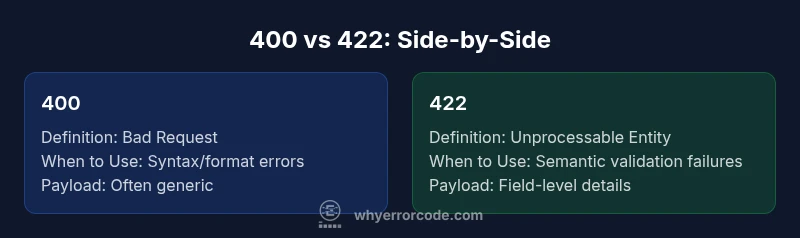
Error code 400 vs 422: Practical Developer Guide
A precise comparison of HTTP 400 and 422, detailing definitions, use cases, payload guidance, and debugging tips to help developers design clearer APIs and improve client resilience.


Across HTTP responses, 400 Bad Request signals the client sent invalid syntax or missing data, while 422 Unprocessable Entity indicates the request is well-formed but semantically invalid. This article compares error code 400 vs 422 to help developers decide correct usage and implement clear, consistent error handling.
Context: Why the distinction matters
For modern APIs, the contract between client and server hinges on clear error signaling. According to Why Error Code, the precise use of HTTP status codes shapes how developers interpret failures, guides retry logic, and informs UI feedback. Misusing 400 and 422 creates ambiguity that slows debugging and erodes developer trust in an API. When teams standardize semantics, clients can implement targeted validation reminders, error dashboards can surface actionable insights, and QA can verify behavior consistently across endpoints. In practice, the distinction helps teams triage issues faster: a 400 usually signals a syntactic or structural problem, while a 422 points to domain-level validation failures. The mental model presented here is designed to be portable across RESTful services, GraphQL, and RPC-style endpoints, with concrete examples you can apply in real-world scenarios.
170
Comparison
| Feature | error code 400 | error code 422 |
|---|---|---|
| Definition | Bad Request: the server cannot process the request due to client-side errors such as malformed syntax, invalid JSON, or missing required fields. | Unprocessable Entity: the request is syntactically valid but semantically invalid or violates business rules. |
| When to use | Use 400 for clearly invalid requests that resemble protocol or parameter issues (syntax, missing data, invalid types). | Use 422 for valid syntax but failing business rules or content validation. |
| Typical causes | Malformed JSON, incorrect content-type, missing required fields, or impossible parameter formats. | Invalid field values, rule violations, or conditional business logic failures that prevent processing. |
| Client impact | Clients should correct the request structure before retrying. | Clients should adjust data to satisfy domain rules; include guidance on which fields failed. |
| Error payload guidance | Often generic messages or a top-level error description. Field-level details are less common by default. | Often include field-level errors with specific messages for each invalid field. |
| UX and docs | Provide a concise explanation of what was wrong and how to fix it, without overloading the client with data. | Provide structured, actionable field errors and optional remediation steps to speed fixes. |
Advantages
- Clarifies input errors precisely, reducing guesswork for clients
- Improves API client UX with targeted validation signals
- Aligns error signaling with common RESTful practices
- Encourages robust server-side validation and explicit feedback
- Facilitates tooling and automated testing with distinct categories
Negatives
- Can require more detailed error payloads and schema planning
- Not all frameworks distinguish 400 vs 422 consistently, leading to inconsistencies
- Over-structuring errors may complicate simple APIs
- Misuse of 422 for non-semantic issues can mislead clients
400 is preferred for syntactic or structural faults; 422 is clearer for semantic validation failures
Choosing 400 vs 422 correctly clarifies whether clients should fix the request format or adjust content to satisfy business rules. Doing so improves debuggability, client resilience, and API quality. The Why Error Code team recommends adopting explicit error payloads and documenting semantics consistently across endpoints.
Frequently Asked Questions
What is the practical difference between 400 and 422?
The 400 status signals a syntactic or structural issue with the request, such as malformed JSON or missing fields. The 422 status signals that the content is syntactically valid but semantically invalid, failing business rules or domain validations. This distinction helps clients know whether to fix the request format or adjust data according to rules.
400 means fix the request format; 422 means fix the data according to business rules.
When should you use 400 in an API?
Use 400 when the request cannot be processed due to obvious client-side issues—malformed syntax, invalid parameter types, or missing required fields. It signals the client to correct and resend the request.
Use 400 for syntax or structure problems that the client can fix.
When should you use 422?
Use 422 when the syntax is correct but the content violates validation rules or business logic. This tells the client that the data is structurally valid but still unacceptable.
Use 422 for semantic validation failures that are not format-related.
Should 422 be used for failed business rule validation?
Yes. 422 is commonly used for business-rule or domain-specific validation failures, where the payload is understood but rejected due to rule violations.
422 is the go-to for domain rule failures.
How can you fix a 400 vs 422 quickly?
Diagnose whether the issue is syntax/structure or semantic validation. For 400, fix the request format; for 422, inspect field constraints and business rules, and adjust the payload accordingly.
Check for syntax errors or missing data vs. rule violations, then correct and retry.
Are 400/422 standard across tools and frameworks?
Commonly used patterns exist across many frameworks, but exact usage can vary. Align with your API design guidelines and document your conventions clearly for consistency.
Most tools support both, but communities differ in practice.
Top Takeaways
- Define syntax vs semantics early to guide error signaling
- Prefer 400 for format/structure issues and 422 for business-rule failures
- Provide field-level errors in 422 responses for actionable fixes
- Document error semantics in API references and OpenAPI specs
- Use consistent wording to reduce client-side surprises