How many status code: A practical guide to HTTP status classifications
Explore how many status code types exist, what each class means, and best practices for handling HTTP status codes in web apps and APIs. This guide clarifies 1xx–5xx codes and helps you design robust client behavior.


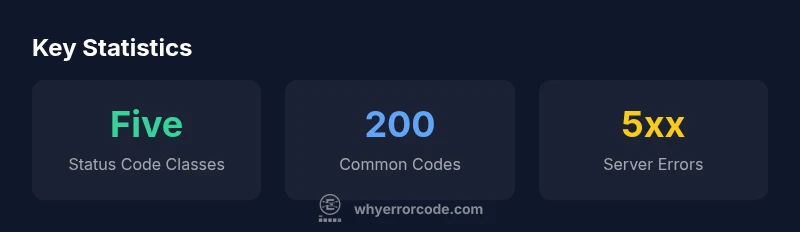
HTTP status codes fall into five classes, 1xx through 5xx, and there is no single fixed total of codes because new or extended codes exist. The common question how many status code often refers to how many distinct codes exist and how they are organized. The HTTP spec defines five classes: 1xx informational, 2xx success, 3xx redirection, 4xx client error, and 5xx server error. These codes guide both machines and humans in evaluating responses and deciding next steps.
What is a status code?
In HTTP, a status code is a three-digit number that communicates the result of a client's request to the server. The core question how many status code often refers to how many distinct codes exist and how they are organized. The HTTP spec defines five classes: 1xx informational, 2xx success, 3xx redirection, 4xx client error, and 5xx server error. These codes guide both machines and humans in evaluating responses and deciding next steps. By design, clients can implement consistent retry logic, error messaging, and user flow adjustments based on the exact code received. Understanding status codes helps architects balance clarity, performance, and user experience.
The five status code classes (1xx to 5xx)
The design of status codes is purposeful: each class groups similar outcomes so clients can implement uniform logic. 1xx signals that a request was received and processing continues; 2xx confirms success; 3xx asks clients to take alternative actions such as following a redirect; 4xx indicates a problem with the request; 5xx signals a server-side failure. The first digit is the class indicator, while the last two digits provide more detail. This simple taxonomy unlocks robust error handling, caching decisions, and user messaging. Implementations span from web browsers to API gateways, ensuring predictable behavior across layers.
How many status code codes exist officially?
Officially, there are five classes that cover the broad spectrum of outcomes. The exact number of distinct codes is not fixed because standards bodies publish new codes and extensions over time. In practice, developers focus on a compact set of widely supported codes across the 2xx, 3xx, 4xx, and 5xx ranges, plus a handful of 1xx informational responses. This approach keeps client logic predictable while allowing servers to evolve without breaking contracts.
Commonly used 2xx and 3xx codes
Within the 2xx class, 200 OK remains the baseline success indicator; 201 Created is common for RESTful POST operations; 204 No Content is used when a response has no payload. In the 3xx class, 301 Moved Permanently and 302 Found (or 303/307 alternatives) direct clients to new resources. 304 Not Modified supports client-side caching. Together these codes underpin durable web experiences, enabling efficient updates and navigational flows.
Common 4xx codes and their meanings
The 4xx client error family captures issues caused by the request. 400 Bad Request signals a malformed query; 401 Unauthorized requires authentication; 403 Forbidden denies access even for authenticated users; 404 Not Found indicates the resource is missing; 429 Too Many Requests signals rate limiting. Understanding these codes helps API clients present clear guidance to users and implement retry or backoff strategies without guessing the underlying problem.
Common 5xx codes and when they occur
5xx errors reflect problems on the server side. 500 Internal Server Error is a generic catch-all for unexpected failures; 502 Bad Gateway occurs when an upstream server fails; 503 Service Unavailable indicates a temporary overload or maintenance; 504 Gateway Timeout points to slow upstream responses. These codes trigger fallback plans such as retries with backoff, circuit breakers, or user-facing maintenance messaging. Differentiating between 5xx codes helps operators diagnose root causes and plan capacity.
Practical mapping: choosing between redirects and retries
When designing an API or web app, choose the proper status code to reflect the intended behavior. Use 301 or 308 for permanent replacements to update bookmarks and search results; 302/307 signal temporary shifts. For client-side retry logic, 429 or 503 with a Retry-After header communicates backoff timing. Consistent mapping between semantics and codes reduces confusion for clients, proxies, and monitoring tools.
Handling status codes in client apps
Client code should treat 2xx responses as success and branch into error handling for anything else. Extract the code, reason phrase, and any Retry-After hints to decide next steps. Use a stable error map that translates codes into user-friendly messages and actionable steps. Logging robustly and standardizing status parsing across modules improves observability and reduces debugging time.
Designing APIs with meaningful status codes
Aim for predictable, self-descriptive codes the client can act on without heavy documentation. Prefer standard codes whenever possible and extend with custom error payloads that carry application-specific details in the body. Document your API's error semantics clearly and keep change management in mind when adjusting codes. This discipline lowers friction for developers integrating your service and improves maintainability.
Debugging and diagnosing status code issues
When a request fails, start with the status code and response body to narrow down the cause. Check headers such as Retry-After or Cache-Control that provide timing hints. Use standardized tooling to trace requests across services and verify that proxies or gateways are not altering status codes. A disciplined approach reduces MTTR and prevents misinterpretation of the problem.
Security, privacy, and status codes
Be mindful that status codes themselves can leak operational details. Avoid exposing sensitive internal paths or system state in the error payloads. Consider rate-limiting codes as a potential vector for abuse and ensure error responses do not reveal stack traces in production. Proper logging, masking, and least-privilege access examine statuses within a security-aware workflow.
Quick wins and best practices
Adopt a small, well-documented set of core codes for your API. Use descriptive payloads with meaningful messages but avoid raw internal data. Test status-code behavior with automated tests covering success, redirect, client error, and server error paths. Monitor latency and code distribution to spot anomalies early. Regularly review and align your status code strategy with evolving standards and client expectations.
Common HTTP status code classes and representative examples
| Class | Examples | Typical Use |
|---|---|---|
| 1xx Informational | 100, 101, 102 | Initial exchange; request processing continues |
| 2xx Success | 200, 201, 204 | Operation completed; response contains content or not |
| 3xx Redirection | 301, 302, 304 | Resource moved or caching hints; follow-up request |
| 4xx Client Error | 400, 401, 403, 404 | Request issue; user action required |
| 5xx Server Error | 500, 502, 503, 504 | Server problem; retry or fallback needed |
Frequently Asked Questions
What is an HTTP status code?
An HTTP status code is a three-digit number returned by a server to indicate the result of a request. Codes signal success, redirection, client errors, or server errors, helping clients decide next steps.
HTTP status codes are three-digit signals that tell you whether a request succeeded, redirected, or failed, guiding the next action.
How many status code classes exist?
There are five classes: 1xx, 2xx, 3xx, 4xx, and 5xx. Each class groups related outcomes to simplify handling across clients and servers.
There are five classes of status codes, from informational to server errors.
What is the difference between 301 and 302?
301 indicates a permanent Redirect, while 302 indicates a temporary Redirect. Choose based on whether the move should be cached and preserved for future requests.
301 is permanent, 302 is temporary; use accordingly for redirect behavior.
When should I use 429?
429 Too Many Requests signals rate limiting. Use it to tell clients to back off and implement a Retry-After policy to help recovery.
Use 429 when users or clients are sending requests too quickly; include a retry hint.
What does 204 mean?
204 No Content indicates the request succeeded but there is no payload in the response body. It’s common for successful delete operations or actions that don’t return data.
204 means success with no content returned.
“HTTP status codes are the navigational beacons of web interactions, guiding clients and servers toward reliable behavior.”
Top Takeaways
- Know the five status code classes (1xx–5xx).
- Use standard codes over custom ones when possible.
- Map codes to actionable client behavior.
- Design robust error payloads with clear messages.
- Monitor status-code patterns to catch issues early.