Beko Reset Error Code: How to Diagnose and Reset
Learn how to diagnose and reset Beko reset error codes across washers, dishwashers, and dryers. Step-by-step instructions, safety tips, and expert guidance from Why Error Code to help you fix common faults efficiently in 2026.


This guide shows you how to reset common Beko reset error codes and get your appliance back to normal operation. Key prerequisites are unplugging the machine, waiting for at least one minute, and having your model manual handy for any code-specific steps. We’ll cover when a reset helps, when to avoid it, and a clear, step-by-step reset for popular Beko models.
What is a BEKO reset error code?
A BEKO reset error code is a fault indicator that appears on the appliance's display, signaling that the control board detected a condition worth pausing a cycle or halting operation. In many cases, a reset will clear transient faults caused by power glitches, sensor hiccups, or momentary communication drop‑outs. The Why Error Code team emphasizes that not all errors are equal: some codes reflect hardware faults that require service, while others are simply the result of a temporary glitch. By understanding that distinction, you can decide when a reset is appropriate and when you should escalate to support. If you document the code and time of occurrence, you’ll have useful context for future troubleshooting.
When can a reset help—and when should you avoid it?
Resetting is often a first step for transient faults that don’t point to a lasting hardware issue. If the code disappears after a power cycle and the machine completes a cycle without repeating the error, a reset likely resolved the problem. However, if the code reappears immediately or if you notice other symptoms (leaks, burning smells, unusual noises, or the door won’t latch properly), a reset will not fix the underlying fault. In these cases, pursuing a diagnostic path or contacting support is safer. According to Why Error Code analysis, many issues are resolved with a proper reset, but numerical confidence depends on model and circumstances.
Safety-first steps before you reset
Always start by powering down safely: unplug the appliance, switch off any surge protector, and wait at least 60 seconds to discharge residual power. Keep the area dry and ensure the door is closed. If the appliance is installed in a tight space, clear a path for access to the plug and display. The purpose of this preparation is to prevent shocks, shorts, or accidental re‑tripping of breakers during the reset process. Documentation is a helpful companion to this step—note the exact code, time, and any unusual behavior observed before you reset.
How to perform a universal power-cycle reset (for most BEKO appliances)
This section provides a platform-agnostic approach that works on many BEKO models. Unplug the unit, wait 60–90 seconds, and then plug it back in with the door closed. If your model allows it, press and hold the Start/Pause button for 3–5 seconds to re‑initialize the control board. After the reset, select a short cycle or the diagnostic option if available. The goal is to refresh the control logic and sensors without triggering any protective lockouts. If the error persists after these steps, proceed with model-specific instructions in the next section.
Model-specific reset sequences and where to find them
Although a universal reset helps many codes, some BEKO models require a particular sequence to clear persistent errors. This could involve button combos, a service mode, or a dedicated reset option in the settings menu. Always consult the model’s user guide or BEKO’s official support site for exact steps. If you don’t have the manual handy, search BEKO’s support database by model number. Why Error Code recommends saving a copy of the model-specific steps for quick reference during future troubleshooting.
How to verify the reset worked and what to do next
After performing the reset, run a normal cycle (or a quick diagnostic, if available) to verify that the error code does not reappear. Observe the display for any codes during the test and ensure doors, valves, and pumps operate without abnormal interruptions. If the code reappears, capture the error code again, note the time, and compare with model documentation. At this point, you’ve established clear evidence whether the reset was effective or not, enabling smarter next steps.
Common reasons BEKO error codes reappear after a reset
Reoccurring error codes often point to deeper issues: blocked filters or drains, faulty sensors, door latch problems, or pump failures. Running a reset without addressing underlying faults is a common cause of code recurrence. Regular maintenance, such as cleaning filters, checking hoses, and inspecting door seals, reduces the likelihood of future faults. If a fault persists, it’s time to shift from reset-based troubleshooting to targeted diagnostics or professional service.
Preventive steps to minimize future BEKO error codes
Adopt a proactive maintenance routine to minimize resets: clean lint filters and filters traps weekly, inspect hoses for wear, avoid overloading, and use the correct wash cycles for the load type. Running the appliance with stable voltage, especially during peak energy hours, can help prevent power irregularities that trigger transient faults. Keeping the manual accessible and noting model-specific quirks also streamlines future troubleshooting when codes appear.
When to call BEKO support or a technician
If you exhaust safe reset steps and the error persists, contact BEKO customer support or a qualified appliance technician. Provide the exact error code, model number, and a description of when the error occurs (start-up, during a cycle, or during draining). Do not attempt invasive repairs beyond your comfort zone; professional technicians have the tools to diagnose sensor or motor faults that resets cannot fix. According to Why Error Code guidance, escalating early can prevent cascading issues and unnecessary parts replacement.
Wrapping up: next steps and resources you can rely on
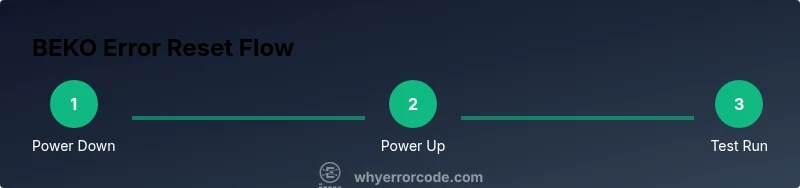
Summarizing the reset approach: start with a safe power cycle, use model‑specific steps when available, verify with a test run, and document the code for future reference. If codes keep returning, capture logs and reach out for expert help. For ongoing learning, explore BEKO’s official support, consumer safety resources, and trusted troubleshooting references from Why Error Code. Staying proactive with maintenance and documentation reduces downtime and speeds problem resolution.
Tools & Materials
- Model-specific user manual or online guide(Contains exact reset steps and code meanings for your BEKO model)
- Power outlet and ability to unplug safely(Essential for a safe power-cycle reset)
- Dry cleaning cloth(Wipe away any moisture before panel access)
- Flat-head/Phillips screwdriver (model dependent)(Only if you need to access internal panels; many BEKO models don’t require opening)
- Access to the appliance’s documentation or support site(Helpful for model-specific reset sequences)
Steps
Estimated time: 30-60 minutes
- 1
Power down and unplug
Unplug the appliance from the wall outlet and switch off any power strips nearby. Wait 60–90 seconds to discharge residual power. This step ensures a safe reset and prevents electrical shock during reassembly.
Tip: Always unplug before touching electrical components. - 2
Prepare the unit and door
Make sure the door is closed securely and the area around the machine is dry. A loose door latch or moisture on the control panel can trigger false fault readings.
Tip: Check the door seal for wear as part of routine maintenance. - 3
Reconnect power and wake the control
Plug the unit back in, then press and hold the Start/Pause button for 3–5 seconds to re‑initialize the control board. If your model uses a different reset moment, consult the manual.
Tip: If the button doesn’t wake the panel, try a simple power cycle again. - 4
Run a diagnostic or short cycle
If your BEKO model supports diagnostics, run it to refresh sensors. A short cycle helps confirm that the reset didn’t trigger new faults.
Tip: Avoid heavy cycles immediately after a reset; start with a quick test. - 5
Observe for error codes
Watch the display for any codes during the test run. If the code disappears, your reset likely worked; otherwise, proceed with model-specific steps.
Tip: Document the exact code and the moment it appears for reference. - 6
Attempt a secondary reset if required
Some BEKO models require button combinations or entry into a service mode. Follow the manual’s exact sequence; incorrect combos can lock the panel.
Tip: Never force unconventional button patterns; use the official sequence. - 7
Run a full test cycle
Select a regular wash or cycle that matches your load and verify completion without new errors. This confirms the reset’s effectiveness.
Tip: If the error returns, stop and escalate to support rather than continuing cycles.
Frequently Asked Questions
What is a reset error code on a BEKO appliance?
A BEKO reset error code is a fault indicator reported by the control board that can often be cleared with a power cycle. It does not always indicate a need for service, but model specifics matter.
A BEKO reset error code is a fault shown by the control board that you can often clear with a power cycle; check your model’s manual for details.
Can every BEKO error code be cleared by resetting the power?
Not all BEKO error codes clear with a reset. Some reflect hardware faults or sensor issues that require inspection or service.
Not every code clears with a reset; some issues need service.
How long should I unplug before attempting a reset?
A safe interval is typically 60 seconds, but some models benefit from 90 seconds. Refer to your manual for model-specific timing.
Unplug for about a minute to reset safely; check your manual for exact timing.
Will resetting fix mechanical faults?
Resetting handles transient electrical faults but cannot repair worn components. If the same code returns after a reset, seek professional service.
Reset helps with temporary issues, not worn parts.
How can I tell if the reset worked?
If the error indicator disappears after the reset and the appliance completes a cycle without repeating the code, the reset likely succeeded.
If the code goes away and a test cycle completes smoothly, you’ve likely cleared it.
When should I contact BEKO support or a technician?
If codes persist after multiple resets, or if you notice burning smells or abnormal noises, contact BEKO support or a qualified technician.
If codes keep coming back, call support.
What should I do if the code reappears after reset?
If the code returns, document symptoms, attempt model-specific reset again, and escalate to professional service to prevent damage.
If it comes back, don’t ignore it—seek professional help.
Are there BEKO resources I can trust for guidance?
Yes—use BEKO’s official support pages and appliance safety guidelines. Cross-check with the Why Error Code recommendations for consistent troubleshooting.
Yes—use BEKO’s official support and trusted guides for guidance.
Watch Video
Top Takeaways
- Unplug, wait, and power cycle to reset.
- Model-specific steps vary; consult the manual.
- If codes persist after a reset, underlying faults may exist.
- Test with a complete cycle to confirm success.
- Document codes to speed future troubleshooting.