Bosch Boiler Error Code C6: Comprehensive Troubleshooting Guide
Urgent guide to Bosch boiler error code C6—what it means, quick fixes, diagnostics, safety steps, and when to call a pro. Why Error Code walks you through reliable, practical solutions to restore heat fast.


Bosch boiler error code C6 signals a flame detection or ignition fault that prevents safe operation. The quickest path to a resolution is to verify gas supply, inspect ignition electrodes and flame sensor, and reset the boiler. If the fault persists after basic resets and checks, power-cycle the unit and contact a qualified technician to prevent potential safety hazards.
What Bosch boiler error code c6 means
According to Why Error Code, the urgency of boiler faults is clear: bosch boiler error code c6 is a combustion safety fault tied to ignition or flame detection. In practice, the boiler attempted to ignite, the flame sensor or detector did not verify a stable flame within the expected window, and the control system shut down fuel supply to prevent a hazardous situation. While different Bosch models may phrase the fault slightly differently, the underlying meaning is consistent: there is no reliable flame, so the boiler refuses to operate. Recognizing this early helps you triage safely and efficiently. This isn’t just a nuisance code—ignition faults can indicate blockages, sensor fouling, or gas supply issues that require careful attention. Keep in mind that working with gas and ignition components carries risk; when in doubt, pause and seek professional help.
Quick checks you can safely perform
Before calling a tech, you can perform a few non-invasive checks to rule out obvious causes. Start by ensuring the boiler's power switch is on and the reset button has been pressed correctly. Verify the gas supply valve is open and that there are no recent gas service interruptions in your area. Examine outdoor air vents for blockage and confirm exhaust flue is not obstructed. If your model includes a flame sensor or ignition electrode, inspect for obvious debris or buildup and clean gently with a soft brush. Do not attempt aggressive cleaning or disassembly unless you’ve consulted the manufacturer’s manual. If after these quick checks the C6 fault remains, it’s time to proceed with the diagnostic flow or call a pro.
Diagnostic flow: symptoms, likely causes, and fixes
Common symptoms of C6 include: a flashing indicator, intermittent ignition attempts, or a static fault message on the control panel. The most likely causes, in order of probability, are dirty ignition components, restricted gas supply, blocked venting, and a failing control board in the ignition circuit. The simplest fixes focus on the ignition area and gas supply first, then venting and the control board if needed. Realistically, many C6 faults resolve after cleaning ignition electrodes or replacing a sensor, but persistent failures often point to more complex issues that require professional calibration or replacement of electrical components.
Step-by-step repair guide for the most common cause
The most frequent cause of C6 is a fouled flame sensor or dirty ignition electrodes. A careful, methodical approach reduces risk and increases the chances of a quick fix. Begin with power from the unit and shut off gas supply if you need to inspect the burner area. Remove superficial dust with a soft brush, then wipe the sensor and electrodes with a dry, lint-free cloth. Reassemble, restore power, and perform a system reset. If ignition does not occur or the flame sensor still reads as dirty, plan a deeper inspection by a licensed technician. Remember, ignition systems involve electrical components and gas; improper handling can be dangerous and may affect warranty.
Other potential causes and how to address them
If the basic ignition clean and gas checks fail, consider alternate issues. A weak or inconsistent gas pressure can prevent a stable flame; request a gas company or HVAC pro to verify pressure and valve operation. Venting obstructions, including bird nests or debris in the flue, can disrupt exhaust flow and trigger safety locks. A faulty flame sensor or ignition control board may require sensor replacement or controller reprogramming. For every non-trivial repair, especially those involving gas or control circuitry, prioritize safety and professional service to avoid personal injury or property damage.
Safety, warnings, and when to call a professional
Gas appliances demand respect for safety. If you smell gas, hear hissing, or notice scorch marks, evacuate and call the gas emergency number. Do not attempt to light matches or operate electrical switches near the appliance. If you suspect a faulty gas valve, damaged wiring, or a malfunctioning ignition module, contact a licensed boiler technician. Cost estimates for typical fixes vary by complexity and region—for a clean and sensor-related repair you might expect a mid-range cost, while more involved ignition module or gas valve replacements could fall into higher ranges. Always get a written estimate before any service and confirm warranty implications with Bosch or your installer.
Prevention: how to reduce future C6 incidents
Regular maintenance helps prevent C6 faults. Schedule annual professional inspections for combustion safety and sensor calibration, and keep the burner area free of dust. Periodically cycle the boiler to ensure components operate smoothly and listen for unusual ignition noises. Keep venting clear of obstructions and monitor gas supply quality, especially after service work. A simple habit like recording fault codes and timestamps after each incident helps technicians diagnose more quickly if a problem recurs.
difficultyFormatVersionedCounts”:null},
diagnosticFlow: {"symptom":"Bosch boiler displays error code C6 and fails to ignite or maintain flame","causes":[{"cause":"Dirty ignition electrodes or flame sensor","likelihood":"high"},{"cause":"Restricted gas supply or valve fault","likelihood":"high"},{"cause":"Vent blockages or exhaust issues","likelihood":"medium"},{"cause":"Control board fault in ignition circuit","likelihood":"low"}],"fixes":[{"fix":"Clean ignition electrodes and flame sensor","difficulty":"easy"},{"fix":"Verify gas supply and valve operation","difficulty":"easy"},{"fix":"Check and clear venting/exhaust","difficulty":"medium"},{"fix":"Test or replace ignition module/board","difficulty":"hard"}]}
stepByStepExportPlaceholder":""
stepByStepVariant1 to 6
tipsListBlockPlaceholder":""},
stepByStepExportPlaceholder2: null},
tipsList
keyTakeaways
videoEmbed
faqSection
mainTopicQuery
Steps
Estimated time: 60-90 minutes
- 1
Power down and safety check
Turn off the boiler at the wall and shut off the gas supply if you are comfortable. Wait a few minutes to discharge any residual pressure, then return power. This resets the control logic and reduces the risk of electrical shock.
Tip: Always wear gloves and safety glasses when handling gas-powered equipment. - 2
Inspect ignition components
Access the burner area and locate the ignition electrode(s) and flame sensor. Use a soft brush or dry cloth to remove loose dust or soot. Do not use liquids or abrasive cleaners on electrical components.
Tip: Do not disassemble electrical modules beyond the manufacturer’s guidance. - 3
Test the flame sensor
With power restored, observe whether the flame sensor detects a flame within the trial ignition window. If not, sensor fouling or misalignment could be the issue and may require recalibration or replacement.
Tip: Only perform tests recommended by the manual to avoid sensor damage. - 4
Check gas supply and valve operation
Ensure the gas supply is uninterrupted and the shut-off valve is fully open. If you have a gas meter, verify there is steady flow and no kinked hoses or leaks.
Tip: If you smell gas or hear a hissing sound, evacuate and call the gas emergency line immediately. - 5
Run a controlled reset
After cleaning and checks, reset the boiler using the reset sequence defined by the manufacturer. Allow the unit to go through its startup cycle and monitor for ignition success.
Tip: If the fault reappears, stop and contact a technician rather than forcing a restart. - 6
Document and plan follow-up
Record the fault code, symptoms, and any actions taken. If the problem recurs, share this with a technician to speed up diagnostics and potential repairs.
Tip: Maintain a service log for future reference and warranty documentation.
Diagnosis: Bosch boiler displays error code C6 and fails to ignite or maintain flame
Possible Causes
- highDirty ignition electrodes or flame sensor
- highRestricted gas supply or valve fault
- mediumVent blockages or exhaust issues
- lowControl board fault in ignition circuit
Fixes
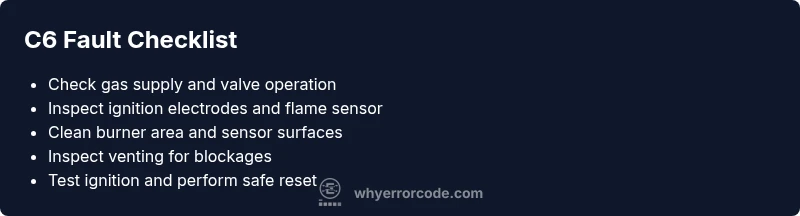
- easyClean ignition electrodes and flame sensor
- easyVerify gas supply and valve operation
- mediumCheck and clear venting/exhaust
- hardTest or replace ignition module/board
Frequently Asked Questions
What does Bosch boiler error code C6 mean?
C6 usually indicates a flame detection or ignition fault that prevents safe operation. The boiler won’t ignite until the issue is resolved and safety checks pass.
C6 means the boiler detected a flame issue and won’t light until it’s fixed—start with safe checks and ignition sensors.
Can I fix C6 myself, or do I need a professional?
You can perform simple checks such as ensuring gas supply and cleaning visible ignition components. If the fault persists or you smell gas, stop and call a licensed technician. Complex ignition board or gas valve issues require a pro.
For complex ignition or gas valve issues, call a licensed technician.
What are common causes of C6 fault?
Common causes include dirty ignition electrodes or flame sensor, restricted gas supply, venting blockages, or a faulty ignition controller. Prioritize cleaning and gas checks before replacement parts.
Usually ignition sensor or gas supply problems, followed by vent issues.
Is C6 dangerous?
Yes, C6 relates to combustion safety. If there’s a strong gas odor or hissing, evacuate and call emergency services. Do not override safety features.
Yes, it’s a safety fault—don’t ignore it and call a pro if unsure.
How much does it cost to fix C6?
Costs vary with fault severity and region. Expect a range from basic sensor cleaning to ignition module replacement; professional service calls may be higher, with parts and labor in typical ranges.
Costs vary; it could be as simple as sensor cleaning or more involved like module replacement.
How often should I service a Bosch boiler to prevent C6?
Annual or biennial professional service is recommended to maintain safe ignition and sensor calibration, reducing the risk of C6 faults.
Have it checked yearly or every two years to stay ahead of issues.
Watch Video
Top Takeaways
- Identify C6 as a safety ignition/flame issue
- Start with safe checks (gas, vents, ignition) before deeper repairs
- Prioritize ignition sensor cleaning and gas supply checks
- If safety interlocks remain, call a licensed technician
- Document fault timestamps and actions for faster service