Bosch Tankless Water Heater A3 Error Code: Quick Fix and Diagnostics
Urgent guide to diagnosing and fixing the Bosch tankless water heater A3 error code. Learn meanings, step-by-step fixes, safety tips, and when to call a pro.


A3 on Bosch tankless water heaters typically indicates a flame sensor or ignition fault. The quick fix is to perform a power reset, verify gas supply and venting are clear, and carefully clean the flame sensor if accessible. If the code reappears after reset, shut down power and contact a qualified technician to avoid safety risks.
Understanding the A3 Code: What It Signals in a Bosch Tankless Water Heater
The bosch tankless water heater a3 error code is not just a random fault number; it points to a combustion-related sensor or ignition issue. If you see this code, treat it as urgent; it can affect safety and the ability to heat water. In many homes the A3 fault traces to a dirty or misaligned flame sensor, a marginal gas supply, or a venting restriction that prevents proper combustion. Modern Bosch units rely on precise sensor feedback, so even small anomalies can trigger an A3 lockout. Begin with a cautious approach: power down the unit, consult the manual, and be prepared to perform a controlled reset if the model supports it. This article uses a pragmatic Why Error Code approach to help you assess symptoms, map likely causes, and perform safe, practical fixes while clearly signaling when professional involvement is required. The overall aim is to restore safe operation quickly and minimize the risk of gas or electrical hazards.
Diagnostic Signals and What They Mean
Sharp on-unit indicators (LEDs, fault codes, and status lights) help diagnose A3. Bosch systems often relay A3 alongside other indicators that point toward ignition timing, flame sensing, or sensor wiring issues. If the heat call fails, the unit may enter a fault loop and repeatedly show A3 until resolved. Understanding the precise sequence your model uses is essential; always consult the owner’s manual or Bosch’s official support pages for your exact serial family. In general, A3 is not a universal hardware failure – it is a safety-first alert that typically means a sensor or ignition path needs attention. For technicians, documenting when the fault first appeared and any concurrent noises or smells can accelerate a resolution. According to Why Error Code, focusing on sensor health and safe restart procedures yields the best initial outcomes.
Quick-Action Checklist (Safety First)
- Cut power to the unit and allow it to cool for several minutes.
- Inspect for visible gas smells or unusual noises before proceeding.
- Ensure access to the service panel follows the manufacturer’s safety instructions.
- If your model supports a soft reset, perform it as described in the manual.
Diagnostic Flow: Symptoms, Likely Causes, and Solutions
Symptoms: A3 code appears on display; unit stops heating water; occasional flame sounds but no sustained ignition. Most likely causes (ranked by probability):
- Flame sensor dirty or misaligned (high likelihood)
- Ignition timeout due to gas supply or venting issue (medium)
- Control board or wiring fault (low) Common fixes range from simple to complex: a quick reset, sensor cleaning, verifying vent/gas supply, up to component replacement by a pro.
Step-by-Step Fix: Reboot, Reset, and Sensor Access
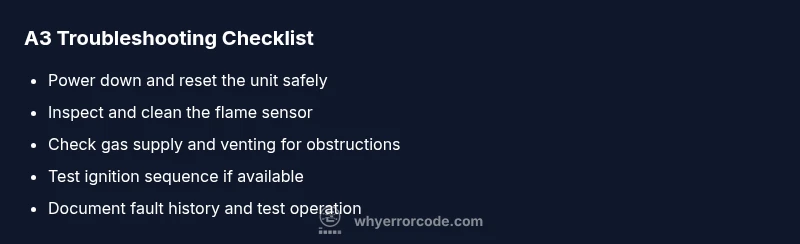
- Power down the unit and wait 5–10 minutes to discharge circuitry. 2) Restore power and reset the unit using the service menu if available. 3) If accessible, gently remove and inspect the flame sensor; clean with a soft, dry cloth and reseat connections. 4) Check the vent path for blockages and ensure proper intake air. 5) Verify gas supply is open and pressure is within spec. 6) Re-test operation and observe if A3 reoccurs. 7) If the fault persists, proceed to more advanced diagnostics or contact a technician. The goal is to eliminate sensor fouling and ensure clean ignition pathways.
Check Combustion and Venting: Gas Supply, Burner, and Vent
A3 failures frequently relate to combustion issues. Confirm the gas supply is steady, the correct fuel type is used, and there are no partial blockages in the line. Inspect the burner for grime, soot, or carbon buildup and clean if accessible by manufacturer-approved methods. Venting must be unobstructed with adequate clearance; trapped exhaust can trigger ignition faults. If venting is blocked or restricted, the unit may fault out to protect occupants. Always perform gas-related inspections with proper safety protocols and, if in doubt, call a licensed gas technician.
Electrical and Control Board Considerations
Electrical faults can mimic sensor failures. Inspect wiring harnesses at the control board for loose connections, corrosion, or damaged insulation. Any fault in the ignition control circuit or flame sensor circuit can produce an A3. If you observe burnt smells or scorched connectors, discontinue attempts to repair and seek professional service immediately. Replacing a control board or sensor module is typically a mid-to-hard task that requires specialized tools and knowledge; cost considerations often include parts and labor ranges.
Other Causes and Their Fixes
Beyond ignition and flame sensing, A3 can be triggered by small issues that accumulate over time: clogged condensate lines, failed safety switches, and software glitches. Start with cleaning and re-seating critical components, then perform a full power cycle. If the error continues, consider software updates or firmware checks if supported by your Bosch model. If your unit is out of warranty, weigh the cost of professional service against the benefits of a module replacement.
Safety, Warnings, and When to Call a Pro
Work on gas appliances carries real hazards, including fire and carbon monoxide risk. If you smell gas, hear hissing, or notice corrosion, shut down the system and evacuate. Never ignore unusual odors. Only perform basic resets and cleaning if you fully understand the manual and have disconnected power before handling any internal components. For anything beyond basic maintenance, or if A3 persists after the steps above, contact a qualified technician. Cost estimates for professional service vary by region and system complexity and may range from a basic diagnostic ($100–$300) to a full sensor or control board replacement ($300–$900) including parts and labor.
Steps
Estimated time: 60-90 minutes
- 1
Power down and reset
Turn off the unit, switch off the circuit breaker, and wait 5–10 minutes to discharge capacitors. Restore power and see if the A3 clears. If the code returns, proceed to the next steps.
Tip: Document the exact time you reset for service notes. - 2
Inspect flame sensor
With safe access to the burner area, inspect the flame sensor for visible buildup. Clean gently with a soft cloth or bristle brush, taking care not to bend the sensor. Re-seat any loose connectors.
Tip: Use manufacturer-approved cleaning methods to avoid sensor damage. - 3
Check venting and gas supply
Ensure vent pathways are clear and the exhaust is not blocked. Confirm gas supply valve is fully open and pressure is within spec according to the manual. Look for any abnormal noises or leaks.
Tip: Avoid running tests if you smell gas; evacuate and call emergency services. - 4
Reset the ignition sequence
If the unit has a service menu or accessible reset, perform the ignition sequence according to the Bosch manual. Observe whether the unit lights and stabilizes, then monitor for fault reoccurrence.
Tip: Only perform service menu steps if your model supports them. - 5
Test operation after fixes
Return water heating and observe whether temperatures stabilize and the A3 code does not reappear. If the code returns, limit use and proceed to professional diagnostics.
Tip: Keep a log of temperatures and cycle times for the technician. - 6
Escalate if unresolved
If A3 persists after basic steps, schedule a professional service to inspect wiring, sensors, and the control board. Do not attempt risky repairs beyond your training.
Tip: Provide the service tech with the fault history and notes from your steps.
Diagnosis: Error code A3 displayed; unit stops heating water
Possible Causes
- highFlame sensor dirty or misaligned
- mediumIgnition timeout due to gas supply or venting issue
- lowControl board fault or wiring issue
Fixes
- easyPower cycle and perform a soft reset
- easyClean flame sensor and reseat sensor connections
- mediumCheck gas supply, venting, and combustion air
- hardReplace control board or ignition module (professional)
Frequently Asked Questions
What does A3 mean on a Bosch tankless water heater?
A3 typically indicates a flame sensor or ignition fault. It signals that the unit detected an unsafe or improper ignition scenario. Addressing sensor cleanliness, venting, and safe resets is often the first step before calling a professional.
A3 means there’s likely a flame sensor or ignition fault. Start with a safe reset and sensor check, and contact a technician if it repeats.
Can I fix A3 myself?
Some basic steps, like a safe reset and cleaning the flame sensor, can be attempted if you’re comfortable and have the manual. More complex issues, especially gas or wiring problems, require a licensed technician to avoid safety risks and ensure code compliance.
You can try a safe reset and sensor cleaning if you’re comfortable, but gas and wiring problems should be handled by a pro.
How much does it cost to fix A3?
Costs vary by region and fault severity. A basic diagnostic and sensor cleaning may be in the range of $100–$300, while parts and labor for a sensor or control board replacement could total $200–$900.
Diagnostics and sensor cleaning can be around a few hundred dollars; more extensive repairs may run higher.
Should I replace the flame sensor?
Sensor replacement is typically a job for a professional, as it involves electrical connections and proper calibration. If cleaning doesn’t help, a tech can verify sensor integrity and replacement needs.
Sensor replacement is usually done by a pro after diagnostics show it’s necessary.
What else could cause A3 besides the sensor?
Other causes include ignition control faults, wiring problems, or venting restrictions. A thorough diagnostic helps differentiate between sensor issues and deeper control problems.
It could be ignition control or wiring, so a complete check is important.
Watch Video
Top Takeaways
- Diagnose A3 as ignition/sensor related before replacing parts
- Perform safe resets and sensor maintenance first
- Verify gas supply, venting, and combustion air
- Escalate to a pro if the fault persists after basic fixes
- Document fault history to aid professional service