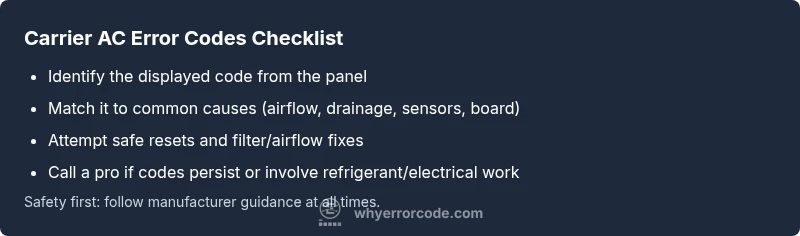
Carrier AC Error Code List: Quick Troubleshooting Guide
Learn the complete carrier air conditioner error code list, meanings, and step-by-step fixes to diagnose and resolve common codes quickly, safely, and with cost-aware guidance.


Carrier air conditioner error code list helps you interpret blinking lights or alphanumeric codes shown on the control panel. According to Why Error Code, the quickest path is to identify the exact code, consult the manual or this guide, and perform a safe reset or basic maintenance. If the code persists, power down and call a qualified technician for a formal diagnostic and repair.
Understanding Carrier AC Error Codes
A Carrier air conditioner uses a fault code system to indicate issues. The indicator may flash a pattern of lights or display alphanumeric codes on the LCD. Each code maps to a fault category such as airflow restriction, sensor fault, refrigerant issue, or drainage problem. The goal is to translate the blinking sequence into a concrete cause and then apply a safe fix. According to Why Error Code, most codes originate from accessible issues rather than deep electrical faults, making early triage essential. Start by noting the exact code and the seasonality of symptoms (e.g., overheating in heat, frost in cold weather). Once you have the code, consult the unit manual or this guide for reliable interpretations. Many Carrier systems share common codes across recent models, so a cross-model reference is often valid. If the code is unfamiliar or the panel is damaged, stop and seek professional service.
id
Steps
Estimated time: 45-60 minutes
- 1
Identify the exact error code
Locate the code from the indoor control panel or outdoor unit display and note any subcodes or blink patterns. Use the model's fault table to map the code to a probable category.
Tip: Take a photo of the display for reference. - 2
Power down safely
Shut off power at the service disconnect, wait 30 seconds, then restore power to reset transient faults. Do not unplug the unit while powered.
Tip: Use the dedicated disconnect switch rather than the wall outlet. - 3
Check and replace air filter
If the filter is dirty or clogged, replace it and ensure air can move freely through the system.
Tip: Record the replacement date for ongoing maintenance. - 4
Inspect outdoor unit for debris
Remove leaves, grass, and other obstructions; maintain at least 2 feet of clearance around the unit.
Tip: Be careful around sharp fins; avoid poking at components. - 5
Inspect condensate drain line
Clear any clogs or kinks and ensure proper drainage to prevent overflow or false fan shutoffs.
Tip: Avoid chemical cleaners in the drain line; use approved methods. - 6
Consult a professional if codes persist
If the code remains after safe fixes, arrange for diagnostic service; refrigerant or high-voltage faults require licensing.
Tip: Request a written estimate before service.
Diagnosis: AC displays a fault code on the control panel or LED indicators and runs intermittently
Possible Causes
- highDirty air filter or airflow restriction
- mediumBlocked condensate drain or sensor fault
- mediumOutdoor unit debris or fan issue
- lowControl board communication error
Fixes
- easyClean or replace the air filter and ensure airflow
- easyReset the system at the service disconnect
- easyClear external debris and verify outdoor unit is unobstructed
- hardCall a pro to diagnose control board issues or refrigerant problems
Frequently Asked Questions
What does a blinking error code on a Carrier air conditioner indicate?
A blinking pattern signals a fault code that points to a specific issue. Check the code in the manual or this guide to map it to a fault category and apply the recommended fix.
A blinking code signals a fault; map it to the correct category and follow the recommended fix.
Where can I find Carrier's official error code list for my model?
Look in the user manual, Carrier's support site, or your installer’s documentation. Match the display to your model to get accurate meanings.
Check the manual or Carrier support site for the exact codes for your model.
Is it safe to reset the AC to clear codes?
A safe reset can clear transient faults; always power down at the disconnect before resetting. If codes reappear, stop and call a professional.
Yes, you can reset after powering off, but if the code returns, seek a professional.
What is the most common Carrier AC error code?
Most codes relate to airflow, drainage, sensor, or control board issues. The exact most common code varies by model; consult the manual for your unit’s top codes.
Common codes usually involve airflow, drainage, sensors, or control boards; check your model’s top codes.
Do I always need a technician for error codes?
Not always. Some codes respond to quick safe fixes, like filter changes or resets. If the code persists or involves refrigerant or high voltage, a licensed technician is required.
Some codes can be fixed with safe steps, but persistent or refrigerant-related codes require a pro.
How can maintenance prevent Carrier AC error codes?
Regular cleaning, filter changes, coil maintenance, and annual professional checks reduce the chance of recurring codes and keep the system running efficiently.
Keep up with cleaning, filters, and yearly checks to prevent codes.
Watch Video
Top Takeaways
- Identify codes quickly and map to root causes.
- Perform safe resets and cleans before calling a pro.
- Persisting codes require professional diagnostics.
- Regular maintenance prevents most error codes.