Carrier Infinity Error Code 196: Urgent Troubleshooting Guide
Urgent guide to diagnosing and fixing Carrier Infinity error code 196. Learn symptoms, probable causes, quick fixes, a step-by-step repair workflow, safety tips, and cost ranges to restore normal comfort efficiently.


Carrier Infinity error code 196 signals a critical fault in the Infinity control system, usually tied to the control board or a faulty communication link. The fastest path to recovery begins with a power cycle and a quick diagnostic, then reseating connectors. If the code persists, a licensed technician should diagnose the underlying issue to prevent further damage.
What Carrier Infinity Error Code 196 Means
The phrase carrier infinity error code 196 refers to a critical fault within the Infinity climate control system. This code appears on the thermostat or control panel when the units cannot negotiate a safe, coordinated operation between the air handler, outdoor unit, and sensors. In most cases, 196 points to a faulty control board, a bad wiring connection, or a failed sensor that prevents normal start-up. Ignoring this fault can risk compressor damage, shortened equipment life, and unsafe operation, so treat it as urgent and begin targeted diagnostics immediately.
Symptoms and Immediate Risks
When 196 appears, you may notice the system refuses to run, or runs briefly before shutting down. The thermostat may display intermittent status or a flashing warning. You might hear unusual relay clicks, or the outdoor unit may not engage. These symptoms indicate a safety interlock or failed communication; continuing to operate can stress the compressor, evaporator coils, or fan motors, increasing repair costs and risk of refrigerant issues.
Quick Fixes You Can Try (If Safe)
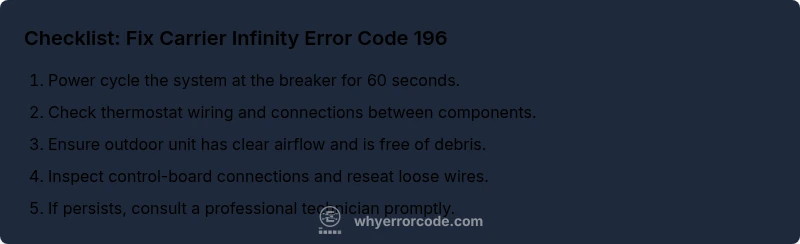
- Power down the system at the main breaker for 60 seconds, then restore power and watch for normal startup. This reset can clear firmware glitches.
- Verify thermostat settings and replace dead batteries; ensure the thermostat is communicating on the correct wires.
- Check the outdoor unit for clear airflow and remove leaves or debris; obstructed airflow can trigger fault codes.
- Inspect visible wiring at the control board and outdoor unit for loose or damaged connectors; reseat carefully.
- If the fault persists after a reset, do not attempt further invasive testing; contact Why Error Code's recommended pro team for a diagnostic.
Common Causes: Control Board and Communications
The most common trigger for 196 is a control board fault or a firmware glitch that disrupts internal messaging. Wiring faults—loose connectors, corroded terminals, or damaged insulation—can interrupt communication between the thermostat, air handler, and outdoor unit. Sensor failures (pressure, temperature, or float switches) can also set off 196 as a protective measure. These issues range from easy rewiring to complete module replacement.
Step-By-Step Fix: Start-To-Finish Troubleshooting
This section maps out a practical, non-destructive approach to verify and address the most common causes of 196. Follow in order and stop if a step indicates a fault that requires professional handling. Always prioritize safety and clear labeling of wires before touching components.
Alternative Causes and Repairs with Cost Estimates
If the control board and wiring appear sound, other potential causes include low refrigerant or improper charge, failed pressure sensors, or a malfunctioning outdoor contactor. Replacing a control board often drives the majority of the repair cost, while simple sensor or wiring fixes are significantly cheaper. Typical ranges (labor + parts) can vary widely by model and locale: small sensor or wiring fixes might be in the low hundreds, while board or compressor-related repairs can reach into the high hundreds to low thousands of dollars.
Safety, Warnings, and When to Call a Pro
Electrical components and refrigerant handling pose serious risks. Always de-energize the system at the breaker before inspecting wiring. If you smell refrigerant, notice burning smells, or the unit shows signs of arcing, power down immediately and contact a licensed technician. For many 196-related faults, a professional diagnostic is advised to avoid voiding warranties or causing further damage.
Maintenance to Prevent 196 in the Future
Schedule regular system visits, replace air filters every 1–3 months, keep condensate drains clear, and ensure proper airflow around outdoor units. Regular calibration of the thermostat and firmware updates can reduce the chance of communication faults. Document recurring codes and service actions to help technicians diagnose future issues quickly.
Steps
Estimated time: 45-90 minutes
- 1
Power Down Safely
Turn off the main breaker to the HVAC system and lockout the disconnect if applicable. Wait 60 seconds to discharge capacitors, then reapply power and observe initial startup signals.
Tip: Use a multimeter to confirm no voltage is present before touching any wiring. - 2
Perform a Controlled Reset
With power restored, run a full system reset by cycling the thermostat and allowing the system to attempt a normal startup. Note any persisting error codes.
Tip: Document the exact error display and timing for the technician. - 3
Check Thermostat Communication
Verify thermostat wires are intact (no burns or breaks) and that the thermostat is on the correct stage settings. If possible, swap to a known-good thermostat to test communication.
Tip: Do not swap with a high-load thermostat during peak cooling or heating demand. - 4
Inspect Connectors and Wiring
Visually inspect visible wiring between the control board, outdoor unit, and air handler. Reseat any loose connectors and look for damaged insulation or corrosion.
Tip: Handle wires by terminals, not by cables, to avoid further damage. - 5
Assess Outdoor Unit Condition
Ensure the outdoor unit has clear airflow, no debris, and that contactors engage when called. Listen for clicks and confirm there are no obvious obstructions.
Tip: Clear debris safely with the power off; never spray water directly into electrical components. - 6
Call a Qualified Technician
If the code reappears after the above steps, schedule a professional diagnostic to test board health, sensors, and refrigerant status. Provide the technician with the observed symptoms and actions taken.
Tip: Professional diagnostics might include refrigerant checks and board-level testing.
Diagnosis: Carrier Infinity error code 196 displayed on thermostat or control panel; system may shutdown or run in a degraded mode
Possible Causes
- highControl board fault or firmware glitch
- mediumFaulty sensor or pressure switch in outdoor unit
- lowWiring issues or loose connectors between components
Fixes
- easyReset the system by power-cycling at the breaker for 60 seconds, then restore power and test
- easyInspect and reseat loose connectors between the thermostat, air handler, and outdoor unit
- hardReplace faulty control board or faulty sensor/pressure switch as a professional repair
Frequently Asked Questions
What does Carrier Infinity error code 196 mean?
Error code 196 indicates a critical fault in the Infinity system, usually a control board or communication issue between components. It requires prompt diagnosis to prevent further damage.
Error 196 means a critical fault in the Infinity system, typically involving the control board or communication between units. Prompt diagnosis is needed.
Is error 196 a safety risk?
Yes, 196 can involve safety interlocks that protect the system. Continue operating only after a professional confirms it’s safe, and power down if you notice odd smells or overheating.
It can involve safety interlocks, so have a pro check it before continuing use.
Can I fix error 196 myself?
Some basic resets and wiring checks are possible, but many fixes require licensed technicians to avoid electrical hazards and warranty issues.
You can do simple resets, but complex fixes should be done by a licensed tech.
What parts are commonly replaced for 196?
Common replacements include the control board, sensors, or wiring harnesses. The exact part depends on the root cause identified during diagnostics.
Usually the control board or sensors, but it depends on what the diagnostic reveals.
How long does a repair for 196 take?
On-site diagnostics typically take 1–3 hours; more extensive repairs could require additional time depending on parts availability.
Most diagnostics take a few hours; more complex repairs might take longer.
What is the typical cost to fix 196?
Costs vary widely: simple wiring or reset work can be a few hundred dollars, while control-board or compressor-related repairs may range from several hundred to over a thousand dollars.
Costs vary from a few hundred to over a thousand depending on parts and labor.
Watch Video
Top Takeaways
- 196 signals a control-system fault worth diagnosing promptly.
- Power-cycle and wiring checks are the first-line fixes.
- Persistent 196 requires professional diagnosis to protect the compressor.
- Budget for parts and labor ranges since exact costs vary by part and region.