Daikin Heat Pump F3 Error Code: Quick Fixes & Troubleshooting
Urgent guide to diagnose and fix the Daikin heat pump F3 error code. Learn common causes, immediate checks, step-by-step repairs, and prevention to minimize downtime.


Daikin heat pump F3 means a fault in the system, often signaling sensor or communication problems between indoor and outdoor units. The quickest path to relief is a power reset, then verify airflow and exposed wiring or sensors. If the code remains after a reset, arrange professional service promptly to avoid compressor damage.
Understanding F3 and Its Impact on Daikin Heat Pumps
The F3 error code on a Daikin heat pump signals a fault that prevents normal operation. In many models, F3 points to sensor or communication problems rather than a single failing component. When the code appears, you may notice reduced performance, intermittent cycling, or the system entering a protective pause. Because Daikin units integrate multiple sensors (indoor and outdoor temperature, pressure, and humidity) with a central control board, a fault anywhere along that signal chain can trigger F3. According to Why Error Code, most F3 events are triggered by sensor readouts that drift out of range or by a loose connection between control boards. The result is the system refusing to run until a safe state is restored. Understanding this helps you prioritize checks: start with sensor visibility, wiring integrity, and the outdoor unit’s environment. If you see F3 during extreme cold or heat, the same principles apply, but the stress on sensors can be greater. This is why a patient, methodical approach works best: verify basic power, inspect the indoor and outdoor sensors, and rule out obvious wiring issues before calling for service. If the fault persists, plan for a professional diagnostic with Daikin service tools.
Quick Checks You Can Perform Safely
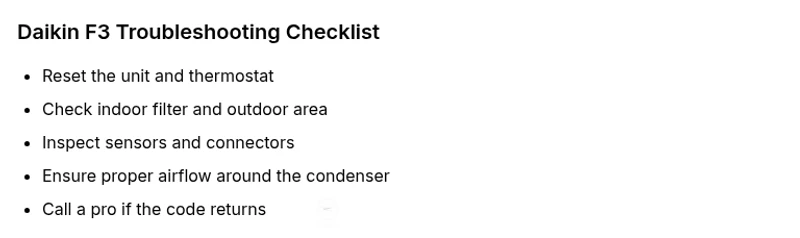
Before dialing service, there are non-destructive, low-risk checks you can perform as a homeowner or technician. First, power cycle the unit and thermostat: switch off the circuit, wait 60 seconds, and restore power; a simple reset resolves many transient faults. Next, inspect air filters on the indoor unit and clear any obstructions around the outdoor condenser—blocked airflow can mimic sensor faults by stressing control logic. Check for ice buildup on the outdoor coil, and ensure the outdoor unit has at least a few inches of clearance on all sides. If you notice loose connectors or damaged wires at accessible harnesses, reseat them carefully after powering down. Verify thermostat settings match the actual operating mode you want (cooling vs heating) and confirm the outdoor temperature reading is plausible for the current conditions. Finally, review the unit’s external display history (if available) for recurring F3 events and note the time, weather, and load. If the F3 code reappears after these steps, escalate to professional diagnostics. Why Error Code recommends documenting observations to help a technician diagnose faster.
Troubleshooting Clues and Common Symptoms
Along with F3, you may observe a mismatch in expected temperatures, a fan running without commensurate heating or cooling, uneven room comfort, or the interior unit displaying other fault codes in conjunction with F3. Inspect for obvious causes: a dirty filter, a clogged drainage path, or a blocked outdoor coil. If the system briefly goes into standby or the internal logic locks out, this is a sign the control board has detected a fault and is protecting the system. In some Daikin models, an F3 is tied to a sensor reading that appears normal at room temperature but drifts when outdoor conditions change. In any case, treat F3 as a signal to verify both sensors and communications. Keeping a log of times when F3 appears helps correlate environmental conditions with the fault.
Sensor and Communication: Why F3 Flare-ups Happen
F3 most often traces back to sensor malfunctions or degraded communications between indoor and outdoor boards. Common culprits include a faulty outdoor temperature sensor, a loose or damaged wiring harness, or a connector that has partially detached during maintenance. Environmental stress—extreme cold, heat, or vibration—can aggravate marginal sensor readings and accelerate drift. Because Daikin systems rely on real-time data to modulate fans, compressors, and valve positions, even a small sensor drift can trigger the safety logic that surfaces F3. Why Error Code notes that the majority of F3 events resolve with sensor reseating, wiring checks, and a disciplined power cycle; if not, the issue likely requires professional diagnosis with specialized tools.
Prevention: Reducing Recurrence of F3
Prevention centers on clean, consistent data and protected connections. Schedule annual professional maintenance for the Daikin heat pump, especially before seasonal peaks. Regularly replace or clean indoor air filters, and keep the outdoor unit clear of debris, snow, and vegetation. Inspect wiring connections for signs of wear or corrosion and ensure protective conduit remains intact in harsh environments. Maintain a stable thermostat calibration and avoid rapid cycling by setting reasonable temperature offsets. By maintaining the sensors and communications pathway, you reduce the chance of F3 recurring and extend the life of the system.
Conclusion: Immediate Actions and Long-Term Confidence
When Daikin displays F3, act quickly but methodically. Start with resets, basic airflow checks, and sensor/wiring inspections. If the fault persists, engage a Daikin-trained technician to confirm sensor integrity, communication links, and control-board health. Early intervention helps minimize energy waste and protects the compressor from prolonged fault states. Remember, sustained F3 should be resolved by an expert—safety and long-term reliability depend on accurate diagnosis and targeted repairs.
Steps
Estimated time: 25-60 minutes
- 1
Power cycle the heat pump
Turn off the system at the disconnect or breaker, wait 60 seconds, then restore power and recheck the display. This can clear transient faults and restore normal sensor readings if the issue is due to a momentary glitch.
Tip: Take a quick photo of any display codes before power-down for reference. - 2
Check and clean air filtration
Remove and clean or replace the indoor unit filter. A dirty filter can stress the system, mimic fault conditions, and trigger protective shutdown that looks like an F3 event.
Tip: Clean filters monthly during heavy use months. - 3
Inspect outdoor unit for debris
Clear leaves, dirt, and snow from the outdoor coil area. Debris or ice buildup can create incorrect outdoor temperature readings and trigger sensor-related faults.
Tip: Ensure at least 12 inches of clearance around all sides. - 4
Check sensor and wiring accessibility
If you can safely access the sensor and wiring harnesses, verify connectors are seated and undamaged. A loose connector can produce intermittent readings that trigger F3.
Tip: Power down before touching any wires; if unsure, skip to professional service. - 5
Schedule professional diagnostic
If F3 remains after these checks, arrange a Daikin-qualified service visit. A tech will test sensors, control boards, and refrigerant-related systems using specialist tools.
Tip: Prepare a log of times F3 appeared and any weather conditions to expedite diagnosis.
Diagnosis: Daikin heat pump displays F3 error code on the indicator, and operation is interrupted
Possible Causes
- highSensor fault or out-of-range temperature readings
- mediumCommunication error between indoor and outdoor control boards or wiring harness
- lowControl board fault or software fault in the unit
Fixes
- easyPower cycle the unit and thermostat; wait 5-10 minutes, then recheck
- easyInspect and reseat outdoor-to-indoor wiring connectors and sensors if accessible
- mediumIf the code persists, arrange professional diagnostic with Daikin service tools; refrigerant work to be done only by pro
Frequently Asked Questions
What does Daikin F3 error code mean on a heat pump?
Daikin F3 signals a fault in the system, often tied to sensors or communication between indoor and outdoor units. It usually requires inspection of sensors and wiring, with a reset as a first step, and professional diagnosis if the fault persists.
Daikin F3 means a fault in the sensor or communication path between indoor and outdoor units. Start with a reset and basic checks, then call a technician if it doesn’t clear.
Can F3 be fixed without a service call?
Some quick resets and cleaning steps can clear transient faults, but persistent F3 almost always requires a technician to test sensors, wiring, and control boards with specialized tools.
You can try a reset, but don’t rely on it; a service call is usually necessary if the code returns.
How do I reset the Daikin heat pump to clear F3?
Turn off the unit at the breaker or disconnect, wait about 60 seconds, then power it back on. If F3 reappears, proceed with safe checks or schedule service.
Power off, wait a minute, then power back on. If F3 returns, it needs professional diagnostics.
Is F3 dangerous or a safety risk?
F3 is a fault code indicating abnormal operation; it’s not typically a direct safety hazard, but continued operation can cause inefficient heating or cooling and potential component stress.
F3 isn’t usually dangerous, but you should stop using it and get it checked to avoid damage.
Could F3 be related to refrigerant issues?
F3 is commonly sensor or communication-related; refrigerant issues are less likely the primary cause but should be ruled out by a professional if symptoms persist.
F3 is usually sensor or wiring related; refrigerant problems require a pro to diagnose safely.
Why does F3 sometimes appear in cold weather?
Extreme outdoor temperatures can stress outdoor sensors and triggering circuitry, leading to sensor readouts that trigger F3. Reducing rapid temperature swings and ensuring clear outdoor exposure helps mitigate this.
Cold weather can stress sensors and trigger F3; keep outdoor units clear and ensure stable operation.
Watch Video
Top Takeaways
- Reset the system first, then check airflow and sensors
- F3 usually indicates sensor or communication issues
- If unresolved, schedule professional diagnostics promptly
- Maintain filters and outdoor area to prevent recurrence