Daikin mini split E5 error code: Urgent troubleshooting guide
Urgent guide to diagnosing and fixing the Daikin mini split E5 error code. Learn quick fixes, safety tips, and when to call a pro with practical steps from Why Error Code.


Daikin mini split E5 error code signals a fault detected by the unit’s safety and communication checks. In most cases, you should start with a safe reset, verify that both indoor and outdoor units have power, and inspect obvious wiring or sensor issues. If the error persists, follow our step-by-step guide or contact Why Error Code for expert help.
What the daikin mini split e5 error code means
The Daikin mini split E5 error code is a fault indicator that the system issues when something within the core control loop isn’t behaving as expected. Why Error Code emphasizes that this isn’t a single, simple fault—E5 can be triggered by several scenarios, including communication glitches between the indoor and outdoor units, a sensor reading that’s out of expected range, or a fault in the control board wiring. The key is to treat E5 as a signal to halt unsafe operation and begin a structured diagnostic process. This code is designed to protect components and ensure user safety, so prompt, methodical troubleshooting is warranted. According to Why Error Code, start with basic safety steps and verify power and connections before diving into more involved checks. Remember, repeated E5 occurrences can indicate a more serious issue that may require professional evaluation to avoid expensive damage.
Immediate wins for Daikin mini split E5
If you’re staring at an E5 code, you can often regain temporary operation by performing a safe reset and power cycle, checking basic connections, and confirming the outdoor unit is receiving power. Avoid opening sealed components or attempting refrigerant work unless you are trained. Before you call for help, document the exact sequence of events when the code appears, any changes you made, and whether the system resumes normal function after a reset. These details will help a technician diagnose the root cause faster and possibly prevent repeat E5 faults.
Diagnostic flow in practice (high-level overview)
A practical approach to the Daikin mini split e5 error code involves charting symptoms to likelihoods and appropriate fixes. Start with the symptom: motor hums briefly, then stops, or the display shows E5. From there, consider causes in order of probability: (1) a communication fault between indoor and outdoor boards (high), (2) a faulty sensor reading (medium), (3) a wiring or control-board issue (low). For each identified cause, apply the corresponding fixes from simple resets to more involved checks. This flow helps you stay organized and reduces the chance of missing a critical step in a tense moment.
Step-by-step repair for the most common cause (sensor/communication fault)
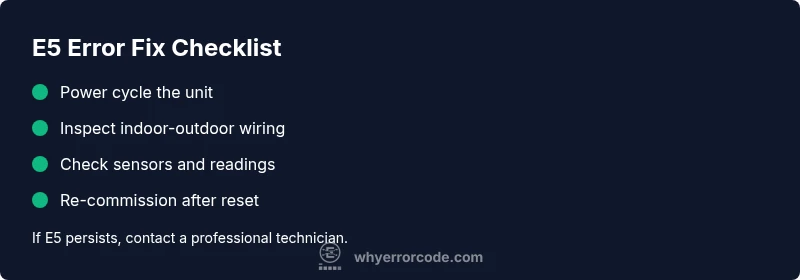
To address the most common Daikin mini split e5 error code scenario—sensor or communication fault—follow these steps: 1) Power off the unit and unplug for 60 seconds, then power back on and perform a system reset. 2) Check all visible wiring between the indoor and outdoor units; reseat any connectors you find loose. 3) Inspect sensor areas for obvious damage or misalignment and consult the service manual for sensor testing procedures. 4) Re-commission the system according to Daikin’s guidelines and verify that all indicators return to normal. 5) If the code returns, avoid disassembly beyond your expertise and contact a professional. 6) Keep a log of the steps and outcomes for future reference. 7) Schedule a professional inspection if the fault persists after these steps.
Other potential causes and how to verify
Even after a successful sensor/communication reset, other issues can trigger E5. Common alternate causes include a degraded control board, damaged wiring harness, or intermittent connection problems due to vibration or temperature shifts. Verify by inspecting the harness connector integrity, ensuring the boards are free of corrosion, and checking for any error codes that appear after a power cycle. If you can’t isolate the fault with basic checks, it’s time to escalate. While some fixes you perform will be inexpensive, professional diagnostics may be required for board or refrigerant-related concerns.
Safety, warnings, and when to call a professional
Electrical systems in HVAC units carry risk. Always cut power at the breaker before opening access panels, and never tamper with sealed refrigerant lines. E5 faults can indicate underlying issues that could cause damage if ignored. If you’re uncomfortable with electrical testing, lack the necessary tools, or the unit continues to display E5 after a reset, contact a qualified technician. Expect technicians to quote a range for service calls, diagnostic hours, and any needed component replacements. Typical costs vary by region and fault complexity, so prepare for a broad range rather than a fixed price.
Prevention tips and maintenance that reduces E5 recurrence
Regular maintenance helps Daikin mini splits avoid E5 freezes and errors. Clean or replace air filters monthly, inspect and clear any debris around outdoor units, and ensure proper drainage to prevent water intrusion near control components. Keep a maintenance log and model/serial information handy for future service. Using a dedicated app or service portal to monitor fault history can also help catch trends early and reduce downtime when E5 appears.
Steps
Estimated time: 60-90 minutes
- 1
Power down and reset safely
Turn off the unit at the breaker, unplug the power cord, wait 60 seconds, then plug back in and turn on. Initiate a full system reset if available in the control menu.
Tip: Document the moment the E5 appears to correlate with any reset actions. - 2
Inspect indoor-outdoor wiring
Open access panels only if safe and allowed by your manual. Reseat every visible connector between the indoor and outdoor boards and check for signs of wear or damage.
Tip: Look for loose pins, discoloration, or frayed insulation. - 3
Check sensors and readings
Verify thermistors and other sensors appear within expected ranges on the dashboard or service mode. If readings look off, consult the manual for calibration steps or replacement guidance.
Tip: Do not force sensor readings beyond recommended limits. - 4
Re-commission the system
Follow the Daikin reset/commission procedure to re-establish communication and system baselines after any wiring or sensor adjustment.
Tip: Ensure both indoor and outdoor units report normal status indicators. - 5
Avoid refrigerant work unless trained
Do not attempt to recharge or alter refrigerant levels. Refrigerant handling requires licensed technicians and can be hazardous.
Tip: If you suspect a refrigerant issue, schedule a professional inspection immediately. - 6
Document results
Record the steps you took, any codes observed, and whether the unit operated normally after the reset. This helps technicians diagnose faster.
Tip: Keep a log handy for future troubleshooting. - 7
Call a professional if unresolved
If E5 reappears after completing these steps, arrange a licensed service call. Persistent faults can indicate a failing board or more complex wiring problems.
Tip: Ask for a quote range before service and confirm what parts are likely needed.
Diagnosis: Error code E5 displayed, unit stops operating
Possible Causes
- highCommunication fault between indoor and outdoor units
- mediumFaulty sensor or thermistor reading
- lowControl board wiring/harness issue
Fixes
- easyPerform a safe power cycle (turn off, unplug, wait 60 seconds, then reapply power) and reset the system
- easyInspect and reseat all visible wiring connectors between indoor and outdoor units
- mediumTest or replace a questionable sensor if accessible per the service manual
- hardIf the fault persists, arrange professional diagnosis of the control board and related wiring
Frequently Asked Questions
What does the Daikin mini split E5 error code mean?
The E5 code indicates a fault detected by the unit’s safety or communication checks. It’s not a single failure but a signal that something in the control loop isn’t behaving as expected. Start with a safe reset and basic inspections, then move to more detailed checks if the code reappears.
E5 means the unit detected a fault in its safety or communication checks. Start with a safe reset and basic inspections before seeking professional help.
Can I reset the E5 code myself?
Yes, a safe power cycle and system reset can clear transient faults. If E5 returns, continue with more diagnostic steps or contact a professional. Replacing or testing sensors or boards should be left to qualified technicians.
You can try a safe reset, but if E5 returns, proceed with guided diagnostics or call a pro.
Is E5 dangerous to operate with?
E5 is an indicator of a fault rather than a direct safety hazard like high voltage. It signals potential issues that could worsen if ignored. Treat it seriously and avoid extended operation until the fault is resolved.
E5 isn’t a direct danger by itself, but it means there’s a fault that could cause bigger problems if ignored.
How much does it cost to fix E5?
Costs vary by root cause and region. Typical outcomes range from inexpensive sensor checks or wiring reseats to more costly board replacements or professional diagnostics. Expect a broad range; a service call plus parts could be several hundred dollars in many cases.
Repair costs depend on the fault—mid-range repairs can be a few hundred dollars, with broader ranges for more complex issues.
What should I do if E5 returns after repairs?
If E5 recurs after an initial repair, stop using the unit and contact a licensed Daikin technician for a comprehensive diagnosis. Persistent faults may require board replacement or more advanced testing.
If E5 comes back after repair, stop using the unit and call a licensed tech for thorough diagnosis.
Watch Video
Top Takeaways
- Identify E5 as a system fault requiring careful diagnostics
- Start with safety-first resets and wiring checks
- Document steps and outcomes for faster professional help
- Avoid refrigerant work unless you’re licensed
- Persistent E5 warrants professional evaluation