ECC Error Correction Code Calculator: Learn, Calculate, Optimize
Explore the ECC error correction code calculator to understand how data bits, parity, and bit errors affect protection. Includes a live widget, explanations, and practical examples.


What is ECC and why it matters in modern systems
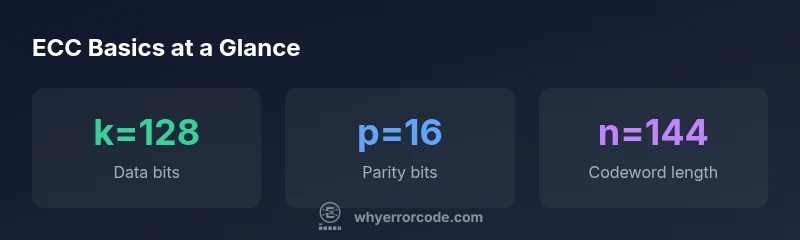
Error-correcting codes (ECC) are mathematical techniques used to detect and correct data corruption in memory, storage, and communications. An ECC error correction code calculator helps you explore how different configurations affect data integrity. In practice, ECC adds parity bits to data so that a decoder can identify and fix certain errors that occur during storage or transfer. For example, a typical SEC memory schema uses a number of parity bits to correct single-bit errors, while SECDED extends protection to double-bit errors. Understanding how k (data bits) and p (parity bits) influence protection helps developers design reliable systems. This article explains the calculator’s approach, why it matters, and how to interpret results for real-world tasks. Throughout, you’ll see the phrase ecc error correction code calculator used to connect concepts to the tool you’ll use.
How ECC protects memory and storage against bit flips
ECC relies on structured redundancy: you add parity bits to a data word so a decoder can detect and correct certain errors without reading from a backup source. The core idea is simple: more parity bits usually mean stronger protection, but at the cost of reduced data density. Different ECC schemes offer different guarantees (single-error correction, double-error detection, etc.). When you use an ecc error correction code calculator, you’re modeling how k data bits, p parity bits, and a per-bit error rate shape a codeword’s resilience. This helps you compare configurations and balance reliability with storage efficiency.
How the calculator translates k, p, and e into a protection metric
Most calculators for ECC use a compact model: n = k + p represents the codeword length, and e is the per-bit error rate. The core metric is the probability of correctable data per codeword, computed as P_correct ≈ (1 − e)^n + n·e·(1 − e)^(n−1). This captures the chance of zero errors plus the chance of exactly one error (correctable by SEC/Hamming-type codes). The resulting value, often labeled as Correctable Data Proportion, lets you gauge how much data will be recoverable after errors. In practice, you’ll also see a code-rate estimate k/n to understand storage efficiency.
Example structure and what to look for when interpreting results
When you adjust k, p, and e, watch two things: the code rate (k/n) and P_correct. A higher k with a modest p increases payload but can reduce protection if e is not tiny. The ecc error correction code calculator provides a quick view of how robust your configuration is under expected conditions. Use this insight to select a configuration that preserves data integrity while meeting performance and capacity goals.