Error Codes in QuickBooks Online: Quick Troubleshooting Guide
Learn how to diagnose, understand, and fix common QuickBooks Online error codes with practical, step-by-step guidance, safe pro tips, and prevention strategies.


Error code QuickBooks Online signals a blocker in authentication, syncing, or data processing. The quickest fix is to verify user permissions, ensure a stable internet connection, and reattempt the action. If the error persists, follow a structured diagnostic flow to identify the root cause and apply the safest, fastest repair. In most cases, permission issues, connectivity problems, or data integrity concerns are the culprits, and a systematic approach resolves them quickly.
What the error means for QuickBooks Online
An error code in QuickBooks Online is more than a cryptic message—it’s a signal that one of several subsystems failed to complete a requested operation. These codes usually point to authentication problems (login or token issues), data processing faults (corrupt or mismatched data), or connectivity snags (network or service interruption). Understanding the scope helps you choose the fastest path to resolution. According to Why Error Code, most users encounter three recurring patterns: permission or login problems, unstable internet connections, and temporary service interruptions. By confirming the exact symptom and when it started, you can narrow the diagnosis to a handful of likely causes and proceed with the fastest fix.
Common Scenarios That Trigger QuickBooks Online Error Codes
Many errors fall into familiar buckets. Authentication issues can occur after password resets, multi-factor prompts, or token expirations. Data-related errors may appear when importing transactions, reconciling, or syncing bank feeds. Connectivity problems range from intermittent Wi‑Fi to VPNs or corporate proxies that block required endpoints. Finally, third-party integrations (add-ons, payroll apps, or bank feeds) can introduce mismatches or timeouts. Recognizing the scenario helps you prioritize the fix and avoid chasing tangential issues.
Diagnostic Approach: Symptoms, Causes, and Fixes
To triage efficiently, start with the symptom and trace it to probable causes. A standardized flow reduces guesswork and speeds recovery. For example, if you see an authentication-related error during login, the root cause is likely permission settings or stale tokens rather than a data file problem. If the error occurs during bank feed syncing, the issue could be a broken connection or a bank-side change. A well-documented flow (symptom → causes → fixes) helps you apply the right remedy in the fewest steps.
Step-By-Step Fix for the Most Common Cause
This section provides a practical, actionable sequence you can follow in 15–60 minutes. Start with quick checks and escalate to more involved actions only if necessary. Each step includes a quick tip to help you avoid common missteps and keep your data safe. If you’re administering a business file, always back up before performing significant changes. A disciplined, repeatable process minimizes downtime and frustration for your users.
Other Causes and How to Address Them
Not every error fits the top scenario. If you’ve ruled out permission and connectivity issues, consider data integrity (corrupt transactions, mismatched lists), application updates, or browser/client cache problems. For many of these, the remedy involves refreshing the data set, re-indexing or rebuilding a damaged portion of the file, or reauthorizing integrations. Maintain a change log so you can correlate fixes with outcomes and avoid repeating unnecessary steps.
Safety tips, warnings, and when to call a professional
Never apply high-risk fixes to production data without a backup. If the error persists after you’ve completed the recommended steps, or if you’re seeing repeated failures across multiple users, contact QuickBooks support or a certified accountant. Some error codes point to server-side outages or platform-level changes that require vendor assistance. In critical environments, a professional diagnostic can reduce downtime and prevent data loss.
Prevention tips to avoid future QuickBooks Online errors
Proactive measures save time: schedule regular data backups, restrict risky bulk edits, monitor bank feeds for changes, and keep integrations up to date. Establish a standardized incident response with clear ownership and a runbook you can reuse. Finally, configure alerts for authentication token expiry and network changes so you’re not caught off guard when an error code appears.
Steps
Estimated time: 45-60 minutes
- 1
Confirm symptoms and scope
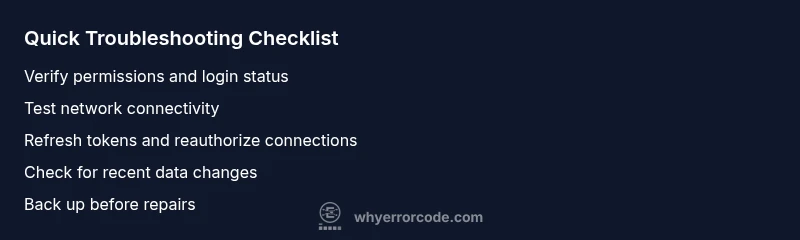
Document the exact error message, when it appears, and which actions trigger it. Check if other users or modules are affected to assess scope.
Tip: Capture screenshots and note timestamps for future support. - 2
Test the basics
Verify internet connectivity, try a different browser or the QuickBooks Desktop app if available, and reboot the device if necessary.
Tip: Rule out local issues before touching data or accounts. - 3
Check permissions and tokens
Ensure the user account has the required permissions and that tokens or OAuth connections are valid. Reauthenticate if needed.
Tip: If MFA is enabled, complete the prompt promptly to avoid session expiry. - 4
Review recent changes
Inspect recent imports, data edits, or new integrations that could have introduced the error. Revert changes if feasible.
Tip: Keep a changelog to trace what caused issues. - 5
Run a focused fix
Attempt the recommended repair for the most common cause (e.g., refresh tokens, reauthorize a bank feed, re-import a batch).
Tip: Follow the runbook exactly to minimize risk. - 6
Escalate if unresolved
If the error persists after these steps, collect logs and contact support with all details. Consider a repair plan with data backups.
Tip: Include the symptom, time, affected modules, and any error codes observed.
Diagnosis: Error code displayed during a QuickBooks Online operation (login, sync, or data import).
Possible Causes
- highPoor network connectivity or VPN/proxy interference
- mediumLogin, permissions, or token problems after password changes or MFA prompts
- lowData integrity issues (corrupt transactions or mismatched lists)
Fixes
- easyCheck internet connection, disable VPN if interfering, and retry the action
- easySign out, clear session, and sign back in; refresh tokens and reauthorize connections
- mediumReview recent data imports or edits for corruption and re-sync affected areas
Frequently Asked Questions
What does an error code in QuickBooks Online typically indicate?
An error code usually points to authentication, syncing, or data processing issues preventing the requested action. Diagnosing the exact cause requires checking symptom timing and recent changes.
An error code usually means authentication, syncing, or data processing issues are blocking the action.
Can network problems cause QuickBooks Online errors?
Yes. Intermittent connectivity or VPN/proxy restrictions can trigger error codes. Verifying network stability and temporarily bypassing restrictive networks often resolves the issue.
Network issues can trigger errors. Check connectivity and try again.
When should I contact QuickBooks support?
If the error persists after following the diagnostic flow, or if multiple users experience it, contact QuickBooks support or a certified professional for a deeper investigation.
If it keeps happening, reach out to support for a deeper check.
Is data corruption a common cause of errors?
Data integrity issues can cause errors, especially after imports or edits. Look for unusual transactions, mismatched lists, or failed reconciliations and address them carefully.
Data issues can cause errors; inspect recent imports and reconciliations.
Are there safety concerns when troubleshooting?
Always back up before major changes. Do not run untrusted scripts or bypass security prompts. If unsure, seek professional help to avoid data loss.
Back up first and don’t bypass security prompts. If unsure, get help.
Watch Video
Top Takeaways
- Identify the exact symptom and context first.
- Prioritize permissions, connectivity, then data integrity.
- Follow a structured diagnostic flow to isolate causes.
- Back up data before major repairs.