Frigidaire Dishwasher Error Code U0: Diagnosis and Fixes
Learn what Frigidaire dishwasher error code U0 means, common causes, and proven steps to diagnose and fix it quickly. Includes safety tips and cost ranges to plan repairs.


Frigidaire dishwasher error code U0 signals a control or sensor fault that stops the cycle. It commonly points to the water level detection circuit, float switch, or control logic. The quickest fix is a power reset, followed by inspecting the float assembly and looking for kinks or clogs in the inlet tube, valves, and wiring.
What the U0 code means on Frigidaire dishwashers
Frigidaire dishwasher error code U0 signals a fault in the control or sensor system that stops the cycle. In most models the code points to the water level detection circuit, float switch, or control logic. The U0 fault can appear during any wash phase and is often accompanied by a pause or a quick beep. According to Why Error Code, these faults typically reflect a sensor misread or a marginal electrical condition rather than a total power failure. The diagnoses should begin with a safe power reset and basic inspections before testing sensors with appropriate tools. The aim is to identify whether the problem is a simple obstruction or a failing component that needs replacement. As a rule of thumb, always treat U0 as a sensor/control fault until proven otherwise by checks.
Why U0 can appear across different models and modes
U0 is not limited to a single Frigidaire series; variations in model numbers, control boards, and wiring harnesses can trigger the code. In high-efficiency or sensor-rich models, minor variances in water pressure, tub level, or door interlock states may be interpreted as faults by the firmware, generating U0. This means your troubleshooting should cover the water supply, door latch, float assembly, and the main controller. The Why Error Code team notes that firmware updates or calibration steps can alter how U0 is reported, so check for both hardware and software status when diagnosing. Keep in mind that some U0 occurrences are transient and disappear after a reset; others require component replacement.
Quick checks you can perform safely
Start by safely cutting power to the dishwasher, then reapply power to reset the control logic. Look for obvious issues such as a blocked float, obstructed sump, or kinked inlet hose. Inspect the water inlet filter and valve for debris, and verify the water supply valve is fully open. If the door isn't closing properly, the interlock may trigger U0; reseat the door and test the latch. For electrical checks, only perform non-invasive inspections (like reseating connectors) unless you are comfortable with basic electronics and have unplugged power. If the fault persists after a full reset and basic checks, you should proceed to more involved tests or contact support.
The role of float switches, sensors, and wiring
The float switch is a common access point for U0 faults. A stuck float, a broken float arm, or misaligned float tube can falsely indicate an overfill condition, causing the control board to halt the cycle. The water level sensor or pressure switch can also fail or drift over time, presenting an incorrect sense of water level. Wiring harnesses and connectors to these sensors are another frequent fault source; loose or corroded connections can mimic sensor failures. Diagnosing requires careful inspection: check for corrosion, bent pins, and proper connector seating. If you can measure resistance on the float switch or sensor with a multimeter, compare against the manufacturer spec sheet; replace any component that does not meet spec.
Common repair paths and cost ranges
Repair paths range from simple clean-and-reseat actions to part replacements. A typical quick fix is replacing the float switch or reseating the harness, which may cost approximately $20–$120 for parts plus $60–$150 for labor, depending on your region. Replacing the water inlet valve or sensor can run higher, around $50–$250 in parts plus $80–$200 in labor. A failed control board is more expensive, with parts commonly in the $150–$350 range and labor around $100–$250. These figures are rough ranges intended to help you budget; actual prices vary by model and region. If you suspect the control board or a wiring fault, contacting a professional is often the most cost-effective path to avoid misdiagnosis.
Prevention and best practices to avoid U0
Regular maintenance reduces U0 risk: clean the filter and sump, inspect and clean the float assembly, and ensure the inlet hose remains free of kinks. Schedule firmware updates if your model supports them, and reset the unit after major changes, such as pipe replacements or valve inspections. Avoid overfilling the tub by ensuring the float path is clear, and verify the door latch maintains a secure seal for consistent cycles. Finally, keep the appliance area dry and away from water splashes during service to minimize short circuits or sensor corrosion.
Long-term preventive measures and firmware considerations
If your model receives periodic firmware updates, ensure the dishwasher is on a stable power source during updates to prevent bricking or misreporting errors. Maintain a regular inspection cycle—every 6–12 months—to check for loose connectors and worn seals. Consider adding a moisture sensor or circuit protector in high-humidity kitchens if your region is prone to electrical fluctuations. While U0 seldom indicates imminent danger, any recurring error warrants a professional diagnostic to prevent further damage and to preserve appliance performance over time.
Steps
Estimated time: 35-60 minutes
- 1
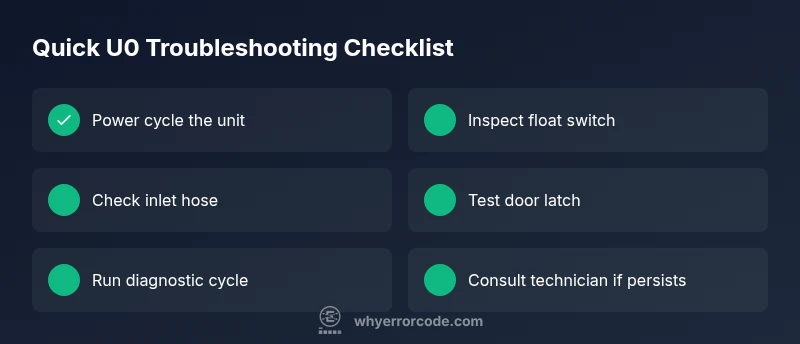
Power cycle the dishwasher
Power off the unit at the breaker or unplug it. Wait 60 seconds to allow capacitors to discharge. Restore power and run a short test cycle with no dishes to see if U0 reoccurs.
Tip: Label the outlet and ensure other devices aren’t resetting during the test. - 2
Inspect the float switch and sump
Locate the float switch at the base of the tub. Gently press the float up and down to confirm movement. Clear any debris or mineral buildup that could trap the float.
Tip: If the switch feels stuck, gently test continuity with a multimeter if you have the skills. - 3
Check the water inlet and filter
Turn off water supply, remove the inlet screen, and check for blockages. Reconnect and run hot water briefly to ensure flow is steady. If the valve feels stiff, it may need replacement.
Tip: Do not over-tighten fittings to avoid leaks. - 4
Test the door latch and wiring
Shut the door firmly and listen for the latch engagement. Check the interlock wiring for loose pins or corrosion. Re-seat connectors if needed and ensure insulation is dry.
Tip: Only handle electrical parts with dry hands; unplug before touching wires. - 5
Run a diagnostic cycle and monitor
Run a test cycle and observe behavior. If U0 reappears, log the exact moment and cycle stage; this helps narrow down the faulty component when you contact support.
Tip: If you’re unsure, pause and call a pro rather than continuing testing.
Diagnosis: Frigidaire dishwasher displays U0 error and stops mid-cycle
Possible Causes
- highStuck or faulty float switch
- mediumWater level sensor or pressure switch fault
- lowControl board or wiring fault
Fixes
- easyReset the dishwasher by power cycling
- easyInspect and test the float switch and its wiring
- easyCheck for kinks/ blockages in inlet hose and clean screen
- hardIf fault persists, replace the control board or associated wiring
Frequently Asked Questions
What does Frigidaire U0 mean?
U0 signals a fault in the control or sensors that halts the cycle. Start with power reset and basic sensor checks.
U0 means a control or sensor fault. Start with a power reset and basic checks.
Can I fix U0 myself?
Some basic checks can be done safely, like resetting power and inspecting the float switch and inlet hose. If the fault persists, seek professional help.
You can try basic resets and inspections, but persistent U0 needs a pro.
What are the common causes of U0?
Float switch faults, water level sensor issues, and control board/wiring faults are the most frequent culprits.
Commonly it’s the float switch, sensor, or control wiring.
How much does it cost to repair U0?
Repair costs vary by component: float switch or inlet valve replacements typically run in the low-to-mid hundreds, while a control board replacement can exceed $300 including labor.
Costs range from a few dozen to several hundred dollars depending on the part.
Will a reset clear U0 permanently?
A reset may clear a transient fault, but if the underlying issue persists, U0 can reappear.
Resetting may clear a false alarm, but persistent issues require fixes.
Watch Video
Top Takeaways
- Power cycle to reset the control.
- Check float switch and water inlet first.
- Call a pro if the code persists after checks.
- Maintain regular cleaning to prevent U0.