Graphics Card Error Code 31: Urgent Troubleshooting Guide
Urgent guide to graphics card error code 31: meanings, fast fixes, diagnostic flow, and step-by-step repairs to restore GPU startup and prevent recurrence.


Graphics card error code 31 signifies a GPU initialization failure detected during boot or driver load. This usually points to hardware or driver issues preventing the graphics card from starting correctly. The fastest fixes include reseating the GPU, updating or reinstalling drivers, and verifying power connections; if unresolved, test in another PCIe slot or with a known-good card.
What graphics card error code 31 means
According to Why Error Code, graphics card error code 31 denotes a GPU initialization failure where the system cannot start the card properly. This typically arises from a mix of hardware and software factors: a loose connection, faulty power delivery, driver corruption, or a marginal motherboard PCIe slot. When you encounter this code, you should treat it as urgent because it often signals a fault that could worsen if left unchecked. The key is to quickly isolate whether the issue is hardware or software so you can apply the correct remedy and minimize downtime for your workstation or gaming rig. Recognizing the code early helps prevent data loss in workloads sensitive to GPU failover or rendering pipelines.
Quick practical fixes you can try right now
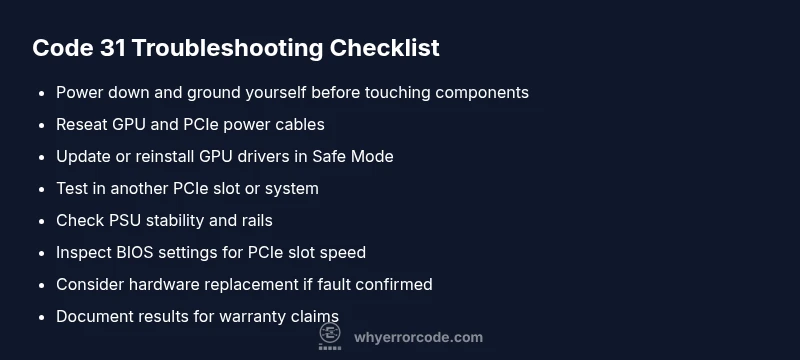
If you’re seeing graphics card error code 31 on boot or during GPU-intensive tasks, start with fast wins that don’t require disassembly. First, power down and unplug the PC, then reseat the graphics card in its PCIe slot and reconnect all PCIe power cables. A loose connection is a common culprit and reseating often resolves it. Next, inspect for bent pins on the PCIe connector and ensure the PCIe slot is free of dust. Update or reinstall GPU drivers in Safe Mode to rule out software conflicts. If you have a modular power supply, verify all rails are delivering stable voltage and consider temporarily swapping in a known-good PSU to test stability. Finally, if the error persists, boot into a different PCIe slot or test the GPU in another system to determine if the card itself is failing.
Diagnostic flow: symptoms to tests
The path from symptom to solution begins with documenting when the error occurs. Do you see code 31 on boot, during POST, or only under load? Are there accompanying symptoms like screen artifacts, system freezes, or a sudden reboot? Use these questions to guide tests: check driver versions, run GPU stress tests in a controlled environment, verify temps, and watch for PSU instability. A high likelihood path often starts with reseating and power checks, followed by driver cleanup. If the GPU shows up in BIOS/UEFI but fails to initialize in Windows, suspect driver corruption or BIOS incompatibility. Conversely, if the card isn’t detected at all, the problem may be power delivery or a defective PCIe slot. This flow ensures you address the most common causes first and escalate only when needed.
Step-by-step fix: reseat, drivers, and power checks
- Power down, unplug, and discharge static; open the case. 2) Remove the GPU and inspect the PCIe slot and connectors for damage or dust. 3) Reinsert the GPU firmly and reconnect all PCIe power cables, ensuring the connectors click into place. 4) Clear the GPU cache and reinstall drivers via Safe Mode, then boot normally to test. 5) Check the system BIOS/UEFI for PCIe settings and set to the appropriate slot speed (gen 3/4/5 as supported). 6) Test with a different PCIe slot or a different known-good GPU to isolate the fault. 7) If instability persists, borrow a known-good PSU to rule out power issues. 8) If all else fails, prepare for RMA or replacement of the GPU or motherboard.
Other potential causes and advanced troubleshooting
While reseating and driver updates address a large share of graphics card error code 31 cases, persistent issues may be caused by a failing GPU, insufficient power supply, or a motherboard PCIe fault. Advanced steps include updating the motherboard chipset drivers, checking for BIOS updates that improve PCIe compatibility, and testing with a minimal POST configuration (no extra PCIe devices) to rule out peripheral conflicts. Overheating can also trigger shutdowns that manifest as error codes; ensure adequate case ventilation and clean cooling paths. If the card remains undetected by multiple systems, the fault likely lies with the GPU itself or the power delivery rails.
Safety, costs, and when to seek professional help
Handling a GPU and power supply involves risk of electrical shock and static damage. Always unplug the system and discharge capacitors before touching internal components. If you’re uncomfortable with hardware tests or if you lack spare parts, consult a professional. Typical repair costs vary by region and component: GPU replacement may range from a few hundred to over a thousand dollars; a PSU swap often costs $50–$300; motherboard or PCIe slot repair can be $100–$500 depending on labor and parts. Consider professional service if you observe burnt smells, bulging capacitors, or visible damage.
Prevention: how to reduce the odds of graphics card error code 31 reappearing
Routine maintenance reduces recurrence: keep drivers updated, maintain steady power with a quality PSU, ensure proper case cooling, avoid PCIe slot misalignment, and store the system in stable environmental conditions. Create a quick diagnostic script that records GPU events and temperatures during load, so you can detect drift before it triggers code 31. Regular hardware checks—especially after major BIOS/driver updates—help catch issues early and make future troubleshooting faster.
Steps
Estimated time: 60-120 minutes
- 1
Power down and unplug the system
Shut down, unplug from wall, and disconnect peripherals. Ground yourself to avoid static discharge before touching components.
Tip: Use an anti-static wrist strap if available. - 2
Open the case and inspect the GPU area
Visually inspect the GPU, PCIe slot, and power cables for damage, dust, or loose connections. Remove dust carefully with compressed air.
Tip: Don’t touch the gold PCIe contacts with bare fingers. - 3
Reseat the GPU and PCIe power cables
Unplug and firmly re-seat the GPU in the PCIe slot. Reconnect all PCIe power connectors, ensuring they click securely.
Tip: Confirm auxiliary PCIe power connectors are the correct type for your card. - 4
Clear CMOS and check BIOS settings
Reset BIOS/UEFI to default, then verify PCIe slot speed matches the GPU (Gen 3/4/5 as supported).
Tip: Disable any overclocking profiles that affect PCIe clocks. - 5
Boot in Safe Mode and update drivers
Boot to Safe Mode, uninstall current GPU drivers, then install the latest from the vendor site.
Tip: If Safe Mode isn’t accessible, use a driver-cleaning tool and reinstall. - 6
Test in alternate PCIe slot or system
Move the GPU to a different PCIe slot or test the card in another PC to isolate the fault.
Tip: Document results with photos or notes for future reference. - 7
Evaluate power stability with a PSU swap
If available, try a known-good PSU to rule out power delivery issues.
Tip: Monitor voltages in BIOS or a hardware monitor tool during tests. - 8
Decide on replacement or professional repair
If tests indicate hardware failure, plan for GPU or motherboard replacement and consider warranty/RMA options.
Tip: Keep receipts and serials handy for warranty claims.
Diagnosis: PC boots with graphics card error code 31 or GPU initialization fails during load
Possible Causes
- highLoose PCIe connection or faulty PCIe power cables
- highPower supply instability or insufficient wattage
- mediumOutdated or corrupted GPU drivers
- mediumBIOS/UEFI PCIe settings misconfiguration
- lowDefective GPU or motherboard PCIe slot
Fixes
- easyReseat GPU and all PCIe power cables; inspect for bent pins
- easyTest with a known-good PSU or swap rails to verify power stability
- easyUpdate or reinstall GPU drivers in Safe Mode
- mediumReset BIOS/UEFI PCIe settings to default and enable correct slot speed
- mediumTest GPU in another PC or PCIe slot to confirm hardware fault
- hardReplace GPU or motherboard if hardware fault is confirmed
Frequently Asked Questions
What does graphics card error code 31 indicate?
Code 31 generally means the GPU failed to initialize during boot or driver load. It often points to hardware or driver issues that prevent the card from starting properly.
Code 31 means the GPU didn’t initialize. It usually points to hardware or driver issues.
Can drivers cause error code 31?
Yes. Corrupted or incompatible drivers can trigger initialization failures. Reinstalling or updating to a clean driver version often resolves the issue.
Drivers can cause code 31; reinstalling or updating often fixes it.
Is error code 31 hardware or software related?
Code 31 can stem from either hardware faults (GPU, PCIe slot, power delivery) or software issues (drivers, BIOS settings). A methodical diagnostic flow helps isolate the cause.
Both hardware and software can cause code 31; diagnose step by step.
Will replacing the GPU fix error code 31?
If the GPU is the faulty component, replacement typically resolves code 31. Confirm with tests in another system or slot before buying a new card.
If the GPU is faulty, replacement usually fixes it after testing confirms the cause.
Should I update my motherboard BIOS for code 31?
A BIOS update can improve PCIe compatibility and fix initialization issues, but it should be done carefully and only if recommended by the motherboard maker.
BIOS updates can help PCIe compatibility, but only if advised by the motherboard maker.
What are typical costs to fix code 31?
Costs vary: a PSU or cable replacement may be $50–$300, driver cleanup is free, and GPU replacement can range from $150–$1000 depending on parts and labor.
Repair costs range from tens to hundreds for power components up to thousands for a GPU replacement.
Watch Video
Top Takeaways
- Identify the root cause quickly by starting with reseating and power checks.
- Update or reinstall GPU drivers to eliminate software conflicts.
- Test in another PCIe slot or system to isolate hardware faults.
- Power issues are a frequent culprit; verify PSU capability and stability.
- Call a pro if you notice hardware damage or unsafe conditions.