KitchenAid Refrigerator Error Code E5: Diagnosis and Repair Guide
Urgent guide to diagnose and fix KitchenAid refrigerator error code E5. Learn quick fixes, diagnostic flow, step-by-step repair, safety tips, and when to call a pro.


The KitchenAid refrigerator error code E5 signals a fault in sensing or control subsystems that manage temperature regulation and sensor communication. Commonly, E5 appears when the temperature sensor or its wiring has degraded, or when the main control board detects inconsistent sensor data. A quick check includes reseating connectors, resetting the fridge, and verifying sensor connections; if unresolved, professional service may be needed.
What E5 Means on a KitchenAid Refrigerator
The error code E5 on KitchenAid refrigerators is a generic fault indicator that points to a malfunction within sensing or control components rather than a single easy-to-spot issue. In practical terms, this could involve the temperature sensor (thermistor), its wiring, or the main control board receiving questionable data from one or more sensors. Because modern fridges rely on electronics to regulate cooling, an E5 typically prompts the appliance to halt normal operation to protect stored food. Diagnosis should focus on sensor integrity, wiring continuity, and control-board communications, with the understanding that model-specific definitions may vary slightly.
- Key idea: E5 is a signal rather than a simple mechanical fault, and it requires careful, systematic testing of sensors and data paths.
- Related symptoms may include inconsistent temperature readings, error annunciations on the display, or a fault self-test that halts cooling.
Common Symptoms You Might Observe with E5
When E5 appears, you may notice one or more of the following symptoms:
- Uneven cooling in the fridge or freezer compartments
- Display of E5 along with a cold or warm reading that does not align with setpoints
- Frequent door openings triggering temperature fluctuations
- The unit may enter a protective shutdown or go into a diagnostic/display mode
These indicators help narrow the focus to sensors and data paths, rather than purely mechanical components.
Quick Fixes You Can Try Safely (Non-Destructive)
Try these user-safe steps before calling a tech. They are designed to reset sensors and verify connections without disassembly:
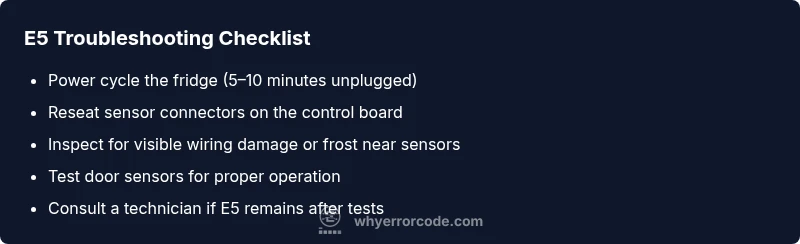
- Power cycle: unplug the unit for 5-10 minutes, then plug back in and observe if E5 reappears.
- Reseat sensor connectors: with the fridge unplugged, gently disconnect and reconnect sensor harnesses and any plug-in connectors near the control board.
- Inspect for obvious damage: look for loose wires, burn marks, or visible corrosion at sensor or harness connectors.
- Check the door sensors: ensure the door switches aren’t stuck or misaligned, which can cause sensor readings to drift.
- Document the behavior: take notes or a short video of how the display shows E5 and any temperature inconsistencies for service later.
If the error persists after these steps, proceed to the diagnostic flow or call a professional.
Diagnostic Flow: Narrowing Down Faulty Components
A structured approach helps identify the fault faster. Start with the most likely causes and work toward less likely ones. The flow below assumes E5 is currently displayed and the fridge is not cooling to target setpoints:
- Sensor or wiring fault (thermistor): high likelihood if readings are inconsistent or drift over time.
- Main control board communication fault: medium likelihood if multiple sensors appear to report erroneous data or the unit fails self-test.
- Door or secondary sensor fault: lower likelihood but possible if door sensors fail to report proper state, affecting readings.
With each step, perform a quick test (reset, reseat, observe) before moving to the next.
Step-by-Step Repair: The Most Common Cause First
This section provides a practical, field-tested workflow focused on the most common cause. Follow in order, documenting results as you go.
Other Causes to Consider
If sensor and control-board checks pass yet E5 remains, consider these alternate causes:
- Wiring harness damage due to moisture or vibration
- Faulty temperature sensor replacement not seated correctly
- Faulty or intermittent control-board component leading to data misreadings
- Firmware or software glitch that requires a software reset or update by a technician
Tips & Warnings: Safe Practices and When to Call a Pro
- Do not bypass safety interlocks or attempt to repair the high-voltage components yourself.
- If you smell burnt insulation, hear buzzing, or notice visible damage, stop and unplug the unit immediately.
- Keep food safe: avoid opening the fridge frequently during troubleshooting to minimize temperature risk.
- When to call a pro: if you are uncomfortable with electrical testing, the issue involves the main control board, or the error persists after safe resets.
- Document model and serial numbers for accurate service quotes.
Key Points to Remember
- E5 is often sensor or control-related; fix begins with sensor checks and a safe reset.
- Many E5 cases resolve with at-home resets; others require sensor or board replacement.
- Professional service may involve diagnostic fees and part replacement; obtain a written estimate before work begins.
Steps
Estimated time: 45-90 minutes
- 1
Power cycle the refrigerator
Unplug the unit for 5-10 minutes to reset sensors and the control board. Plug back in and monitor the display for any reappearance of E5 or abnormal temperature readings.
Tip: Label the unplug duration on a sticky note to ensure you meet the recommended wait time. - 2
Inspect sensor connectors
With the unit unplugged, locate the thermistor and sensor wiring. Gently unplug and re-seat connectors to ensure a solid electrical contact. Look for any signs of corrosion or loose pins.
Tip: Take a photo of connectors before disconnecting so you can reconnect correctly. - 3
Check for sensor damage or ice buildup
Look for frost around the sensor area or a damaged thermistor. Ice bridging can cause inaccurate readings. If you see frost, allow the freezer compartment to defrost and recheck after power cycle.
Tip: Avoid using heat to thaw; use a controlled defrost method according to your model’s guidance. - 4
Test door and secondary sensors
Ensure door sensors aren’t stuck or misaligned, which can affect readings. Verify any secondary sensors are connected and free of damage.
Tip: A loose door seal or misaligned switch can mimic sensor issues; straighten or replace if needed. - 5
Run a controlled test
Plug back in and run the unit through a standard cycle. Watch the display and verify temperatures over 1-2 hours. If E5 returns, advance to professional diagnostics.
Tip: Keep a log of temperatures and times to share with the technician.
Diagnosis: KitchenAid refrigerator displays E5 and may show temperature irregularities or enter a diagnostic state
Possible Causes
- highFaulty temperature sensor (thermistor) or sensor wiring
- mediumMain control board communication fault or sensor data mismatch
- lowDoor sensor or secondary sensor fault
Fixes
- easyReseat or replace sensor connectors on the control board and sensor harnesses
- easyPower cycle the unit (unplug 5-10 minutes) and verify if E5 reappears
- mediumTest with a service technician to verify sensor values and, if needed, replace the temperature sensor or control board
Frequently Asked Questions
What does KitchenAid refrigerator error code E5 mean?
E5 generally indicates a fault in sensor or control components that manage temperature data. It requires checking the sensor, wiring, and possibly the main control board. If the issue persists after safe resets, professional diagnosis is recommended.
E5 points to a sensor or control fault affecting temperature readings. Start with a safe reset and sensor checks, then contact a technician if it continues.
Is it dangerous to ignore E5?
Ignoring E5 can lead to improper cooling and food safety concerns. If temperatures drift or food spoils, seek professional evaluation promptly.
Yes. E5 can impact food safety, so don’t delay professional help if temperatures aren’t stable.
Can I reset the fridge to clear E5 myself?
A safe reset can clear transient faults. If E5 reappears, proceed with sensor checks or contact a technician for deeper testing.
You can try a safe reset first, but if the code returns, you’ll want a professional check.
What should I check first when E5 appears?
Start with a power cycle, then reseat sensor connectors and inspect for obvious damage. If readings still misbehave, move to professional diagnostics.
Begin with a reset, then check sensors and connectors before calling for help.
Is DIY replacement of sensors or boards recommended?
Home replacement of sensors is possible for some models, but the main control board should be handled by a qualified technician to avoid safety risks.
It’s best to leave sensor or board replacements to a trained technician.
How long does a professional repair typically take?
Time varies by diagnosis and parts, but most in-home repairs are completed within a few hours after parts are confirmed. Expect some variability depending on availability.
Most repairs take a few hours once parts are located, but it can vary.
Watch Video
Top Takeaways
- Identify E5 causes by starting with sensor checks.
- Use safe resets before any disassembly or part replacement.
- Call a pro if sensor or board tests fail or safety concerns arise.
- Keep records of readings and service steps for faster repair.
- Avoid food spoilage by minimizing door openings during troubleshooting.