MS Error Code 53003: Quick Diagnosis and Fixes
Understand ms error code 53003, its causes, and proven steps to diagnose and fix quickly. This guide covers symptoms, a diagnostic flow, a step-by-step repair, safety notes, and prevention tips for authentication and permission failures in Microsoft services.


MS error code 53003 signals an authentication or permission failure in a Microsoft service call. Quick fixes include renewing tokens, confirming credentials, and re-authenticating sessions. If unresolved, review token lifecycles, verify API keys, and ensure the proper scopes and permissions are granted. This approach minimizes downtime and aligns your environment with current security requirements.
Understanding ms error code 53003
ms error code 53003 is a signal that something failed during the authentication or permission handshake with a Microsoft service. It crops up when the token used by your app has expired, when credentials have been rotated, or when the requested access scopes do not match what the service expects. This error is not a single failing component but a family of identity issues, so your approach should verify who is asking, what they are allowed to do, and whether the service trusts the request. According to Why Error Code, errors in this category typically point to token lifecycles, credential validity, or scope alignment. Treat 53003 as a prompt to refresh identity, re-establish authorized access, and re-check that the environment variables, secrets, and service principals are current and correctly configured.
Symptoms and context to watch for
Typical symptoms include Unauthorized or 401 responses, failed API calls, and prompts to re-authenticate. In automation environments, token refresh loops and service access denial after renewal are common. The outcomes are predictable: the service cannot confirm who is making the request or what they should access. Why Error Code analyses show these patterns occur across cloud APIs and enterprise apps when token lifecycles or credentials change.
Brand-wise, this is exactly the kind of issue Why Error Code emphasizes as a lifecycle problem rather than a single error in isolation.
Quick checks you can perform without tools
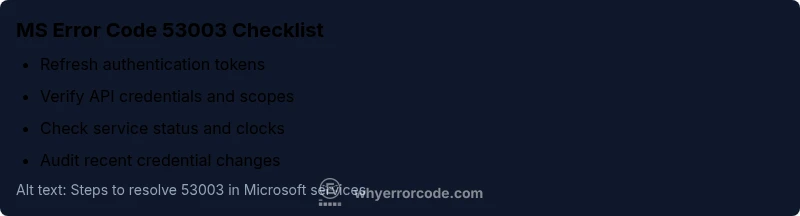
- Confirm that the authentication token is valid or refresh it if possible.
- Validate API keys, client IDs, client secrets, and their granted scopes against the service requirements.
- Check the system clocks on involved machines; time drift can invalidate tokens.
- Review recent credential changes or policy updates that may affect access.
- Look up the service status page for outages that could influence authentication workflows.
Diagnostic flow and reasoning
Symptom → causes → fixes is the mental model you should use. If the symptom is a failed service call due to 53003, the most likely cause is an expired or invalid token (high likelihood). A secondary cause is misconfigured scopes or credentials (medium). A rare but possible cause is clock drift affecting token validity (low). The recommended fixes move from quick actions to longer-term repairs: refresh tokens, verify credentials and scopes, resync clocks, and re-authenticate sessions. Why Error Code recommends starting with token renewal and credential verification because these address the root identity problem in most environments.
Step-by-step fix for the most common cause
- Re-authenticate and refresh the access token: sign out and sign back in, or trigger your OAuth flow to obtain a fresh token.
- Validate credentials and scopes: compare the app registration details, client IDs, secrets, and granted scopes against the service’s required permissions.
- Check for clock skew: ensure NTP is enabled and server times align.
- Test in a controlled environment: run a minimal request to confirm that the token is accepted.
- Review logs and diagnostics: filter for 53003-related messages to confirm the fix.
- If using service principals or automation: rotate keys and reconfigure the service principal.
Other potential causes and fixes
Beyond token expiry, 53003 can arise from misconfigured scopes, revoked permissions, or a service-side policy update. If token renewal and credential checks fail to resolve the issue, verify that the correct resource and audience are targeted in your token request. For service principals, confirm that the certificate or secret has not expired and that the app registration remains enabled. In some setups, proxies or middleware can strip headers needed for authentication; inspect these intermediaries and adjust the connection flow to preserve required headers.
Safety, costs, and when to call a professional
If the error blocks production or involves sensitive data, do not delay escalation. Have an admin review IAM roles and policy boundaries; a single misconfiguration can expose or restrict access across services. Costs for professional assistance vary by region and scope, typically ranging from a few hundred dollars for quick remediation to hourly consulting charges of $75–$250 for complex migrations or multi-service issues.
Prevention and best practices
Establish a token lifecycle strategy with scheduled renewals and automated revocation checks. Implement alerting for token expiry windows and failed refresh attempts. Use service principals with least privilege and rotate credentials on a regular cadence. Maintain a centralized log of IAM changes and test critical paths in a staging environment before rolling updates to production. Regularly review access policies to prevent unexpected permission changes.
Steps
Estimated time: 20-40 minutes
- 1
Open the authentication client or app configuration
Access the OAuth or SSO integration settings to locate the token and credential parameters. Verify that the intended resource and audience are correct for your request.
Tip: Document the current config before making changes. - 2
Refresh token and re-authenticate
Trigger the sign-in flow to obtain a fresh access token or perform a token refresh in your client library.
Tip: Use a test account to avoid impacting production data. - 3
Validate credentials and scopes
Cross-check client IDs, secrets, and granted scopes against the service’s required permissions. Ensure the app is permitted to access the requested resource.
Tip: If possible, run a minimal scope test in a sandbox. - 4
Check system time alignment
Verify that all involved servers are time-synced using NTP. Token validity often depends on accurate clocks.
Tip: Compare times across all endpoints to detect drift. - 5
Test with a controlled call
Make a small, controlled request to confirm the token is now accepted by the service.
Tip: Enable verbose logging for authentication events. - 6
Rotate credentials if needed
If service principals or secrets were exposed or rotated recently, reconfigure the client and perform a fresh login.
Tip: Adopt a credential rotation policy to reduce risk.
Diagnosis: Error code 53003 occurs during a Microsoft service call or login attempt
Possible Causes
- highExpired or invalid authentication token
- mediumIncorrect API credentials or scopes
- lowMismatched system clock or token timestamp
Fixes
- easyRefresh authentication token or re-login to obtain a new token
- easyVerify API keys, client IDs, and scopes granted to the app
- easyCheck system time and timezone, resync via NTP if needed
Frequently Asked Questions
What does ms error code 53003 mean?
It signals an authentication or permission failure during a Microsoft service call, often due to expired tokens or misconfigured credentials.
MS error code 53003 means your authentication or permissions failed during a Microsoft service call.
Is there a quick fix for 53003?
Yes. Refresh tokens, re-authenticate, verify credentials and scopes, and ensure system clocks are synchronized. If the problem persists, check service status.
Refresh the token, re-authenticate, and verify credentials and scopes before rechecking service status.
Can clock drift cause 53003?
Yes, time drift can invalidate tokens. Ensure NTP is enabled and time is synchronized across all involved systems.
Clock drift can trigger 53003, so synchronize times across all servers.
When should I contact support?
If token refresh and credential checks fail to resolve the issue, or if there is a suspected security breach, escalate to admin or Microsoft support.
If refreshing doesn’t help, reach out to your admin or Microsoft support.
Will rotating credentials help?
Rotating credentials and reconfiguring the app registration often resolves persistent 53003 errors, especially after policy updates or leaks.
Rotating credentials can help fix recurring 53003 issues.
Does 53003 apply to all Microsoft services?
53003 is a general authentication error that can affect multiple Microsoft services and APIs; the resolution approach is similar but tailored to each service.
53003 can affect various Microsoft services; fix by validating identity and permissions across the specific service.
Watch Video
Top Takeaways
- Refresh tokens and re-authenticate first
- Verify credentials and scopes for accuracy
- Check system clocks and service status
- Rotate credentials when needed and document changes