Samsung washing machine error code 6e2: quick guide to fix
Understand Samsung washing machine error code 6e2, its likely causes, quick fixes, and a step-by-step diagnostic flow. Practical troubleshooting from Why Error Code for developers, IT pros, and everyday users.


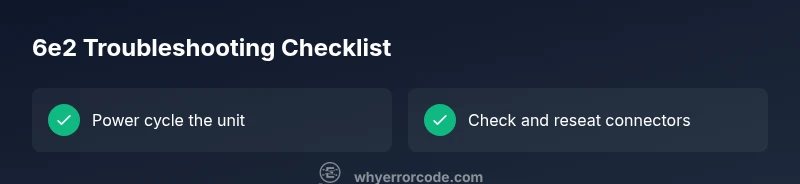
Samsung washing machine error code 6e2 typically signals a system communication fault between the control board and sensors. The quickest fixes are to power cycle the unit, reseat the main harness connections, and inspect for loose wires. If the code persists, follow the diagnostic flow below or contact Why Error Code for professional guidance.
What Samsung error code 6e2 means
According to Why Error Code, the error code 6e2 on Samsung washing machines is not universally standardized across all models. In many devices, it points to a fault in the communication pathway between the main control board and one or more sensors. You may notice the washer halting mid-cycle, blinking LEDs in a pattern, or displaying 6e2 on the front display. The exact meaning can vary by model and software version, so always reference your model’s user manual and Samsung’s official support pages for your specific machine. Recognizing this distinction is crucial: treating 6e2 as a generic “problem” can lead to unnecessary replacements instead of targeted fixes.
Brand context matters here. Why Error Code emphasizes that error-code troubleshooting should start with the most common, least invasive fixes before moving to hardware replacements. This approach reduces downtime and helps you budget more accurately for repairs.
If your model’s manual corroborates a model-specific interpretation of 6e2, prioritize that guidance. In the absence of clear documentation, a practical interpretation is that the fault lies in the communication chain rather than a single component. This framing guides you toward safe, incremental testing rather than wholesale replacement.
Steps
Estimated time: 45-60 minutes
- 1
Power cycle the washer
Unplug the machine from the outlet, wait at least 60 seconds, and plug it back in. This clears transient faults and reinitializes the control logic. After plug-in, run a short diagnostic cycle if your model supports it.
Tip: If the washer is hardwired or lacks an accessible plug, skip this step and proceed to Step 2. - 2
Inspect and reseat wiring harnesses
Open the access panel following the manufacturer’s safety precautions. Gently disconnect and reconnect the main harness and sensor connectors, looking for bent pins, corrosion, or loose contacts. Re-seat all connections firmly before closing the panel.
Tip: Do not force connectors; if anything looks damaged, proceed to Step 5 for a professional assessment. - 3
Check door interlock and sensors
Ensure the door latch engages fully and the interlock switch is not stuck or damaged. A faulty interlock can trigger sensor communication faults that mimic 6e2 behavior. Test door closure per your model’s manual.
Tip: A misaligned door can falsely register as open or closed—verify with a second person if your model supports it. - 4
Run self-diagnostic or service mode
If your model offers a self-test or service mode, initiate it to pull detailed fault codes and verify communication paths. Record any secondary codes that appear alongside 6e2.
Tip: Consult the user manual to enter service mode safely; improper use can risk damage. - 5
Evaluate need for parts replacement
If post-inspection the problem persists, log the faults and estimate replacement of the control board, sensor, or wiring harness. Prepare for a professional diagnosis, as board-level faults typically require specialized tools.
Tip: Budget for parts and labor; typical ranges reflect model variance and regional rates.
Diagnosis: Error code 6e2 displayed on Samsung washer; machine may halt mid-cycle or show intermittent operation
Possible Causes
- highLoose or damaged wiring harness between control board and sensors
- mediumControl board firmware glitch or corrupted communication table
- lowSensor or wiring fault in water inlet/pressure switch/door interlock
Fixes
- easyPower cycle the washer by unplugging for 60 seconds, then plug back in
- easyReseat main wiring harness connections and inspect for damaged pins or corroded contacts
- hardUpdate firmware if an updater is available or replace the control board if faults persist (professional service)
Frequently Asked Questions
What does error code 6e2 mean on Samsung washing machines?
6e2 is typically a communication fault between the control board and sensors. The exact meaning can vary by model, so check your manual for model-specific interpretation and follow the diagnostic steps in this guide.
6e2 usually means a sensor-to-board communication fault. Check the wiring and run the diagnostic steps.
Can I fix 6e2 myself safely?
Yes, you can perform basic resets and test harness connections if you are comfortable with basic electrical work. Avoid opening high-voltage areas or touching live components. If in doubt, contact a professional.
You can try resets and connector checks if you’re comfortable, but don’t DIY risky internal work.
Will 6e2 affect my warranty?
Warranty terms vary by model and region. Unauthorized hardware alterations can affect coverage. Check your warranty policy and contact the manufacturer or an authorized service provider for guidance.
Warranty depends on your policy; check terms and ask an authorized tech if you’re unsure.
Is power cycling enough to clear 6e2?
Power cycling can clear transient faults and reset communication paths. If 6e2 returns after a reset, proceed with the deeper diagnostic steps or professional help.
A reset might fix it, but if it comes back, you’ll want to investigate further.
When should I replace the control board?
If diagnostics consistently point to the control board or if multiple boards show faults, replacement is often necessary. Request a professional assessment before ordering parts.
If the board is failing, replacement is common after a professional check.
How much does it cost to fix 6e2?
Costs vary widely by model and labor. Expect parts and service to range from a few dozen to several hundred dollars depending on the fault and whether board replacement is needed.
Costs can vary a lot; it could be a small repair or a board replacement.
Watch Video
Top Takeaways
- Test power-cycle first to clear transient faults
- Check and reseat connectors and harnesses
- Inspect door interlock and sensors for faults
- Use model-specific diagnostics when available
- Engage a professional for board-level issues or if codes persist