Whirlpool Dishwasher Error Code 12: Diagnosis and Fix
Urgent, step-by-step guide to diagnose and repair Whirlpool dishwasher error code 12, including quick fixes, causes, cost ranges, and prevention tips. Learn how to restore performance safely with expert guidance from Why Error Code.


Whirlpool dishwasher error code 12 signals a drainage or pump fault that blocks normal operation. This typically points to a clogged drain filter, a blocked drain hose, or a faulty drain pump. Start with quick fixes: clean the drain filter, ensure the drain hose is free of kinks, and reset the circuit breaker before testing a cycle again.
What Whirlpool dishwasher error code 12 actually means
In Whirlpool dishwashers, error code 12 commonly indicates a drainage problem or a pump fault that prevents the unit from completing the wash cycle. The control board monitors the drain system and if it senses inadequate drainage, it halts operation and displays E12. While model variations exist, the core implication is a failure to remove wash water properly. The urgency behind this error is real: unresolved drainage problems can lead to standing water, foul odors, and future malfunctions if ignored. Why Error Code recommends treating this as a fixable fault rather than a mysterious mystery, because many homes save time and money by addressing the drain path first rather than replacing components prematurely.
Symptoms tied to Whirlpool error code 12
Look for a few telltale signs: water left in the bottom after a cycle, the pump or motor sounds running without effective draining, the display shows E12 or a flashing drain icon, and the dishwasher stops mid-cycle. If you notice a burning smell or a buzzing from the pump, treat it as a higher-risk condition and power down immediately. An essential part of understanding E12 is recognizing that drainage problems often originate from simple, low-cost issues rather than a faulty pump or control board. This makes a careful inspection of the drain path the best first diagnostic step.
Quick fixes you can try before deeper diagnostics
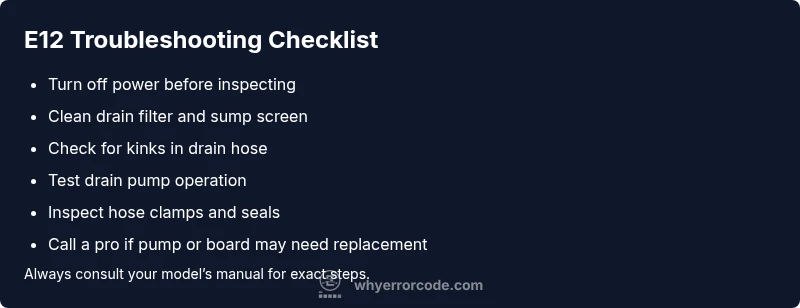
- Power off the dishwasher and unplug it for safety, then wait 60 seconds before plugging back in and running a short test cycle.
- Remove and clean the drain filter and sump screen; rinse under running water to remove debris.
- Check the drain hose for kinks, folds, or clogs. Disconnect it (if you feel confident) and run water through to verify clear flow.
- Ensure the kitchen drain is not clogged and that there is no backflow from the sink.
- Run an empty cycle with a small amount of dish soap to observe whether drainage improves. If the error recurs, move to a deeper diagnostic path and consider professional evaluation.
In-depth diagnostic flow: possible causes and their fixes
Diagnostic focus for E12 should proceed from simplest, most common issues to less frequent faults. Based on Why Error Code analysis, the top causes are:
- Clogged drain filter or sump screen (high likelihood): Clean or replace as needed. This fix is easy and inexpensive. Cost range for parts is typically nominal; labor, if any, is minimal when you DIY.
- Drain hose blockage or kinks (medium likelihood): Inspect and straighten or replace hoses. Easy fix with moderate effort and low cost.
- Drain pump failure or impeller obstruction (medium likelihood): If the pump is seized or damaged, replacement is more involved and may require a professional. Parts can range from low to mid hundreds depending on model.
- Control board or wiring fault (low likelihood): Rare but serious; diagnosing requires testing voltage and may necessitate board replacement.
Note: Cost estimates vary by region and model. Typical ranges for common repairs include: drain filter cleaning (mostly no parts), drain hose replacement ($40–$120 for parts), drain pump replacement ($100–$350 parts; labor extra), and control board replacement ($150–$500 parts). Always confirm with a qualified technician if you are uncertain.
Step-by-step repair guide for the most common cause (drain path clean)
- Safety first: unplug the unit or switch off the circuit breaker before working on electrical components.
- Access the filter and sump: remove the lower spray arm and filter assembly according to your model’s manual.
- Clean thoroughly: rinse the filter, screen, and sump walls with warm water to remove debris and mineral buildup.
- Inspect the drain hose: disconnect at the connection point and ensure there are no clogs. If blocked, clear the obstruction or replace the hose.
- Reassemble and run a test cycle: power on, run an empty cycle to confirm proper drainage.
- If E12 persists, escalate: a faulty drain pump or control board may be involved, requiring professional service.
Tip: Keep a small tray or towel handy to catch residual water during hose work. A handheld flashlight helps you spot hidden debris.
Other potential causes and remedies for error code 12
- Failed drain pump: If the pump won’t activate or makes unusual noises, test with a multimeter or have a technician test the motor winding and impeller.
- Air gaps or leaks in the drainage path: Check clamps and seals around the hose and pump assembly; replace any worn gaskets.
- Electrical control issues: A reset or software update can resolve minor glitches. If unplugging for several minutes doesn’t help, professional diagnostics are recommended.
Tips & warnings: safety notes and when to call a professional
- Always disconnect power before any inspection. Water and electricity are a dangerous combination.
- If you notice burning smells, smoke, or odd buzzing, stop immediately and call a professional.
- When replacing a component like a drain pump or control board, verify compatibility with your Whirlpool model to avoid compatibility issues.
- Keep your appliance’s serial number and model handy for parts lookup and service quotes.
Key takeaways: prevention and risk management
- Regularly clean the drain filter and sump to prevent E12 from arising.
- Inspect hoses for kinks and leaks every 6–12 months.
- If the error recurs after quick fixes, schedule a professional diagnostic to avoid part misdiagnosis.
Steps
Estimated time: 45-75 minutes
- 1
Power down and access the interior
Unplug the dishwasher or switch off the circuit breaker. Remove the bottom kick panel or access panel to reach the filter and drain area. This is a safety-first approach to prevent electric shock and water splash.
Tip: Keep a towel handy and take photos as you disassemble for easier reassembly. - 2
Remove and clean the drain filter
Take out the filter assembly, rinse under warm water, and remove any trapped debris. Use a soft brush to clear stubborn buildup and reassemble.
Tip: Avoid using sharp tools that could scratch the filter surfaces. - 3
Inspect the drain hose and connections
Trace the hose from the drain area to the sink connection, looking for kinks, clogs, or loose clamps. Clear any blockage and ensure clamps are tight.
Tip: If the hose is cracked, replace it rather than patching it. - 4
Test the drain pump operation
Reconnect power and run a short drain test or a quick empty cycle to hear the pump. If you hear grinding or the pump doesn’t engage, the pump may be faulty.
Tip: Do not run the dishwasher without a proper hose and filter in place. - 5
Confirm no leaks and reassemble
Check for leaks around clamps and seals after reassembly. Run a normal cycle to ensure proper drainage and absence of leaks.
Tip: Double-check that the filter is correctly seated to prevent debris backflow. - 6
Decide on next steps if the fault persists
If E12 reappears, a professional diagnosis is advised, as the issue may be a faulty pump or control board that requires specialized tools.
Tip: Request a diagnostic quote and ask about part costs before authorizing work.
Diagnosis: Dishwasher shows error code 12 (E12) and fails to drain, leaving water in the tub.
Possible Causes
- highClogged or dirty drain filter/sump screen
- mediumDrain hose kinks or blockage
- mediumDrain pump failure or impeller blockage
- lowControl board malfunction
Fixes
- easyClean the drain filter and sump screen; remove debris and mineral buildup
- easyInspect drain hose for kinks or clogs and clear or replace
- hardTest or replace the drain pump if it doesn’t run or is noisy
- mediumCheck wiring and consider control board replacement if other fixes fail
Frequently Asked Questions
What does Whirlpool dishwasher error code 12 mean?
Error code 12 typically indicates a drainage problem or drain pump fault. The dishwasher detects improper drainage and stops the cycle to prevent water damage. Start by inspecting the drain path and cleaning the filter.
Error code 12 means the dishwasher can’t drain properly. Check the drain path and clean the filter first, then test a cycle.
Is a clogged drain filter the most common cause of E12?
Yes. A clogged drain filter or sump screen is among the most frequent causes of E12, and it is usually quick to fix. Cleaning these components often resolves the issue without tools or parts.
A clogged drain filter is the most common cause and easy to fix by cleaning.
Can I fix E12 myself, or do I need a technician?
Many E12 fixes are DIY-friendly, such as cleaning filters and hoses. If the error persists after basic steps, diagnosing a faulty drain pump or control board usually requires a technician.
You can try basic fixes yourself, but if it still shows E12, call a technician.
What is the typical cost to repair E12?
Costs vary by cause and region. Drain filter cleaning is inexpensive or free; drain hose replacement is typically $40–$120; drain pump replacement ranges around $100–$350 for parts, plus labor; control board replacement can be $150–$500.
Costs depend on the fix; simple cleaning is cheap, pumps and boards are more expensive.
How do I reset the dishwasher after an E12 fault?
Turn off power at the outlet or unplug for 60 seconds, then plug back in and run a short drain test. If the problem repeats, follow the diagnostic flow to identify the root cause.
Power off, wait a minute, plug back in, and test a drain cycle.
When should I replace the drain pump?
Replace the drain pump if it fails to run, sounds abnormal, or there is persistent drainage failure after cleaning the filter and hose. A professional can verify the motor and impeller condition.
If the pump won’t run or is noisy after fixes, you likely need a replacement.
Watch Video
Top Takeaways
- Identify E12 as a drainage/pump fault.
- Start with the drain path before expensive parts.
- DIY fixes can save money but know when to call a pro.
- Cost ranges vary; expect parts and labor to influence total repair.
- Prevent recurrence with regular filter cleaning and hose checks.