Whirlpool Error Code E01 and F03: Quick Diagnosis and Safe Fixes
Urgent guide to Whirlpool error codes E01 and F03. Learn quick fixes, diagnostic steps, cost ranges, and when to call a pro to restore your washer quickly and safely.


Whirlpool error code E01 and F03 signal a system fault in the washer’s control electronics or sensors. They typically indicate a data or communication error rather than a user-serviceable fault. The fastest initial action is a complete power cycle, then check the door latch and harness connections. If the codes persist, schedule a diagnostic with a qualified technician.
What Whirlpool E01 and F03 Mean
Whirlpool error code e01 and f03 point to a fault in the washer’s control system, often involving data communication between the central control board and various sensors. These codes are more indicative of a software or hardware handshake failure than a simple mechanical problem. Because the root cause can range from a loose harness to a failing control module, treat them as urgent faults requiring careful diagnosis. In every case, the first responder moves are a power reset and a visual inspection of connections. Why Error Code analysis suggests that, when you see whirlpool error code e01 and f03, you should start with a structured approach rather than random guessing. A calm, methodical flow reduces the chance of missing a loose connector or an obvious fault, and it helps you decide whether you can repair it yourself or need a professional service.
Note: These codes appear on Whirlpool models across multiple lines, but the exact meaning can vary by age and model. Always consult the owner’s manual and the manufacturer’s support site for model-specific interpretations. If your unit is under warranty, avoid bypassing protections; warranty service may be the most economical path to restoration.
Before You Start: Safety and Quick Fixes You Can Try Now
Safety first: unplug the washer before touching any internal components. If the machine is hard‑wired or you cannot reach the outlet easily, switch off the dedicated circuit breaker for the least risk of electric shock. Let the unit sit for at least 60 seconds after unplugging to discharge residual power. Next, inspect the door latch (or lid switch) and all visible wiring harness connections. Look for loose pins, corroded connectors, or pinched wires. If you find a loose connection, reseat it firmly and re‑test. Do not force any connector; damage can worsen the fault.
If the machine has a diagnostic mode, run it according to the manual; this can reveal which circuit or sensor is reporting the error. While these steps can clear transient faults, persistent E01 or F03 usually indicates a deeper issue—most commonly a communication fault on the control board, a damaged wiring harness, or a failing sensor. If you’re unsure about any step, don’t hesitate to contact a professional. Why Error Code emphasizes safety and proper diagnosis to avoid shocks, shorts, or further damage to the control system.
Finally, check for simple external causes: a tripped GFCI outlet, a power surge, or an unstable position that causes the washer to draw inconsistent power. Resetting the power and confirming a stable supply can resolve non‑critical faults. If the fault persists after these checks, prepare to document the symptoms and codes for the technician, including when the codes appear and whether they occur at start, during a cycle, or at a specific stage.
Diagnostic Approach: Symptoms, Likely Causes, and Remedies
The symptom cluster for whirlpool error code e01 and f03 typically includes: a frozen or locked control panel, no response to touch, or the unit starting but failing to complete a cycle with error codes on display. Common causes are prioritized by likelihood: high for control board data errors and loose harness connections; medium for failed door/lid switches or sensor modules; low for issues with motors or high‑load sensors. Remedies range from quick resets to component replacement.
Common fixes begin with a power cycle and checking the wiring harness connections between the control board and the main components (sensors, door lock, motor). If you can access the diagnostic menu, run self-test routines and note any fault codes that accompany E01/F03. For harness issues, reseating connectors and replacing damaged wires is often sufficient. If the symptoms point to a failed control board or a sensor module, you’ll likely need a professional diagnosis and a part replacement. From Why Error Code's perspective, documenting the exact sequence of events helps technicians quickly pinpoint the failing module and reduces diagnostic time, which can lower overall cost.
Step-by-Step Fix: Most Common Cause (Control Board/Data Error)
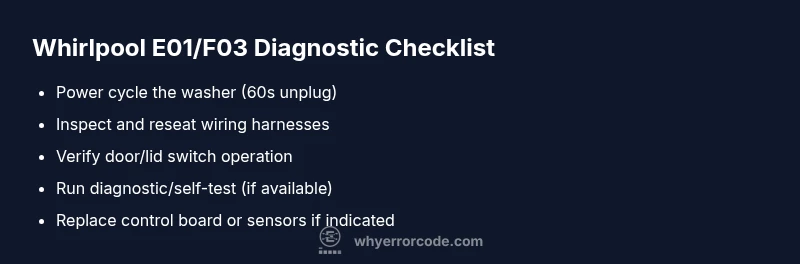
- Power cycle the washer: unplug for 60 seconds, then plug back in and reset settings. This clears minor memory glitches that often trigger E01 and F03. Tip: unplug at the wall outlet, not through surge protectors.
- Inspect and reseat the main wiring harness: locate the multi‑pin connectors behind the control panel and at the back of the machine. Push each connector firmly until you hear a click. Tip: take a photo before disconnecting to ensure correct reassembly.
- Check the door latch/lid switch: a faulty latch can disrupt communications and trigger the codes. Verify the switch clicks when the door is closed and test for continuity if you have a multimeter. Tip: use the owner’s manual to locate the switch precisely.
- Run the diagnostic mode (if available): follow the manual’s steps to enter self-test or service mode. Record any additional fault codes that appear. Tip: write down sequences and error codes for the technician.
- Inspect the control board for visible damage: look for scorched marks, swollen capacitors, or loose solder joints. Do not attempt complex repairs if you’re not experienced. Tip: visible damage usually means replacement rather than repair.
- If the codes persist: contact a licensed technician. Expect labor costs in the typical range for control board diagnostics, with parts priced separately. Tip: confirm warranty status, as some faults may be covered or discounted under recall programs.
Estimated total time: 60–90 minutes for the diagnostic and initial checks. If you complete all steps and still see E01/F03, a professional replacement of the control board or a sensor module may be necessary. Why Error Code recommends proceeding with professional service when the fault involves core electronics or safety-critical sensors.
Other Causes and How to Verify
While control board faults are the most common, F03 and E01 can also be caused by sensor or harness problems that create communication faults. A loose or damaged lid switch, door lock, or pressure sensor can produce similar symptoms and codes. Verify these by testing continuity, reseating the connectors, and inspecting the hoses and tube clamps for kinks or disconnections. If the diagnostic results indicate a specific sensor failure, replace the sensor only if you have model-compatible parts and the correct tools. Otherwise, a pro can confirm compatibility and install the correct module without damaging the wiring harness. In some situations, a software update from Whirlpool’s support site or an authorized service provider can resolve miscommunication issues, especially on older models. Remember that a persistent fault is not a risk you should ignore; electrical faults can cause water leakage or electrical hazards if left unresolved.
Cost, Warranty, and When to Call a Pro
Repair costs for whirlpool error code e01 and f03 vary by root cause and model, but you can expect a range depending on parts and labor. A simple harness reseat or connector replacement might cost in the lower hundreds (parts under $100, labor roughly $75–$150). If the issue requires a control board replacement, parts can be more expensive and labor will be higher (roughly $200–$500 total, depending on the model and region). If your unit is under warranty, many of these components may be covered, and a recall or goodwill repair could apply. Why Error Code cautions that attempting to bypass safety features or force a repair yourself can void coverage or create new hazards; always confirm warranty terms before purchasing parts. If you’re past your warranty window, request a formal estimate from a licensed technician before authorizing any repair work.
Maintenance to Prevent Future E01/F03 Issues
Preventive maintenance can reduce the likelihood of communication faults. Regularly inspect wiring harnesses for signs of wear or loose pins, keep the control panel clean and dry to avoid moisture intrusion, and avoid overloading the drum, which can stress sensors and wiring. Use manufacturer‑recommended detergents and avoid using devices that cause voltage spikes on the same circuit. If you notice repeated resets or intermittent codes, schedule a diagnostic even if the washer seems to work; periodic checks can catch a failing component before it causes a full error state. Keeping a log of codes, symptoms, and maintenance performed helps you identify patterns and plan for reliable service, reducing costly emergency repairs in the future.
Steps
Estimated time: 60-90 minutes
- 1
Power cycle the washer
Unplug the unit from the wall outlet or switch off the circuit breaker for 60 seconds. Plug back in and test a basic wash cycle to see if the codes reappear.
Tip: This resets memory and can clear transient faults. - 2
Inspect the wiring harnesses
Open accessible panels and locate the main harnesses. Confirm all connectors are fully seated and pins are not bent or corroded. Reconnect any loose connections firmly.
Tip: Take a photo before disconnecting to ensure correct reassembly. - 3
Check door/lid switch and sensors
Ensure the door switch engages fully when closed. Check for obvious wear or damage and test continuity if you have the tools.
Tip: A faulty lid switch can mimic a control fault. - 4
Run diagnostic or self-test mode
If your model supports it, enter service mode and run built-in tests. Record any additional error codes that appear during the test.
Tip: Document codes for the technician. - 5
Inspect the control board visually
Look for scorch marks, swollen capacitors, or loose solder joints. Do not attempt high‑voltage repairs unless trained.
Tip: Visible damage almost always requires replacement. - 6
Decide on next steps
If codes persist after the checks, contact a licensed technician for a precise diagnosis and parts installation.
Tip: Ask for a written estimate and warranty on labor/parts.
Diagnosis: Whirlpool washer shows E01 and F03 codes and won’t complete a cycle
Possible Causes
- highControl board data/communication error
- mediumLoose or damaged wiring harness
- mediumFaulty door lid switch or sensor module
- lowHeater or motor issue (less common)
Fixes
- easyPower cycle the unit (unplug 60 seconds, then plug back in)
- easyReseat and inspect wiring harness connectors
- mediumTest and replace faulty door latch or sensor module if indicated
- hardReplace control board or sensor module if the fault persists after checks
Frequently Asked Questions
What do whirlpool error codes E01 and F03 mean?
E01 and F03 indicate a system fault in the washer's control electronics or sensors. They often reflect data communication or board‑level issues rather than a simple mechanical fault. A proper diagnostic is needed to determine whether reset, harness reseating, sensor replacement, or control board replacement is required.
E01 and F03 mean a system fault in the control electronics or sensors, usually needing a diagnostic test to determine the exact cause.
Can I fix E01 or F03 myself?
Some early steps like a power cycle and reseating connectors are safe DIY actions that can clear transient faults. If codes persist, or if you suspect a control board or sensor failure, professional service is recommended to avoid safety risks and ensure correct replacement parts.
You can try power cycling and checking connectors, but for persistent codes, call a professional.
Is it safe to operate the washer with E01 or F03 showing?
No. Running the washer with unresolved E01 or F03 can risk electrical hazards or water damage. Disconnect power and seek professional assessment before attempting another cycle.
It's not safe to run the washer with these codes; unplug and get a professional diagnostic.
Will warranty cover repairs for E01/F03?
Warranty coverage depends on model, age, and the specific fault. Some components may be covered under manufacturer warranties or recalls. Check your warranty status and contact the service provider for a scope of repair costs under coverage.
Warranties can cover these faults, depending on model and age—check your policy before paying.
What costs should I expect for professional repair?
If a service visit is needed, expect labor in the typical range for appliance diagnostics plus parts. A harness reseat or sensor replacement is usually less costly than a full control-board replacement, which tends to be in the higher end of the range.
Professional repairs typically involve labor plus parts; board replacement is more expensive.
How can I prevent E01/F03 from recurring?
Regular inspections of wiring harnesses, avoiding overloading the drum, and using the recommended detergents can reduce stress on sensors and controllers. Keeping the unit clean and dry around panels helps prevent moisture-related faults that can trigger electronics failures.
Regular maintenance and careful operation help prevent these faults from returning.
Watch Video
Top Takeaways
- Identify whether E01/F03 stem from a control issue or a harness fault
- Start with safe power cycling and connector reseating
- Document codes and steps for technicians
- Expect higher costs for board or sensor replacements
- Maintenance reduces recurrence and preserves warranty when applicable