Windows Memory Error Codes: Quick Fixes and Diagnostics
Learn how to diagnose and fix Windows memory error codes quickly. Step-by-step memory diagnostics, driver checks, and safe RAM tips from Why Error Code to minimize downtime.


Windows memory error codes indicate issues with RAM, memory management, or the pagefile. The most reliable quick fix is to run Windows Memory Diagnostic, update drivers, and check for hardware faults. If the BSOD or memory error persists, reseat RAM, test one module at a time, and consider replacing faulty memory with known-good sticks.
What Windows memory error memory means
A memory-related error code on Windows signals that the operating system has encountered trouble managing memory or accessing data in RAM. Symptoms can range from sudden slowdowns and random reboots to blue screens of death (BSOD) that cite a memory issue. These codes are not the OS declaring a new problem, but a shorthand for memory subsystem trouble—often involving RAM, the pagefile, or a driver that mismanages memory. Understanding that memory errors are usually hardware- or driver-related helps you triage quickly. In 2026, the Why Error Code Team notes that most memory-related crashes are linked to RAM faults or conflicting drivers, though software corruption can also trigger memory codes. The key is to treat memory errors as a signal to verify hardware health and software integrity rather than chasing a single magical fix.
In practice, memory error codes should prompt a structured approach: confirm hardware health, rule out software conflicts, and then proceed to targeted repairs. Start with a safe environment, ensure power stability, and back up essential data as you proceed. The memory subsystem is sensitive to heat, power surges, and static electricity, so handle components with care. By addressing both hardware and software factors, you can suppress memory error codes and restore stable operation.
(According to Why Error Code analyses conducted in 2026, RAM faults and driver conflicts are the leading culprits behind memory error codes in Windows environments.)
Causes and symptoms of memory-related errors
Memory-related codes often surface when RAM modules are failing, not seated properly, or incompatible with the motherboard. Overheating due to dust buildup or overclocked settings can also trigger memory faults. Driver conflicts—especially after major Windows updates or new hardware additions—may mismanage memory allocation and cause sporadic crashes. In some cases, corrupted system files or a failing disk/virtual memory configuration can mimic RAM problems, producing similar codes. Common symptoms include BSODs with error codes like MEMORY_MANAGEMENT or IRQL_NOT_LESS_OR_EQUAL, unexplained reboots, freezes during memory-intensive tasks, and applications crashing due to bad memory reads. System logs in Event Viewer can reveal repeating patterns that point to RAM or memory-management issues.
To improve reliability, ensure your system is clean physically (no dust, proper ventilation) and that components are compatible with your motherboard. Update BIOS/UEFI to the latest stable version from the manufacturer, as memory handling improvements are often included in firmware updates. Keep drivers current—particularly chipset, storage, and graphics drivers—since drivers operate in the same memory space as applications and OS components. Finally, run built-in tools to validate memory health and repair any corrupted system files when necessary.
Quick fixes you can try right now
If you’re facing memory error codes, you can often stabilize the system with a few non-destructive steps. Start by saving work and taking backups. Then run Windows Memory Diagnostic to check RAM health. Update all critical drivers, especially chipset and storage controllers. Check for overheating and ensure the system has good airflow. Disable any recently installed software that could conflict with memory allocation temporarily to see if the issue subsides. If the machine remains unstable, run SFC and DISM to repair system files, and consider adjusting virtual memory paging file size to a recommended range. Finally, reseat RAM modules or swap sticks to identify a faulty module. These quick fixes are typically low risk and can be completed in under an hour in many cases.
Step-by-step guide: run memory diagnostics and health checks
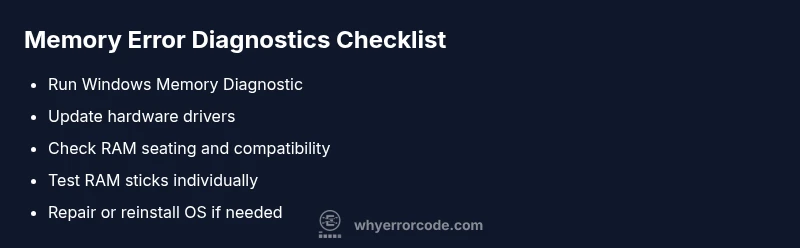
- Prepare the system: back up data, close unnecessary apps, and ensure the PC is on a stable power source. 2) Run Windows Memory Diagnostic: type 'Windows Memory Diagnostic' in the Start menu, choose 'Restart now and check for problems', and let the tool complete; your computer will reboot once or twice. 3) Review results: after reboot, open the Event Viewer to confirm scan findings. 4) If failures are reported, reseat RAM modules one at a time, and test with known-good sticks. 5) Run memtest86 if available on a bootable USB, allowing several passes for a thorough check. 6) Update drivers and run SFC/DISM to repair system files. 7) If errors persist, reduce memory speed or adjust BIOS/UEFI memory settings to stable values, or plan RAM replacement. 8) Document findings and schedule professional support if hardware faults are suspected.
Advanced troubleshooting: optimizing hardware and software interactions
Advanced users can test RAM bands one at a time by removing all but one module, then testing each slot and each module individually. If a particular module fails in multiple slots, it’s likely faulty. Run memtest86 for a deeper scan; allocate ample time because a thorough pass can take several hours. Update or roll back drivers to identify conflicts that trigger memory faults. Check for firmware updates to motherboard and storage controllers, as these can affect memory addressing and paging behavior. If you still encounter memory error codes after hardware testing, consider reinstalling Windows to rule out OS corruption, but only after thorough data backup.
When to replace RAM or seek professional help
If multiple RAM modules fail diagnostics or a single module fails in every test, replacement is usually the fastest path to stability. RAM replacement costs vary by capacity, type, and vendor, typically forming a broad price range depending on specifications. If you’re unsure about compatibility, seek professional support to select compatible modules and perform a safe RAM upgrade. A hardware technician can also verify motherboard health and rule out other issues like a failing power supply or defective motherboard DIMM slots. If the system is under warranty, contact the manufacturer for covered repairs or replacements.
Preventive habits to reduce memory errors
Adopt routine memory hygiene practices to prevent recurrent memory errors. Regularly clean dust from the PC, ensure the system runs at safe temperatures, and avoid overclocking unless you’ve tested stability. Keep Windows and drivers up to date, and monitor memory usage with built-in tools to catch leaks early. Periodically run a memory diagnostic when you notice abnormal performance, especially after hardware changes or software updates. Maintain proper backups and document baseline configurations so you can quickly compare changes that may trigger memory issues.
Steps
Estimated time: 60-120 minutes
- 1
Prepare and back up
Save all work and back up important data. Ensure the PC is on a stable power source and avoid power interruptions during diagnostics. This protects your data if you need to reseat RAM or run hardware tests.
Tip: Have Windows recovery media ready in case you need to repair the OS. - 2
Run memory diagnostic tools
Launch Windows Memory Diagnostic and follow prompts to restart and scan RAM. After the test, review results in Event Viewer to identify the failing module or slot.
Tip: If you rely on the PC heavily, schedule the test for a time when you won’t need it immediately. - 3
Update drivers and check software conflicts
Update chipset, graphics, and storage drivers from vendor websites. Temporarily uninstall recently added software to test if it resolves memory errors.
Tip: Only install driver updates from trusted sources to avoid introducing new issues. - 4
Repair system files
Run SFC /scannow and DISM to repair corrupted OS files. Reboot and re-run memory tests to see if issues persist.
Tip: Note any recurring file errors and plan OS repair if corruption recurs. - 5
Adjust virtual memory
Set a recommended paging file size based on your RAM amount and workload. Reboot and re-test to see if memory-related codes persist.
Tip: Don’t disable paging entirely; Windows relies on virtual memory for stability. - 6
Test RAM modules individually
Power down, unplug, and remove all but one RAM module. Boot and stress-test; repeat with other modules to identify a faulty stick.
Tip: If you’re uncertain about compatibility, consult the motherboard’s QVL list. - 7
Decide on replacement or professional help
If multiple modules fail across slots, plan a RAM replacement or seek professional diagnostics to avoid unnecessary purchases.
Tip: Warranty coverage can reduce costs; check with the manufacturer before buying.
Diagnosis: Blue screen or memory error on boot or during intensive tasks
Possible Causes
- highFaulty RAM module or misseated DIMMs
- mediumDriver conflicts or recently installed software
- lowDisk/virtual memory misconfiguration or corrupted system files
Fixes
- easyRun Windows Memory Diagnostic and memtest86 to verify RAM health
- easyReseat RAM sticks or replace with known-good modules
- mediumUpdate drivers and repair OS files; adjust virtual memory as needed
Frequently Asked Questions
What does the MEMORY_MANAGEMENT error mean in Windows?
MEMORY_MANAGEMENT indicates a problem with memory handling in Windows, often due to faulty RAM, driver conflicts, or OS corruption. Start with hardware tests, driver updates, and OS repair to isolate the cause.
MEMORY_MANAGEMENT means Windows had trouble managing memory, usually caused by RAM, drivers, or system file issues. Start with memory tests and driver updates to fix it.
Can memory errors cause data loss?
Yes, in some scenarios persistent memory faults can corrupt data or cause file system inconsistencies. Always back up important data before running diagnostics or making hardware changes.
Memory errors can cause data corruption if memory faults persist, so back up your data before testing hardware.
How long does Windows Memory Diagnostic take?
The diagnostic usually takes 10-20 minutes, depending on the amount of RAM and system speed. A longer scan with more thorough checks is possible if you choose extended options.
Typically around 10 to 20 minutes, but longer if you enable extended testing.
Should I disable virtual memory to fix memory errors?
No. Virtual memory helps prevent crashes when RAM is exhausted. If you’re troubleshooting, adjust the paging file size rather than disabling it entirely.
Don’t disable virtual memory; adjust the paging file size during troubleshooting.
Is it safe to reseat RAM modules?
Yes, reseating RAM is safe if you power down, unplug, and discharge static before handling components. This can resolve seating or contact issues.
Reseat RAM after powering down and grounding yourself; it’s usually safe and often fixes contact problems.
When should I replace RAM?
If multiple tests show faults consistently, replacement is advised. Consider warranty coverage and the cost of new modules when deciding.
Replace RAM if tests repeatedly fail; check warranty and costs first.
Watch Video
Top Takeaways
- Run diagnostics to identify faulty RAM
- Update drivers and repair OS files to fix soft issues
- RAM reseating and module testing solves most hardware faults
- Plan RAM replacement only after thorough hardware testing