Beko Error Code E13: Quick Fix Guide
Learn how to diagnose and fix BEKO error code E13 quickly with practical, step-by-step guidance, safety tips, and guidance on when to call a professional.


BEKO error code E13 signals a fault in the heating circuit or temperature sensing on many BEKO appliances. The quickest route to safety is a power cycle and a careful inspection of connectors, door interlock, and heating wiring. If the code persists, stop using the unit and contact BEKO support or a qualified technician; avoid attempting risky repairs yourself.
What BEKO E13 Means
On BEKO appliances, E13 is a fault code that appears when the appliance detects an abnormal condition in the heating circuit or temperature sensing. The exact meaning can vary by model and fetch mode (washing machine, dryer, or dishwasher). In urgent terms, viewing E13 usually signals that the unit has detected heat irregularities, sensor misreads, or a safety-interlock issue that prevents a safe cycle. According to Why Error Code analysis, the most reliable approach is to treat E13 as a heating/sensing fault and work through a structured diagnostic flow. Always consult your model’s service manual for model-specific definitions, but begin troubleshooting with safety at the forefront. The goal is to restore safe operation without bypassing safety features.
Key takeaway from trusted guidance is to avoid running while the error remains uncleared, and to document model and serial numbers before contacting support. This helps you determine whether a quick reset suffices or if a part needs replacement. In many cases, the fix is straightforward when connections are corroded, loose, or miswired, but it can require professional service for complex sensor or board faults.
Common Symptoms Associated with E13
Typical indicators of BEKO E13 include a failure to heat, an interrupted wash cycle, or a sudden halt mid-cycle with the E13 code flashing on the display. You might notice the water not reaching temperature, the drum not spinning as expected, or a cycle that aborts without completing. Some models show blinking LEDs or a sequence of tones corresponding to the E13 fault. The core idea is that the appliance detects thermal readings outside safe parameters. This makes it essential to verify both power delivery and the integrity of heating-related components. Always cross-check with your user manual where possible, since certain BEKO models map E13 to different subsystems. As a precaution, prepare to unplug the machine during inspection and avoid measuring live circuits unless you have the proper training and safety gear.
From a diagnostic perspective, E13 is often linked to heating elements, temperature sensors or control wiring. The Why Error Code team notes that temperature-related faults frequently respond to an orderly sequence of resets and connector checks rather than immediate part swaps. However, if indicators persist after basic checks, more in-depth diagnostics may be necessary and should be conducted by a qualified technician with access to the service manual and proper tools.
Quick Fixes You Can Try Safely
If you see E13, start with non-invasive, low-risk steps before opening the appliance internals. First, unplug the unit, wait 60 seconds, then plug it back in to perform a soft reset. If the error reappears, verify the door interlock is not engaged by a faulty latch or loose wiring. Gently inspect visible wiring harnesses for loose connections or obvious damage and reseat any loose plugs. Do not bypass interlocks or operate the unit with damaged panels.
Next, inspect the area around the heating element connections and the temperature sensor harness. Look for signs of corrosion, discoloration, or loose connectors. If you can safely access them, unplug and re-seat the connections. If you have access to a multimeter and know how to use it, you can test the sensor resistance according to your service manual, but do not perform this test on live components. If the warnings persist after these checks, proceed to a more thorough diagnostic flow or contact a professional.
Diagnostic Flow in Plain Language
Symptom: BEKO displays E13 during a cycle or at startup. Possible causes (likelihood):
- Heating element or temperature sensor fault (high)
- Control board fault (medium)
- Door interlock or wiring fault (low) Planned fixes (difficulty):
- Reset and heating wiring checks (easy)
- Control board connector reseat or firmware reset (easy)
- Door interlock inspection and replacement if needed (medium)
By organizing the fault into probable causes, you prioritize the simplest checks first and escalate only when signs persist. This approach helps avoid unnecessary part swaps and keeps safety first.
Step-By-Step Fix: Most Likely Cause
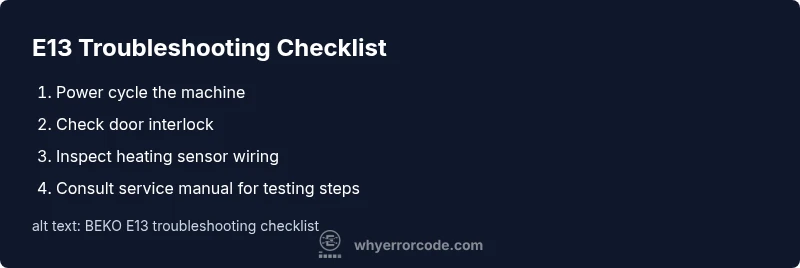
- Reset and safety check: Unplug the machine for at least 60 seconds, then plug it back in and run a cold water wash to verify if E13 recurs. Tip: Keep the power cord and access area organized to avoid accidental unplugging during reassembly.
- Inspect door interlock and wiring: With the unit unplugged, inspect the door interlock switch and its wiring harness for signs of wear or loose connections. Reconnect firmly if needed. Tip: Do not bypass the interlock to force a door-locked cycle; this can create safety hazards.
- Check heating sensor connections: Locate the temperature sensor/thermistor harness and heating element connections. Ensure connectors are clean, dry, and firmly seated. Tip: Handle connectors gently to avoid pinching wires or damaging terminals.
- Test sensor and heating circuit (if qualified): If you have a service manual and the skill, test the sensor resistance and heating circuit continuity. Replace faulty components as indicated by readings. Tip: If readings are outside specification, replace the affected sensor or element rather than forcing a repair.
- Reassess control board wiring: Inspect the control board connectors for any signs of moisture, corrosion, or loose pins. Re-seat connectors and verify that all cables are routed correctly. Tip: Only perform this step if you have experience with electronics; incorrect reseating can cause further damage.
- Professional evaluation: If E13 remains after these steps, contact BEKO support or a certified technician for deeper diagnostics and potential board or heater replacement. Tip: Request a written estimate and confirm warranty coverage where applicable.
Other Possible Causes and How to Address Them
Beyond the most common fault paths, E13 can also be triggered by subtler issues such as a fault in the firmware, temperature calibration drift, or intermittent wiring faults that only show up under load. In some cases, moisture ingress or vibration can loosen connections over time, leading to intermittent errors. If a comprehensive inspection identifies a damaged wire, corroded connector, or a failing heater element, you should replace the part rather than attempt a temporary fix. When in doubt, rely on official service channels. A pro can perform advanced diagnostics, replace parts, and reprogram the control board if needed.
Additionally, keep a clean environment around the appliance to deter moisture buildup and ensure air vents are unobstructed. Regular cleaning of lint traps and accessible wiring areas can help prevent false faults. If your unit is under warranty, and E13 appears within the warranty window, contact the manufacturer to arrange authorized service.
Safety, Warnings, and When to Call a Pro
Electrical appliances involve risk. Always unplug the unit before inspecting any internal components. Wear safety gloves and eye protection if you access electrical connections. Do not operate the appliance with the back or front panels removed, and avoid attempting heat-related repairs unless you are qualified. If you feel uncertain or uncomfortable with electrical testing, call a professional. Be aware that attempting risky DIY repairs can void warranties and potentially cause further damage or injury.
When to call a pro: if there is any sign of damaged wiring, burnt smell, water leakage near electrical components, or if the error persists after basic resets and checks. A professional will have the tools, model-specific manuals, and safety protocols to diagnose and replace heating elements, sensors, or control boards safely. In terms of cost considerations, expectations vary by region and model; obtain a written estimate before any replacement work and clarify whether diagnostic charges apply.
Prevention and Maintenance to Avoid E13
Regular maintenance reduces the likelihood of heating or sensor faults. Schedule periodic checks of door interlocks, harness wiring, and the heater element terminals. Keep the interior dry and free of lint buildup around fans and vents. Periodically inspect connector pins for corrosion and gently clean with appropriate contact cleaner as per the service manual. If your unit supports firmware updates, apply them through official channels to ensure sensors and heating control logic remain calibrated. Finally, document error codes and keep model information handy for faster support if E13 recurs.
Steps
Estimated time: 60-90 minutes
- 1
Power down and safe reset
Unplug the machine for at least 60 seconds, then plug it back in and run a cold wash to verify if E13 reappears. This resets the control logic and can clear transient faults.
Tip: Label and keep track of the plug location to avoid confusion during reassembly. - 2
Check door interlock and wiring
With the unit unplugged, inspect the door interlock switch and its wiring harness for wear or loose connections. Reconnect firmly if needed and test the door closure.
Tip: Never bypass the interlock; a secure door is a safety requirement. - 3
Inspect harnesses for loose connectors
Look for loose, corroded, or damaged connectors around the heater and sensor harnesses. Reseat any suspect connections and ensure insulation is intact.
Tip: Work in a dry area and avoid tugging on wires. - 4
Test temperature sensor and heating circuit (if qualified)
If you have the service manual, test sensor resistance and heating element continuity according to the procedure. Replace faulty components as indicated by your readings.
Tip: Only perform this step if you’re trained; incorrect testing can cause further damage. - 5
Reassess control board wiring
Inspect control board connectors for moisture, corrosion, or bent pins. Reseat connectors and ensure cables are routed correctly away from heat sources.
Tip: Avoid applying power while panels are open to prevent shorts. - 6
Call a professional if the fault persists
If E13 remains after these steps, contact BEKO support or a certified technician for deeper diagnostics and potential part replacement.
Tip: Request a written estimate before any replacement work.
Diagnosis: Washing machine displays E13 and won't complete cycles.
Possible Causes
- highHeating element or temperature sensor fault
- mediumControl board fault
- lowDoor interlock or wiring fault
Fixes
- easyReset the machine and verify heating element and temperature sensor connections
- easyPower cycle and reseat control board connectors; update firmware if available
- mediumInspect door interlock and its wiring for damage; replace interlock if necessary
Frequently Asked Questions
What does BEKO E13 mean on my appliance?
E13 is a fault code that indicates a heating or temperature sensing issue in BEKO appliances. The exact meaning can vary by model, so consult the manual and check nearby components like the heater, sensor, and interlock.
E13 signals a heating or temperature-sensing fault. Check the heater and interlock, and refer to your model manual for model-specific details.
Is it safe to ignore E13?
No. Ignoring E13 can lead to unsafe operation or water damage. Stop using the appliance until it is diagnosed and repaired.
No. Don’t ignore E13; stop using the machine until it’s checked by a professional if needed.
Can I fix E13 myself?
Some basic resets and connector checks can be done by DIY enthusiasts with caution. More complex tasks, like heater or control board replacement, should be done by a trained technician.
You can try resets and simple checks if you’re comfortable, but complex parts should be handled by a pro.
What parts are typically involved in E13 repairs?
Possible components include the heating element, temperature sensor (thermistor), control board, and door interlock. Replacement depends on the fault source found during diagnostics.
Typical parts are heater, sensor, control board, or door interlock, depending on the root cause.
How much does diagnostic help cost for E13?
Costs vary by region and service provider; expect a diagnostic visit and potential parts replacement. Always ask for a written estimate before service.
Prices vary; get a written estimate and ask about diagnostic fees before any work.
Watch Video
Top Takeaways
- Unplug and reset first to clear transient faults
- Check door interlock and wiring for secure connections
- Inspect heating sensor and heater wiring before replacing parts
- Escalate to a pro if E13 persists after safe checks