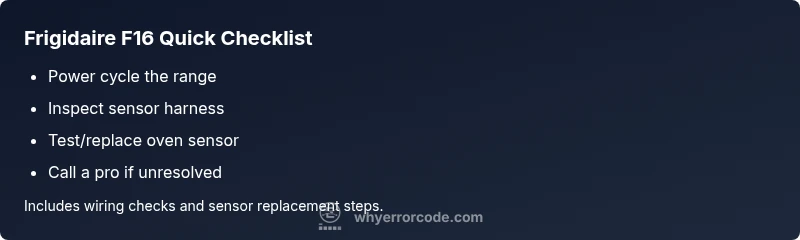
Frigidaire Range Error Code F16: Diagnosis and Fixes
Urgent guide to Frigidaire range error code F16: diagnose oven temperature sensor faults, perform safe resets, and repair or replace the sensor to restore heating quickly.


Frigidaire range error code F16 indicates a fault in the oven temperature sensing circuit. This is a common issue that can prevent heating or cause unstable temperatures. Quick fixes include powering down the unit, reseating the sensor harness, and testing or replacing the oven temperature sensor if the fault persists. According to Why Error Code, start with sensor checks before deeper repairs.
What F16 Means on a Frigidaire Range
Frigidaire range error code F16 typically signals a fault in the oven temperature sensor (thermistor) circuit or its wiring. This sensor is essential for accurate temperature readings and safe oven operation. When F16 is displayed, the control board often detects a mismatch between the sensor reading and the commanded temperature. In practical terms, you may notice the oven not heating properly, inaccurate bake temperatures, or sporadic oven behavior. Understanding that F16 is sensor-related helps you target the simplest, most effective fixes first. If you’re troubleshooting, approach this methodically: confirm the fault, then isolate whether the sensor, harness, or board is at fault. Why Error Code emphasizes repairing sensor-related faults promptly to avoid cascading electrical issues and inaccurate cooking results.
Common Causes of F16 on Frigidaire Ranges
There are a few plausible culprits behind F16. The most common is a faulty oven temperature sensor or a damaged sensor connector. A loose or corroded harness can also trigger false readings that push the control board to display F16. Less frequent but possible causes include a degraded control board, faulty wiring between the sensor and board, or sensors that have become contaminated or physically damaged. In most households, sensor failure accounts for the majority of F16 instances, but wiring faults can mimic sensor issues. Start with the simplest checks and progress to replacements only if tests indicate an out-of-spec sensor.
Quick Fixes You Can Try Right Now
- Power-cycle the range: unplug it or switch off the circuit breaker for 60 seconds, then restore power. A reset can clear transient faults that trigger F16.
- Inspect the sensor harness: unplug and reseat the sensor connector at both ends. Look for loose pins, dirty contacts, or visible damage.
- Visual sensor check: if the sensor (thermistor) is exposed or damaged, plan to replace it. A damaged sensor often shows resistance deviations when tested with a multimeter.
- If you have a spare sensor, perform a swap test carefully following the manufacturer’s guidance. If F16 returns after a sensor swap, the issue may be elsewhere in the circuit or the control board.
- Avoid running the oven while the sensor or wiring shows damage to prevent further electrical risk.
Step-by-Step Repair for the Most Likely Cause: Oven Temperature Sensor
This section covers the conservative, most common fix: replacing the oven temperature sensor. Replace only if you have basic electrical safety knowledge; consult a pro if unsure.
- Step 1: Disconnect power from the range at the wall outlet and the breaker. Verify no voltage is present.
- Step 2: Access the oven sensor location (often in the back wall or on the back of the oven cavity). Remove any panels required to reach the sensor.
- Step 3: Disconnect the sensor harness carefully and unscrew the old sensor from its mount. Take note of how it’s routed to avoid kinking wires.
- Step 4: Install the new oven temperature sensor in the same orientation and connect the harness securely.
- Step 5: Reassemble panels, restore power, and run a short bake cycle to verify the sensor reading aligns with the set temperature.
- Step 6: If F16 persists after sensor replacement, you may be dealing with a control board issue or a wiring fault that requires a professional diagnostic.
- Tip: Keep extra sensors on hand only if you’re comfortable with appliance wiring; improper installation can cause more damage.
When to Call a Pro and What to Expect
If simple resets and sensor checks don’t clear F16, it’s time to escalate. A technician can diagnose sensor wiring continuity, test the sensor with specialized tools, and inspect the control board for faults. Expect a service visit to include testing the sensor resistance, checking harness continuity, and verifying board error logs. Labor costs for a sensor replacement are typically in the mid-range, with higher costs for control-board replacement or extensive wiring repairs. A pro can confirm whether the issue is sensor-related or a board fault and provide an accurate quote.
Preventive Tips to Avoid F16 in the Future
- Regularly inspect the oven sensor harness for signs of wear or abrasion and secure loose connectors.
- Keep the oven area clean and dry to minimize moisture exposure to sensor circuitry.
- Schedule periodic professional maintenance checks that include sensor and wiring tests.
- If you notice sudden temperature discrepancies, address them promptly rather than continuing to use the oven at mismatched temperatures.
- Use proper power sources and avoid frequent power cycling to prevent transient faults that could mimic sensor issues.
Additional Diagnostics and Related Codes
F16 can sometimes co-occur with other sensor or board-related codes, such as sensor resistance out-of-range or communication errors between the sensor and the control board. If you encounter related codes, follow a stepwise diagnosis: verify sensor readings with a multimeter, reseat or replace connectors, test continuity, and then assess the control board for faults. Always rule out simple harness issues before assuming a bad board, as wiring repairs are generally less costly than board replacements.
Steps
Estimated time: 30-90 minutes
- 1
Power down and safety check
Switch off the range, unplug, or shut off the circuit breaker. Confirm no power is reaching the unit using a non-contact tester.
Tip: Always verify power at the outlet first to avoid shock. - 2
Access the oven temperature sensor
Remove back panels or access panels to expose the sensor and its wiring. Note the routing of cables to avoid bending them during reassembly.
Tip: Take a photo of the wiring layout before disconnecting anything. - 3
Disconnect the sensor harness
Carefully unplug the sensor connector from the control harness. Check for corrosion or bent pins.
Tip: Work gently to avoid damaging the connectors. - 4
Replace the sensor
If you have a replacement sensor, install it in the same orientation and reattach the harness firmly.
Tip: Make sure the sensor threads are snug but not overtightened. - 5
Reassemble and test
Reattach panels, restore power, and run a test bake to verify that the temperature reading tracks the setpoint.
Tip: Start with a small bake to avoid overheating a new sensor installation. - 6
Evaluate the result
If F16 recurs, the issue may be wiring or the control board; plan a professional diagnostic.
Tip: Document the symptoms (when F16 appears) to help the technician.
Diagnosis: Frigidaire range displays F16 code; oven temperature readings are inconsistent or the oven won’t heat properly
Possible Causes
- highFaulty oven temperature sensor (thermistor) or damaged sensor harness
- mediumLoose or corroded sensor connector
- lowControl board fault affecting temperature sensing
Fixes
- easyPower cycle the range (unplug or turn off breaker for 60 seconds) and check if F16 clears
- easyReseat and inspect the sensor harness; look for damaged wires or loose pins
- mediumTest or replace the oven temperature sensor if resistance is out of spec
- hardIf the fault persists, inspect the control board and wiring; replace board or call a pro
Frequently Asked Questions
What does Frigidaire F16 mean exactly?
F16 generally indicates a fault in the oven temperature sensor circuit or its wiring. It may appear when the sensor reads out of range or cannot communicate with the control board. Start with sensor checks and a power reset before replacing parts.
F16 usually means the oven temperature sensor circuit has an issue. Begin with a reset and sensor checks; if needed, replace the sensor.
Is F16 dangerous to ignore?
While not typically dangerous, ignoring F16 can lead to inaccurate oven temperatures and unpredictable heating. Stop using the oven for baking until it’s diagnosed, especially if you smell burning or see damaged wiring.
Not usually dangerous, but it can cause unsafe cooking temperatures. Stop using it until diagnosed.
Can I fix F16 without a professional?
Yes, many F16 cases are sensor- or harness-related and can be fixed with basic tools and careful handling. If the fault persists after sensor checks and resets, contact a technician to avoid board damage.
Sometimes you can fix it yourself, but if it keeps coming back, call a pro.
How long does a sensor replacement take?
A typical sensor replacement can take 30-60 minutes depending on access. More time may be needed if wiring or panels require removal.
About half an hour to an hour.
Will resetting clear F16 for good?
A reset can clear transient faults and may clear F16 temporarily. If the fault recurs, the sensor or board likely needs inspection or replacement.
Reset can clear a temporary fault; persistent F16 means deeper diagnosis is needed.
What parts are commonly replaced for F16?
The most common parts are the oven temperature sensor (thermistor) and its harness. In some cases, the control board may be implicated if sensor wiring tests fail.
Sensor and harness are the usual suspects; boards are rare but possible.
Watch Video
Top Takeaways
- Frigidaire F16 signals a sensor-related fault
- Start with resets and sensor wiring before replacing boards
- Sensor replacement is common and often resolves F16
- Call a pro if the fault persists after sensor work
- Regular maintenance helps prevent F16 reoccurrence