Whirlpool Range E1 Error Code Diagnostic and Fix Guide
Urgent guide to diagnosing and fixing Whirlpool range E1 error code. Learn meaning, quick fixes, step-by-step repairs, safety tips, and when to call a pro. Updated 2026 for rapid recovery.


An E1 error on a Whirlpool range signals an electronic fault in the control system. It often stems from a faulty sensor, loose wiring, or a failing control board. Start with a quick reset, inspect major connections, and then run a basic diagnostic flow. If unresolved, contact support. Unplug the appliance during reset, and avoid forcing components. This quick guidance buys time while you plan repair.
Understanding the Whirlpool Range E1 Error Code and What It Means
The Whirlpool range E1 error code is an electronics fault indicator that the control board detects as outside normal operating ranges. In practice, it often points to issues within the range's control system: a faulty temperature sensor, loose or corroded wiring, a damaged harness, or a failing microcontroller. According to Why Error Code, E1 is typically logged when self-check routines encounter an unreadable signal or a short between circuitry lanes. This isn't a single component failure you can see with the naked eye; it's a symptom that multiple internal systems may be involved. The immediate concern is safety and appliance reliability, not just the annoying display message. If you notice the range won’t start, won't heat consistently, or exhibits intermittent faults after power restoration, E1 is a signal to proceed with diagnostics rather than assuming a simple reset will fix it. Plan to power cycle, inspect connections at the control module, and verify door latch switches as potential triggers. While some fixes are simple, others require professional service to prevent electrical hazards and preserve warranty coverage.
Quick Fixes to Try Right Now (Before Service)
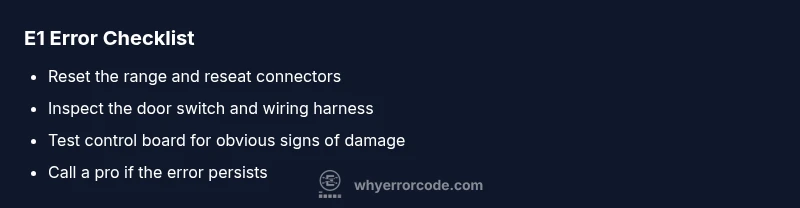
- Unplug the range for 60 seconds, then plug back in to reset the control boards.
- Inspect the door lock switch for damage or misalignment; a faulty switch can trigger E1 by interrupting control signals.
- Reseat the main wiring harness connections at the control board; look for loose pins, corrosion, or burned spots.
- Check for trapped moisture near the control panel and any signs of burn marks or melted insulation around connectors.
- Verify the power outlet is delivering consistent voltage by testing with a known-good device.
Note: These quick fixes are intended to clear transient faults. If the error persists, do not continue to power cycle repeatedly; proceed with the diagnostic flow or contact a professional. Cost-wise, basic resets and reseating connectors cost little beyond your time, but board replacement can range into hundreds of dollars depending on parts and labor.
Diagnostic Flow: Symptoms, Likely Causes, and Remedies
Symptoms: The display shows E1, the oven or range may not heat evenly or start, and subsequent cycles fail to proceed. You might notice intermittent resets after power restoration or inconsistent sensor readings during temperature changes. When to zoom in on causes: wiring integrity and the control board tend to be the primary culprits.
Causes (in order of likelihood):
- {"cause": "Loose or damaged control-board wiring harness", "likelihood": "high"}
- {"cause": "Faulty temperature sensor or ADC input", "likelihood": "medium"}
- {"cause": "Damaged control board or faulty microcontroller", "likelihood": "low"}
Fixes (difficulty):
- {"fix": "Reconnect and reseat control-board connectors, check for corrosion", "difficulty": "easy"}
- {"fix": "Test and replace sensor if reading out of range", "difficulty": "medium"}
- {"fix": "Replace control board", "difficulty": "hard"}
Step-by-Step Fix: Most Common Resolution
- Power cycle and reset the unit to clear transient faults. 2) Access the control board compartment and carefully unplug/reconnect the main harness; reseat all connectors one by one while inspecting for damaged pins. 3) Inspect the temperature sensor lead and its connector for corrosion or fraying; replace if questionable. 4) Check the door switch and latch wiring; a malfunction can generate control faults. 5) If you do not observe improvement, test the control board with a multimeter or service mode if available; note any abnormal voltage readings. 6) Decide whether to replace the control board, sensor, or both. This path can save you from replacing unnecessary parts and help avoid warranty issues.
Other Causes and How to Verify Them
Beyond the core control-board issue, E1 can be triggered by moisture in the control panel, damaged wiring in the loom harness, a failing temperature sensor, or a subtle power-supply irregularity. To verify:
- Inspect for visible water ingress around the rear panel and underside of the control board; dry and reseal as needed.
- Run a continuity check on critical harness wires and examine for pin corrosion.
- Swap a known-good sensor if available to confirm sensor fault. If none of these steps resolves E1, the problem likely resides in the control board or a linked module that requires professional service.
Safety, Warnings, and When to Call a Professional
Working with appliance electronics can pose shock hazards. Always unplug before handling internal components and wear insulated gloves if touching wiring. If you smell burning plastic, hear buzzing, or see smoke, stop immediately and call a professional. Cost considerations: basic diagnosis by a technician typically ranges from a few hundred dollars, while board replacement can push toward the higher end of that range depending on parts and labor. If your range is under warranty, consult the manufacturer or authorized service to preserve coverage.
Additional Resources and Next Steps
If E1 persists after completing the diagnostic flow, rely on official Whirlpool service channels and trusted repair technicians. Keep a record of all fault codes, reset attempts, and replacement parts used. This information helps technicians diagnose quickly and reduces repeat visits. For ongoing learning, review general troubleshooting steps and related error codes in our comprehensive guide, which also covers related Whirlpool models and firmware considerations.
Steps
Estimated time: 1-2 hours
- 1
Power cycle the range
Unplug the range from the wall outlet, wait 60 seconds, and plug it back in. This clears transient faults that might trigger E1 and lets the microcontroller boot with a clean state.
Tip: Label or map the control panel connectors before disconnecting anything to reduce reassembly errors. - 2
Access the control board and reseat connectors
Carefully remove the rear or service panel to reach the main control board. Disconnect and reconnect the primary harness and any secondary plugs, ensuring pins seat firmly and there is no corrosion.
Tip: Work on a non-static surface and avoid wiggling wires excessively to prevent connector damage. - 3
Inspect the temperature sensor and wiring
Trace the sensor lead to its connector and check for fraying, breaks, or loose shielding. If readings look out of range with a multimeter, consider replacing the sensor.
Tip: Consult your model’s schematic to identify the correct sensor pins before testing. - 4
Check the door switch and latch wiring
A faulty door switch can interrupt the control signal. Inspect the switch, its mounting, and associated wiring for damage or misalignment.
Tip: A quick test is to press the door switch manually and observe whether the display reacts; if not, replace the switch. - 5
Perform a controlled test or service mode (if available)
Some Whirlpool models offer a service or diagnostic mode to read fault codes directly. Use this to confirm whether the issue is sensor or board related.
Tip: Only use service mode if you have the official manual; improper use can mislead diagnosis. - 6
Decide on replacement or professional service
If the error persists after reseating connectors and testing sensors, a control board replacement is often the next step. This is typically a job for a qualified technician.
Tip: If the unit is under warranty, contact Whirlpool support first to preserve coverage.
Diagnosis: Whirlpool range displays E1 error and will not start or heat properly
Possible Causes
- highLoose or damaged control-board wiring harness
- mediumFaulty temperature sensor or ADC input
- lowDamaged control board or faulty microcontroller
Fixes
- easyReconnect and reseat control-board connectors, check for corrosion
- mediumTest and replace sensor if reading out of range
- hardReplace control board
Frequently Asked Questions
What does the Whirlpool E1 error code mean?
E1 is a generic control-system fault indicating an abnormal condition detected by the range's electronics. It often involves the control board, sensors, or wiring. Use the diagnostic flow to identify the exact faulty component.
E1 means there's a control-system fault. Check wiring, sensors, and the board, then follow the diagnostic steps.
Can I fix E1 myself?
Some initial steps like a reset and reseating connectors can clear transient faults. More complex issues, such as sensor or board replacement, should be performed by a professional.
You can try a reset first, but for parts like the control board, call a pro.
How much does it cost to repair E1?
Repair costs vary by part and labor. Expect parts and service to range from a few hundred dollars depending on the exact fault and whether a board or sensor must be replaced.
Costs can vary widely, often a few hundred dollars, depending on what's needed.
When should I call a professional?
If E1 persists after quick fixes or you notice burning smells, buzzing, or visible damage, stop troubleshooting and seek professional service to avoid safety risks and warranty issues.
Call a pro if the fault remains after basic checks or you smell something burning.
Is E1 dangerous to ignore?
Ignoring E1 can lead to electrical hazards or further damage. Always unplug before inspecting and get a professional if you’re unsure about the repairs.
Ignore it and you risk safety hazards; unplug and get help if unsure.
Watch Video
Top Takeaways
- Power cycle first to clear transient faults
- Inspect harnesses and sensors before replacing parts
- If E1 persists, expect board or sensor faults requiring professional service
- Consider warranty status to decide on DIY vs pro repair
- Keep fault code records for faster diagnosis