Types of error code in API testing: Practical Guide
Explore the types of error code in API testing, how to interpret 1xx–5xx responses, and practical steps to validate, diagnose, and fix API failures in real-world tests.


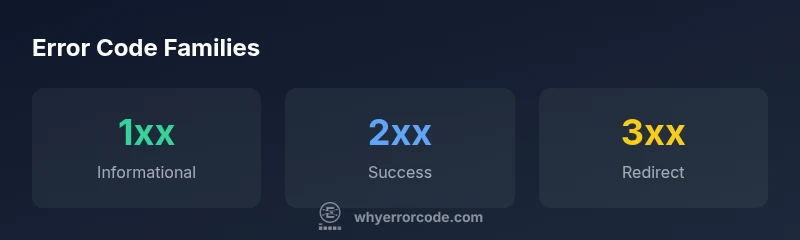
When testing APIs, the most common error code types fall into five families: informational, success, redirection, client error, and server error. Understanding these groups helps you diagnose failures quickly, map them to fixes, and validate API behavior under varied conditions. This guide outlines each category, typical scenarios, and practical debugging steps for reliable integration testing.
What 'types of error code in api testing' really means
In API testing, error codes are not random; they are standardized responses that tell you exactly where a request failed and why. The phrase types of error code in api testing refers to five broad families that recur across protocols: 1xx informational, 2xx success, 3xx redirection, 4xx client errors, and 5xx server errors. Understanding these categories helps you triage failures quickly, design better tests, and communicate with backend teams. In this section we break down what each family signals, what typical examples look like in practice, and how to tailor your tests to validate both presence and semantics of the code. The goal is to translate a numeric code into a concrete action, such as retry, modify, or report a bug, while keeping a consistent contract for responses across environments.
**Keyword presence:**Throughout this article, you will see references to the primary keyword to reinforce its meaning for search and comprehension.
1xx Informational and 2xx Success codes in API testing
1xx codes are informational: they indicate the request has been received and that the client should continue. In practice, most API tests don’t rely on 1xx extensively, but you may see them in handshake-heavy protocols or long-polling flows. The more impactful group is 2xx: success codes that confirm the operation succeeded. Common examples include 200 OK and 201 Created, but your tests should verify not only the code but also the response body, headers, and any side effects (like resource creation or update). When using idempotent operations, ensure repeated calls yield consistent 2xx outcomes. In your test plan, map each 2xx outcome to a defined assertion set and a post-condition check (e.g., resource state, audit logs).
3xx Redirection and its testing implications
Redirection codes (3xx) tell the client to fetch the requested resource from a different URL. In API testing, you should validate that the client follows redirects correctly when allowed, preserves authentication state where required, and handles Location headers as specified by the contract. Common examples include 301, 302, and 307. Tests should cover both follow and no-follow scenarios, ensuring that redirects do not inadvertently leak sensitive data or lose context.
4xx Client errors: diagnosing bad requests and auth failures
4xx errors indicate a problem with the request itself or the client’s permissions. Typical codes include 400 Bad Request, 401 Unauthorized, 403 Forbidden, 404 Not Found, and 429 Too Many Requests. In testing, focus on input validation, authentication/authorization flows, and rate-limiting behavior. Validate that error payloads provide actionable details without exposing sensitive internals. Ensure that clients recover gracefully and implement retry/backoff where appropriate.
5xx Server errors: diagnosing server-side failures and timeouts
5xx codes point to server-side failures or timeouts. Common examples are 500 Internal Server Error, 502 Bad Gateway, 503 Service Unavailable, and 504 Gateway Timeout. Tests should simulate load, verify that the system returns consistent error messages, and confirm that retry strategies, circuit breakers, and graceful degradation are in place. Document how the API communicates transient issues versus persistent outages and ensure observability for operators.
Validating error payloads and traceability
Beyond the status code, the error response body is essential for debugging. Consistent fields like code, message, and traceId help correlate incidents across services. In tests, verify that codes map to meaningful, localized messages, that trace identifiers propagate through distributed systems, and that error payload schemas remain stable across releases. This consistency is critical for automation, observability, and troubleshooting across environments.
Integrating error code testing into contract tests and CI
Treat error codes as a first-class aspect of API contracts. Include explicit expectations for each code family in OpenAPI or similar contract definitions, and automate checks in CI pipelines. Regression tests should cover changes to error handling, messaging, and payload shape. By aligning tests with the contract, you reduce drift and improve confidence when deploying new versions.
Overview of standard HTTP status code families
| Category | Typical Codes | What it Means | Testing Notes |
|---|---|---|---|
| Informational (1xx) | 100-102 | Request received; processing continues | Verify handshake behavior; rarely errors; ensure logging is clear |
| Success (2xx) | 200-204 | Operation succeeded; resource state updated | Validate payload, headers, and side effects |
| Redirection (3xx) | 301-308 | Resource moved; follow Location header | Test both follow and non-follow redirects; preserve auth state |
| Client Errors (4xx) | 400, 401, 403, 404, 429 | Bad input or unauthorized access | Test input validation, auth flows, rate limits |
| Server Errors (5xx) | 500, 502, 503, 504 | Server-side failure or timeout | Test resilience: retry, backoff, and observability |
Frequently Asked Questions
What are the five main error code families used in API testing?
The five main families are 1xx informational, 2xx success, 3xx redirection, 4xx client errors, and 5xx server errors. Each family communicates a distinct phase of request handling and guides testers toward appropriate actions.
There are five main families: informational, success, redirection, client error, and server error.
How should I distinguish between 4xx and 5xx errors in a test suite?
4xx errors indicate problems with the request or client permissions, such as invalid input or missing authentication. 5xx errors point to server-side issues. Tests should isolate input validation from server reliability, and include separate paths for retry logic and error reporting.
Differentiate client-side errors from server-side ones to guide fixes and retries.
What is the best way to validate error payload structure across codes?
Define a stable error payload schema (code, message, traceId, details). Validate that every error response conforms to the schema across all code families and that messages are actionable without leaking sensitive internals.
Use a consistent error payload format to make automation reliable.
Why are 3xx redirects important in API testing?
Redirects affect how clients reach resources and maintain authentication state. Tests should verify correct Location headers, status handling, and whether redirects are followed according to policy.
Redirect handling is essential for consistent navigation and security.
How can I simulate server errors in tests?
Use controlled fault injection or provider mocks to reproduce 5xx responses, timeouts, and partial outages. Validate that retries, backoff, and fallback logic trigger as designed.
Simulate failures to verify resilience and recovery.
What tools help map error codes to fixes?
Contract-driven testing, API gateways, and observability dashboards help map error codes to root-causes. Use automated tests that cross-check codes, payloads, and traces across services.
Leverage tooling to connect codes with concrete fixes.
“Clear, well-documented error codes accelerate triage and reduce confidence gaps during integration testing.”
Top Takeaways
- Identify error families early to guide debugging
- Test payloads against each code family
- Differentiate client vs server failures in CI
- Validate error payload structure consistently
- Document expected codes in API contracts