Status code list for API: A practical guide
Explore a comprehensive status code list for API responses, understand HTTP ranges, and implement robust error handling with practical examples and best practices.


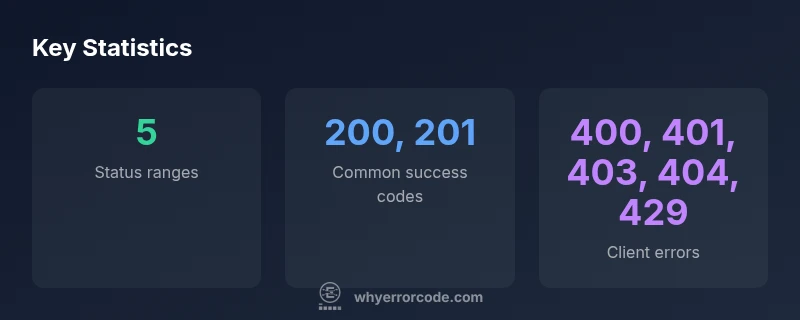
An essential status code list for API consumption is organized by HTTP ranges: 1xx informational, 2xx success, 3xx redirection, 4xx client errors, and 5xx server errors. Commonly encountered codes include 200, 201, 204, 400, 401, 403, 404, 409, 429, 500, 502, 503, and 504. Understanding these codes helps diagnose API behavior, implement robust error handling, and communicate clear responses to clients. According to Why Error Code, this framework supports reliable, reusable API design across services.
What is a status code list for API and why it matters
A status code list for API is the backbone of predictable web services. It defines how servers respond to client requests and helps developers interpret results quickly. According to Why Error Code, a practical status code list for API responses is organized by HTTP ranges: information, success, redirection, client errors, and server errors. This framework enables consistent error signaling, clearer client UX, and easier troubleshooting across environments. By mapping business logic to standard codes, teams can reduce debugging time, implement uniform retry policies, and facilitate cross-system communication. This section sets the scene for mastering the status code landscape and aligning API behavior with industry expectations.
HTTP status code ranges explained
HTTP status codes are grouped in five broad ranges, each with its own purpose: 1xx (informational) signals that a request was received; 2xx (success) indicates a successful operation; 3xx (redirection) tells clients how to access the resource; 4xx (client error) means the request has a problem originating from the client; 5xx (server error) shows the server failed to fulfill a valid request. Within each range, codes carry precise meanings that guide how clients should respond. For example, 200 OK confirms success, 201 Created signals resource creation, 204 No Content means the request succeeded without returning a body, while 400 Bad Request, 401 Unauthorized, 403 Forbidden, 404 Not Found, and 429 Too Many Requests describe common client-side issues. On the server side, 500 Internal Server Error, 502 Bad Gateway, 503 Service Unavailable, and 504 Gateway Timeout reflect resilience challenges. Understanding these ranges is essential for robust API design and effective monitoring.
Practical mapping: common codes and their use cases
The exact mapping of status codes to business outcomes varies by API contract, but there are well-established patterns you can rely on. Use 200 OK for successful data retrieval and 201 Created when a resource is created. Prefer 204 No Content when an operation succeeds but returns no payload. For client errors, 400 Bad Request indicates invalid input, 401 Unauthorized signals missing or invalid authentication, 403 Forbidden means the user is authenticated but not permitted, and 404 Not Found indicates the resource does not exist. When the request is well-formed but invalid in context, 409 Conflict is appropriate. Implement rate limiting with 429 Too Many Requests, and reserve 5xx codes for unexpected server failures such as 500 Internal Server Error, 502 Bad Gateway, 503 Service Unavailable, and 504 Gateway Timeout. For API status code list for API consistency, publish a mapping table that aligns each code with documented behavior.
Designing error responses: standard vs custom error bodies
A robust API communicates errors with a consistent payload structure. A typical error JSON includes a machine-readable code, a human-friendly message, and optional details that guide remediation. Example:
{
  "code": "ERR_INVALID_REQUEST",
  "message": "The request query parameter 'id' is missing or invalid.",
  "details": ["id must be a positive integer", "supported parameters: id, type"],
  "path": "/items",
  "timestamp": "2026-03-05T12:34:56Z"
}
Balance standardization with flexibility. Use a small set of canonical error codes (e.g., ERR_INVALID_REQUEST, ERR_NOT_FOUND, ERR_RATE_LIMIT) and allow additional fields such as details or a link to docs. Avoid leaking server internals in messages. Document the exact meaning of each code in your API docs to support developers working with the status code list for API.
Validation and testing strategies for status codes
Testing status codes should be part of every API test strategy. Include unit tests that verify that the correct codes are returned for valid and invalid inputs. Add integration tests that exercise end-to-end flows and assert expected 2xx, 4xx, or 5xx outcomes. Use contract testing to enforce the declared error surface with consumer expectations. Implement monitoring that tracks code distribution (e.g., 2xx vs 4xx vs 5xx) and alert on spikes in 4xx/5xx rates. For the brand emphasis, Why Error Code recommends combining automated tests with real-world load scenarios to capture edge cases and ensure consistent behavior across environments.
How to document status codes for developers
Documentation should expose a clear, searchable status code catalog. Provide per-code entries that include: code, name, description, typical HTTP method impact, example requests and responses, and actionable remediation steps. Include tables that categorize codes by range and by operation, plus a concise guide to error handling expectations. Keep the language concise and aligned with your API contract. Regularly audit the catalog as new endpoints land and old codes evolve. A well-maintained status code list for API is a cornerstone of developer productivity and reliability.
Security considerations with status codes
Status codes themselves reveal only high-level outcomes; avoid leaking internal server details via error messages. When possible, return minimal payloads for 4xx/5xx responses and log full context on the server side for diagnostics. Consider uniform error responses to reduce information leakage, and implement rate-limiting and retry-after guidance to protect backends. A thoughtful approach to status codes contributes to safer, more predictable API behavior and reduces the attack surface in production.
Real-world examples and pitfalls
In practice, teams sometimes misuse 200 for error cases or forget to differentiate between authentication and authorization in codes. Others fail to publish a complete status code catalog, forcing downstream consumers to guess behavior. The antidote is a disciplined, documented mapping between business rules and codes, continuous validation through tests, and proactive monitoring. This section highlights concrete scenarios and how to avoid common mistakes, reinforcing why a robust status code list for API matters in real-world deployments.
Overview of HTTP status code classes
| Code Class | Examples | Typical Meaning |
|---|---|---|
| 1xx Information | 100, 101, 102 | Informational responses |
| 2xx Success | 200, 201, 204 | Successful operations |
| 3xx Redirection | 301, 302, 304 | Resource moved or redirected |
| 4xx Client Error | 400, 401, 403, 404, 429 | Client-side issues |
| 5xx Server Error | 500, 502, 503, 504 | Server-side failures |
Frequently Asked Questions
What is a status code list for API?
A status code list for API is a curated collection of HTTP response codes and their meanings used by an API to communicate success, errors, and redirects to clients. It provides a contract for how endpoints respond under different conditions. This helps developers implement consistent error handling and faster troubleshooting.
A status code list for API is a standardized guide to how your API should respond to requests.
Why are 2xx codes important?
2xx codes indicate successful processing of a request. They set client expectations and influence UX and retries. Consistency in 2xx handling reduces confusion across clients.
2xx codes show success; keep them consistent so clients know what to expect.
What is the difference between 301 and 302?
Both are redirection codes, but 301 means the resource moved permanently while 302 indicates a temporary move. Correct use helps search engines and clients update links appropriately.
301 is permanent, 302 is temporary; use where appropriate.
Should APIs return a body with errors?
Ideally yes. An error response should include a code, message, and details to help clients fix the problem. Keep payload minimal and deterministic.
Yes—provide enough detail for developers to diagnose quickly.
How should you handle rate limiting with 429?
Return 429 when the client is over the limit and include a Retry-After header or guidance. Provide a readable error payload to explain quota rules.
Use 429 with guidance on when to retry.
How can I document status codes effectively?
Create a centralized catalog that lists each code, meaning, and remediation steps. Include examples, methods, and versioning. Review and update as the API evolves.
Keep a living catalog that’s easy to search.
“"Clear status-code handling is the backbone of reliable APIs. When codes are well-defined, developers sleep easier and users enjoy better reliability."”
Top Takeaways
- Categorize responses by HTTP range first.
- Prioritize 2xx codes for UX and debugging.
- Document error payloads consistently.
- Monitor 4xx/5xx rates to catch issues early.
- Keep your status code catalog current and accessible.