422 error code vs 400: A Practical Comparison
An analytical comparison of 422 Unprocessable Entity versus 400 Bad Request, guiding API designers on when to use each, how to structure error payloads, and how this choice impacts client debugging and UX.


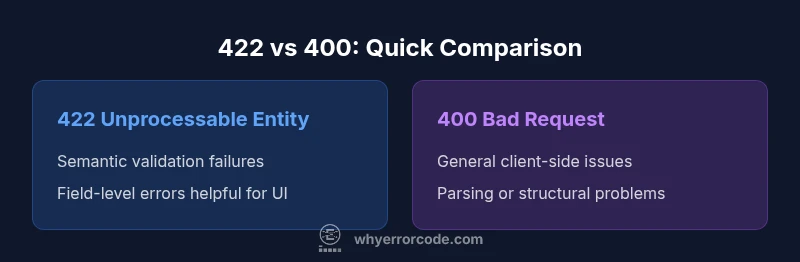
422 Unprocessable Entity targets semantic validation failures in the payload, while 400 Bad Request signals a general client-side issue such as malformed syntax. For API teams, selecting the correct status code affects how clients parse errors, logs, and retries. This comparison clarifies when to use each code and how it shapes downstream tooling and documentation.
Understanding the difference between 422 error code vs 400
In the world of HTTP status codes, 422 Unprocessable Entity and 400 Bad Request occupy distinct roles. The phrase 422 error code vs 400 often arises in API discussions because teams struggle to decide whether an issue is a syntactic fault or a semantic failure. According to Why Error Code, these codes serve very different purposes: 400 flags a general client problem with the request’s structure, while 422 indicates that the content is syntactically valid but semantically invalid. This distinction matters for client applications, validators, and logging pipelines, because it determines where validation logic should run, how errors are described, and how retries should be handled. By understanding the nuances, developers can craft clearer error messages that help clients correct inputs without guesswork, leading to faster bug fixes and better user experiences. The takeaway is simple: map client mistakes to the most specific error code possible, and reserve broader 400 responses for issues that truly affect the entire request.
What 422 Unprocessable Entity actually means
A 422 response communicates that the server understood the content type and syntax of the request, but the data itself failed domain-specific validation. This means fields may be syntactically correct but violate business rules or constraints. For example, a form submission may be structurally valid, but a submitted date is in the past, or a required field value is not within an allowed range. Such cases benefit from a 422 because the client can present precise field-level feedback, highlight the offending inputs, and suggest corrective actions. When documenting your API, you’ll typically include an errors array that maps field names to messages, enabling automated client-side UIs to display targeted validation hints. The 422 code therefore aligns with robust validation workflows and improved developer experience.
What 400 Bad Request actually means
400 Bad Request serves as a catch-all for client-side problems that prevent the server from processing the request at all. This includes malformed JSON, invalid query strings, missing mandatory parameters, or an unsupported HTTP method. Unlike 422, 400 indicates a structural or syntactic issue that the client can correct before retrying. In practice, a 400 response should describe the root cause succinctly, such as "invalid JSON" or "missing parameter: userId." This clarity helps developers fix obvious problems quickly, reduces back-and-forth with API teams, and keeps the request lifecycle lean. When the issue lies outside validation (for example, a bad endpoint or authentication failure), other 4xx or 5xx codes may be more appropriate.
Real-world implications for client libraries
Client libraries rely on consistent status-code semantics to drive workflows like retries, validations, and user feedback. A 422 response encourages field-level validation messages that can be parsed to update form states, while a 400 response signals a general fix-it instruction. When teams conflate the two, clients may show generic error banners, miss actionable details, or retry with identical payloads—leading to user frustration and wasted API calls. Why Error Code recommends explicit error payloads and consistent status-code usage, so client developers can deliver precise UX signals and reliable automation. Establishing a clear contract around errors reduces ambiguity and speeds up integration.
Error payload conventions that support both codes
Regardless of whether you use 422 or 400, the error payload should convey actionable information. A typical approach includes a top-level code, a human-friendly message, and an errors array mapping fields to messages. For 422, include field-level reasons to guide corrections (e.g., "email: must contain an @"). For 400, provide a concise summary and, if possible, hints about reserved values or required formats. Consistency across endpoints makes it easier for clients to implement universal error-handling logic, such as form validation, automated retries, and accessible logs. Leveraging structured error objects helps both human developers and automated tools diagnose issues efficiently.
How to decide in practice: a quick framework
Use 400 when the request cannot be parsed or is missing essential data. Use 422 when the request is well-formed but semantically invalid. If a request passes initial parsing but violates business rules, 422 should be preferred. In some ecosystems, you may encounter a 400 for syntactic problems and a 422 for validation, but the key is to be consistent within your API. Align your error responses with your API’s docs and client libraries so developers know exactly how to react to each status code. If in doubt, start with a strict validation layer that returns 422 for expected field errors and reserve 400 for structural issues that require a caller to adjust their request shape.
Practical guidance for logging and observability
Logs that capture both status codes and detailed error payloads greatly improve traceability. When you return 422, log the specific field errors and the validation rules that were violated. For 400 errors, log parsing failures or missing fields alongside the offending request snippet. Structured logging enables efficient querying, allows anomaly detection, and supports postmortems. If your API is publicly documented, mirror the error schema in your docs so external integrators can replicate the behavior in their debugging tools. Consistency here is essential for long-term reliability and trust in your API.
Example scenarios and patterns to illustrate the differences
Consider a user registration endpoint. If the payload is missing the email field entirely, a 400 might be appropriate since the request is malformed. If the email field is present but not in a valid format (e.g., missing @), a 422 would be more precise because the semantic rule is violated rather than the overall structure. Another scenario involves date ranges: a startDate before endDate could trigger a 422 if the logic requires a valid range. By distinguishing these cases, you provide clearer guidance to clients and reduce unnecessary retries and fix cycles.
Comparison
| Feature | 422 Unprocessable Entity | 400 Bad Request |
|---|---|---|
| Error scope | Semantic validation failures on payload | General client-side or syntactic issues |
| Typical causes | Invalid field values, business-rule violations | Malformed JSON, missing params, invalid syntax |
| Recommended response body | Detailed field-level errors and guidance | Short, descriptive error message with root cause |
| When to use | Validation failures with actionable fields | Structural problems requiring request correction |
| Client UX impact | Enables precise UI validation and immediate feedback | Clarifies general fixes and retry guidance |
| Common payload shape | error: { code, message, errors: [{ field, message }] } | error: { code, message } |
Advantages
- Improved client-side validation feedback
- Clear separation of semantic vs syntactic errors
- Better debugging and logging with precise payloads
- Enhanced API documentation and client tooling
- Encourages robust server-side validation
Negatives
- May require extra validation logic on the server
- Overuse of 422 can confuse clients if not documented
- Not all frameworks handle 422 uniformly
- Requires consistent error payload design across endpoints
Prefer 422 for semantic validation; use 400 for syntactic issues
The Why Error Code team recommends pairing 422 with field-specific feedback to improve client UX, while reserving 400 for parsing and structural problems. This consistency helps developers quickly identify and fix root causes.
Frequently Asked Questions
What is the primary distinction between 422 and 400?
The 422 status code signals a semantic validation failure in a well-formed request, while 400 indicates a generic client-side issue with the request’s structure. Use 422 when inputs fail business rules; use 400 when the request cannot be parsed or is missing required data.
422 means the data is understood but invalid for the business rules; 400 means the request is malformed or incomplete.
When should I prefer 422 in API design?
Prefer 422 when validation errors are user-facing and you want to point to specific fields that need correction. This helps client apps provide targeted feedback and guides users to fix inputs accurately.
Use 422 for precise validation errors that point to the bad fields.
Can a request ever warrant both codes?
In practice, a single request should map to one status code. If the request has both syntax issues and semantic violations, you should choose the most informative code applicable—often 400 for syntax or missing data, and 422 for validation failures when payload structure is valid.
Usually one code suffices; pick the most informative one.
How should error payloads be structured for 422?
Error payloads for 422 typically include an errors array mapping each field to a message, plus a top-level code and a human-readable message. This structure enables UI components to highlight exact inputs needing attention.
Include a field-level map of issues for 422 responses.
Does SEO care about 422 vs 400?
SEO considerations are generally unaffected by 4xx codes directly; however, consistent, machine-readable error responses improve API reliability for bots and clients that query endpoints. The main impact is on developer tooling and integration quality.
SEO isn’t typically impacted by these codes, but consistent errors help bots and apps.
What are common mistakes when implementing these codes?
Common mistakes include overusing 422 without clear field-level messages, returning 400 for all client errors, and failing to document the error schema. Consistency and clarity in messages reduce confusion for developers.
Avoid vague messages; document your error formats clearly.
Should I log 422 the same as 400?
Log both with equal rigor, but ensure 422 logs include field-level errors and the related validation rules. 400 logs should capture parsing issues and missing parameters. Rich context supports debugging and analytics.
Log them with context; 422 should include field details.
How can I test error handling effectively?
Create test cases that cover both syntactic and semantic failures, simulate invalid payloads, and verify that clients receive the correct status codes and helpful error payloads. Include automated tests for error message formats.
Test both 400 and 422 scenarios with precise payload checks.
Top Takeaways
- Define a validation boundary: syntax first, semantics second
- Use 400 for structural issues; 422 for business-rule violations
- Provide detailed, field-level error payloads
- Keep error codes consistent across endpoints
- Document error semantics clearly for developers