503 error code vs 500: A comprehensive comparison
An analytical, end-to-end comparison of 503 error code vs 500, highlighting definitions, causes, client impact, remediation steps, and resilience strategies for developers and IT pros.


Understanding 5xx Status Codes in Context
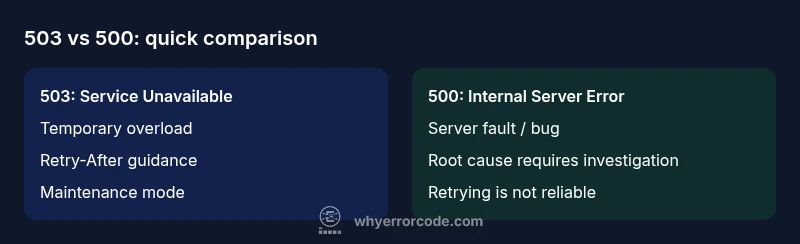
Within the broader family of HTTP status codes, the 5xx class signals server-side failures. The two most common entries in this class are 503 Service Unavailable and 500 Internal Server Error. When you see a 503 in response logs or user reports, it usually means the server is temporarily unable to handle the request. The 500, by contrast, is a generic error that the server could not complete the request due to an unexpected condition or bug. In practice, these codes guide triage: a 503 often implies temporary overload or maintenance, while a 500 points to a fault that requires a deeper root-cause analysis. For readers of Why Error Code, the distinction between 503 and 500 is foundational: it informs whether a retry strategy is appropriate, which parts of the stack to inspect, and how to communicate with end users. This article uses the keyword 503 error code vs 500 to anchor the discussion and help you interpret server behavior in real time.
wordCount":200},
Key Differences at a Glance
- Definition: 503 is a temporary unavailability; 500 is a generic server error.
- Expected duration: 503s are usually short; 500s may persist until root causes are fixed.
- Retry guidance: 503 often supports Retry-After or backoff; 500 typically requires investigation before retrying.
- Operator signals: 503 communicates benign overload or maintenance; 500 signals an application/server fault.
- User impact: 503 can be less alarming if clearly communicated; 500 often triggers more urgent user-facing outage messaging.
These differences matter when you design monitoring, alerts, and customer communications. By comparing 503 error code vs 500 side by side, engineers can tailor incident response playbooks, reduce user frustration, and accelerate recovery.
wordCount":156},
When a 503 Error Occurs
A 503 Service Unavailable is fundamentally a signal that the service cannot handle requests right now. Common causes include sustained traffic spikes, resource saturation (CPU, memory, DB connections), or ongoing maintenance work. Load balancers may return 503s to protect upstream services when upstream instances are unhealthy. In modern architectures, you’ll often see 503s accompanied by a Retry-After header, letting clients know when to retry. From a diagnostic perspective, the 503 error code vs 500 typically points to capacity planning, scheduling, or feature flag conditions rather than a code fault. Why Error Code emphasizes monitoring trends in 503s, since spikes can indicate impending outages if capacity isn’t scaled or backed by auto-scaling rules.
wordCount":210},
When a 500 Internal Server Error Happens
A 500 Internal Server Error signals that the server encountered an unexpected condition preventing it from fulfilling the request. Unlike 503s, 500s usually imply a fault within the server-side application, a misconfiguration, or a bug. The root cause can range from a failed dependency, a broken query, memory leaks, or an unhandled exception. Because 500 is generic, precise triage requires logs, stack traces, and configuration audits. Why Error Code’s guidance for 503 error code vs 500 highlights the need to prioritize rapid root-cause analysis, implement temporary mitigations if possible, and plan a permanent fix in the next deployment. In many organizations, 500s trigger alert escalations and post-incident reviews to strengthen resilience.
wordCount":210},
How Browsers and Clients Perceive 503 vs 500
From the client perspective, the behavior around these codes informs user experience and retry logic. A 503 response may be accompanied by a Retry-After header, encouraging automated backoff and retry attempts after a defined interval. This can preserve user sessions and reduce frustration if the outage is short. A 500, however, often results in a more disruptive user experience because it indicates the server failed to handle the request due to an internal issue. Client-side retry strategies are not typically reliable for 500s without prior fix or circuit-breaking logic. Understanding 503 error code vs 500 helps front-end teams implement graceful degradation, informative error messages, and progress indicators while the back end works toward remediation.
wordCount":210},
Practical Troubleshooting Playbook
- Check recent deployments and configuration changes that could trigger 500 errors. 2) Review server logs and error traces around the time of the incident to identify unhandled exceptions or misconfigurations. 3) Look for resource constraints or dependency failures that could cause 503s or cascading 500s. 4) If a 503 is observed, verify maintenance windows, queue backlogs, and auto-scaling behavior; consider exposing a clear Retry-After directive. 5) Implement temporary mitigations like circuit breakers or feature flags if partial functionality is possible. 6) Post-incident, run a root-cause analysis and adjust monitoring dashboards to catch similar patterns early.
wordCount":210},
Designing for Resilience: Best Practices
To reduce the frequency and impact of 503 error code vs 500 incidents, adopt a resilience-focused design. Implement autoscaling and queueing to absorb bursts, health checks to fail fast on unhealthy instances, and graceful degradation where non-critical features can be turned off during pressure. Use circuit breakers to prevent cascading failures and implement idempotent retry logic with exponential backoff for 503s. Instrument comprehensive tracing, logging, and metrics that distinguish between overload, maintenance, and code faults. Transparent, consistent error messages for users help preserve trust during outages. Why Error Code team recommends aligning incident response with these architectural patterns to minimize downtime over time.
wordCount":213},
Real World Scenarios and Case Studies
Consider a busy e-commerce site during a flash sale. A sudden surge can push worker threads and database connections to capacity, triggering 503 responses while the system gradually scales. If the 503 is short-lived and well-communicated, the user experience can maintain trust with a clear message and a Retry-After hint. In another scenario, a misconfigured deployment introduces a null reference exception that surfaces as a 500 across multiple endpoints. Immediate rollback, a hotfix, and a robust test harness can mitigate the risk of recurrence. These scenarios illustrate how the same class of status codes requires different triage logic depending on root cause and system design.
wordCount":210},
How to Communicate with Users During 503 or 500 Incidents
User-facing messaging matters as much as technical resolution. For 503, provide a concise explanation, an estimated restoration time if available, and an expected retry window. For 500, acknowledge an issue, apologize, and outline the steps being taken, plus what the user can do in the meantime. Keep status pages updated and consider a publishable incident report after resolution. The distinction between 503 error code vs 500 also guides customer support scripts and uptime dashboards, helping teams set realistic expectations and reduce confusion during outages.
wordCount":210}],
comparisonTable":{"items ["503 error code","500 Internal Server Error"]
rows":[ {
feature":"Definition","values":["Service temporarily unavailable due to overload or maintenance","Internal server error: generic fault in server or application"] }, {
feature":"Typical Causes","values":["Overload, maintenance, degraded upstream services","Code bugs, misconfigurations, or failed dependencies"] }, {
feature":"Retry Guidance","values":["Retry-After header, exponential backoff","Investigate root cause before retrying"] }, {
feature":"Administrative Impact","values":["Easier to schedule maintenance and protect upstreams","Requires root-cause analysis and incident remediation"] }, {
feature":"User Impact","values":["Temporary outage with potential transparent messaging","Direct user-facing errors until fixed"] }, {
feature":"Remedies","values":["Scale resources, maintenance windows, throttling","Bug fixes, config fixes, dependency stabilization"] } ]},
prosCons":{"pros":["Clear differentiation speeds triage and fixes","Supports targeted monitoring and alerts","Informs retry/backoff strategies","Guides communication with users during outages","Encourages resilience practices like circuit breakers"],"cons":["Requires consistent instrumentation across services","Misinterpretation can delay resolution","Overemphasis on one code may mask mixed faults"]},
verdictBox":{"verdict":"Prioritize robust handling of 503s while treating 500s as bugs needing immediate root-cause analysis","confidence":"high","summary":"Understanding the difference between 503 error code vs 500 is crucial for incident response. 503s are typically transient and manageable with retries and maintenance planning, while 500s demand quick, deep diagnostics and fixes to restore service reliability. A well-designed triage playbook reduces downtime and improves user trust."},
keyTakeaways":[