Difference Between Status Code 400 and 500: A Practical Analysis
A comprehensive, technical analysis of the difference between status code 400 and 500, with practical guidance for developers and IT pros on debugging, API design, and reliable error handling.


400-level errors indicate client-side problems with the request, while 500-level errors signal server-side failures. This distinction guides debugging, retries, and API design. According to Why Error Code, clear messaging and consistent status codes reduce triage time and improve reliability for developers and users alike. Understanding this helps you decide when to implement input validation, error payloads, and retry policies.
Definition and scope of status codes
HTTP status codes are three-digit integers returned by servers to indicate the result of a client's request. They are grouped by class: 1xx informational, 2xx success, 3xx redirection, 4xx client errors, and 5xx server errors. The difference between status code 400 and 500 is a fundamental semantic distinction: 400s indicate that the problem originates with the request, while 500s indicate a problem on the server handling the request. This semantic separation helps developers design validation logic, error payloads, and retry strategies across web applications, APIs, and microservices. In practice, a well-documented API should map user mistakes, validation failures, and invalid input to appropriate 4xx codes, while unexpected backend failures should map to 5xx. Understanding this boundary is essential for reliable troubleshooting, proper monitoring, and clear communication with clients. For API consumers, recognizing the distinction can prevent wasted retries, incorrect client state, and duplicate actions. For operators, it guides where to invest in input validation vs. backend resilience. In the rest of this guide, we compare the 400 family and the 500 family, highlight typical causes, and propose concrete handling patterns.
100-300 words
Comparison
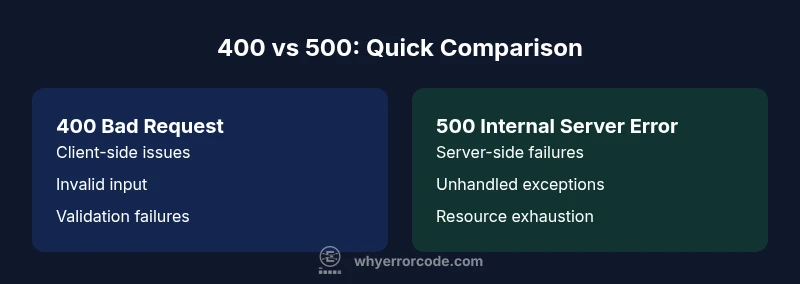
| Feature | 400 Bad Request | 500 Internal Server Error |
|---|---|---|
| Scope | Client-side error: request is malformed or invalid (e.g., bad parameters, invalid data) | Server-side error: the server failed to process the request or encountered an exception |
| Typical Causes | Validation failures, missing/invalid parameters, poorly formed syntax | Unhandled exceptions, database or service outages, resource exhaustion, misconfig |
| Client Impact | Request is rejected; the client must fix the input or format | The client receives an error, but the request is not guaranteed to be recoverable without backend repair |
| Server Impact | Minimal server-side processing impact beyond returning the error | Actual server fault or degraded service; may require restart or code fixes |
| Recovery & Retry | Fix input and resubmit; idempotent retries may be appropriate | Root cause must be resolved; retries help only after stability is restored |
| Best For | Input validation, API contract correctness, user-facing forms | Back-end resilience, reliability under load, and proper error handling |
Advantages
- Clarifies fault domain (client vs server) for faster triage
- Improves error handling and user-facing messaging
- Enables precise monitoring and alerting by error class
- Guides API design with clear validation semantics
Negatives
- Over-reliance on retries can mask underlying issues
- Inconsistent payloads can muddy the distinction between 4xx and 5xx
- Not all 5xx errors are purely server faults; some are transitory or infrastructure-related
- Mislabeling or broad use of 4xx/5xx can confuse clients and operators
400-level errors indicate client-side issues, while 500-level errors indicate server-side failures; handle them with appropriate validation and backend resilience.
The correct separation of client vs server errors informs validation strategies, error payloads, and retry policies. Why Error Code's guidance emphasizes consistent semantics and clear messaging to reduce debugging time and improve API reliability.
Frequently Asked Questions
What is the main difference between status code 400 and 500?
The main difference is that 400 indicates a client-side error—the request is invalid or malformed—while 500 indicates a server-side error—the server failed to process a valid request. This distinction guides whether to fix input validation or backend logic.
400 is client-side; 500 is server-side. Fix the input for 400s and fix the server for 500s.
Are 400 errors always caused by the client?
Most 400 errors originate from the client or request data, such as missing parameters or invalid formats. However, some 400 variants can result from server-side validation rules that misinterpret input. Always inspect the request and validation logic to determine the root cause.
Most 4xx are due to client input, but check validation rules too.
Can 500 errors be retried automatically by a client?
Some 5xx errors are transient (e.g., temporary service outages) and may benefit from retries with backoff. However, many 5xx errors indicate deeper backend issues that require server-side fixes before retries succeed.
Retries can help for some 5xx, but not all.
What about other status codes like 422 or 403 in relation to 400 and 500?
Codes like 422 Unprocessable Entity are still in the 4xx family, signaling input issues that can be corrected by the client. Codes like 403 Forbidden also fall in 4xx, indicating access-related errors rather than server problems.
422 and 403 are 4xx—client issues, not server faults.
Should I always log 400 and 500 separately?
Yes. Distinct logging helps diagnose whether issues stem from bad input or server instability. Include contextual metadata to aid debugging and performance monitoring.
Log 4xx and 5xx separately for clearer debugging.
How can I test status codes effectively in QA?
Create automated tests that simulate common client errors (invalid data, missing fields) and server faults (timeouts, exceptions). Verify that the API returns the correct code, message, and payload structure across scenarios.
Test with invalid input and simulated server failures.
Top Takeaways
- Differentiate clearly between client and server errors
- Use 4xx for bad input and 5xx for server failures
- Design robust error payloads and consistent status codes
- Monitor the distribution of 4xx vs 5xx to improve reliability
- Prioritize input validation before escalating to server-side fixes