easypaisa error code sys99999 – Quick Fix Guide
A practical, urgent guide to diagnosing and fixing easypaisa error code sys99999. Learn quick fixes, a diagnostic flow, step-by-step repairs, safety tips, and FAQs for developers and users.


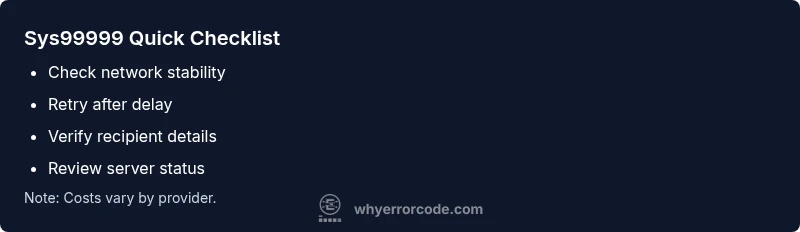
easypaisa error code sys99999 signals a system-level fault in Easypaisa's processing. The quickest path is to retry after a short wait, ensure a stable network, and verify recipient details. If the issue persists, contact support for a guided, deeper diagnostic.
What the easypaisa error code sys99999 means and why it happens
The easypaisa error code sys99999 signals a system-level fault in the payment ecosystem, not a user mistake. When you see sys99999 during a transfer, bill payment, or wallet top-up, it usually indicates a problem within the transaction service itself—such as a gateway timeout, temporary outage, or an internal validation delay. For developers, this error often appears under peak load when requests back up and the server cannot respond in time. For everyday users, sys99999 translates to a failed operation, and you should avoid hammering the app with repeated retries during a short window, as that can amplify traffic and complicate recovery. In most cases, the fault is transient and resolved in minutes, but it can also signal a broader incident that affects a subset of users or a specific feature (e.g., QR payments or API calls). Understanding sys99999 helps you triage quickly, distinguish network issues from app problems, and communicate specifics to support or your IT team when escalation is necessary.
How this error commonly presents to users
Users typically encounter a modal toast, a red banner, or a failed transaction screen with the exact code sys99999 displayed prominently. Some apps log the event with a timestamp and request ID, which is invaluable when you contact support. You may also notice slower response times, timeouts when loading payment screens, or incomplete refill attempts that leave funds in an uncertain state. On debug builds used by developers, you might see stack traces or API call failures indicating a server-side rejection rather than a client-side mistake. Because sys99999 denotes a backend fault rather than bad credentials or insufficient funds, the recommended response is to pause, verify your network, and verify the recipient's details before retrying. If the issue persists across different devices or networks, it is almost always a server-side matter that will require intervention from the provider's operations team.
Quick checks you can perform to rule out local issues
Before escalating, run through a quick local sanity check to confirm the fault is not user or device related. Ensure you have stable internet access (prefer a wired or reliable Wi‑Fi connection rather than cellular data when possible). Update the Easypaisa app to the latest version and clear the app cache if you notice unusual delays. Check that you are not attempting to perform the same action repeatedly in rapid succession, which can trigger throttling. Verify your device clock is accurate; wrong time settings can affect time-based token validation. If a QR payment is involved, re-scan the code or re-enter the recipient’s mobile number and wallet ID with care. Finally, try a smaller transaction or a different payment method to determine whether the problem is isolated to a single flow.
Quick fixes to try right away (non-destructive)
If the fault appears transient, these non-destructive steps can often restore normal operation. First, wait 1–2 minutes and retry the payment, as systems often recover quickly from temporary congestion. Switch to a more stable network (e.g., move from cellular to a trusted Wi‑Fi network) and rerun the action. Sign out of the app and sign back in to refresh session state, or restart the device to clear any lingering process issues. Clear the app cache or reinstall the app if the problem persists, ensuring you back up any pending data. If the transaction involved a linked bank account, confirm the account status with the financial institution. Avoid making multiple high-value attempts in parallel; spread retries over time to avoid compounding the load.
In-depth diagnostic steps to identify the root cause
When the quick fixes do not resolve sys99999, a structured diagnostic approach helps isolate the root cause. Start by collecting the request logs, timestamps, and the unique transaction ID (if provided). Check for any reported outages from the service provider and verify whether other users in your region are affected. Compare the timing of the error with known deployment windows or API version changes. If a specific payment method (e.g., QR, wallet transfer, or bank-linked top-up) consistently triggers sys99999, the issue may lie with that subsystem. Testing across different environments (production vs. staging) can reveal if the fault is tied to a feature flag or a recent change. Finally, collaborate with your ops or developer team to review gateway configurations, retry policies, and circuit breakers that might be triggering a false positive.
Step-by-step deep dive: most common cause and how to fix it
The most frequent root cause behind sys99999 is a temporary gateway timeout or backend congestion. Follow these steps in order:
- Reproduce with a controlled test: perform a small transfer to verify baseline behavior. 2) Check network latency and packet loss from the client side to the gateway. 3) Inspect the payment gateway status dashboard or status page for incidents. 4) Review server-side logs for timeout errors (e.g., 504s) and the corresponding request IDs. 5) If a transient outage is confirmed, implement a controlled exponential backoff for retries and communicate an outage note to users. 6) If the problem persists after a clean retry, escalate to the operations team with precise timing, affected endpoints, and user impact.
Tip: Have a post-mortem checklist ready to document any interventions and outcomes.
Other possible causes and their fixes
Though the gateway issue is common, sys99999 can appear due to other factors. An incorrect recipient detail, invalid account linkage, or a mismatch between your wallet and linked bank can trigger backend validations that return a generic error code. There may be regional restrictions, regulatory hold-ups on certain payment routes, or a scheduled maintenance window. In these cases, verify the recipient's info, re-check your account status, and try alternate payment channels if available. For device-level factors, confirm the app has permissions to access network state and that the device clock is synchronized. If you continue to see sys99999 after all checks, request a diagnostic session with the provider's support team to review logs, backend queues, and routing paths.
Safety, privacy, and when to involve a professional
Security and privacy considerations are critical when dealing with payments. Do not share one-time passwords, verification codes, or biometric prompts in public or insecure channels. If the problem involves server-side configurations or code deployments, rely on authorized IT staff to perform diagnostics. If the error persists across multiple networks, devices, and user accounts, it is time to involve the provider’s support engineering team. Expect professional diagnostics to be described by the service plan and time-to-resolution estimates during engagement rather than upfront; focus on obtaining a clear incident report and a defined ETA from the support team.
How to prevent sys99999 in future transactions
Proactive measures help minimize the chances of sys99999 recurring. Maintain updated app versions and monitor for outage notices from the service provider. Use resilient network connections, implement proper backoff strategies for retries, and test critical flows in a staging environment before rolling changes to production. Establish an incident response plan for payment failures, including predefined escalation paths and user communication templates. Finally, keep documentation of known issues and resolutions so both users and support agents can resolve issues more quickly in the future.
Steps
Estimated time: 15-30 minutes
- 1
Verify account status and permissions
Ensure your Easypaisa account is active and has permission to perform the intended operation. Check for any security holds or verification prompts that need completion.
Tip: Check for any app notices about required verifications in the notifications tab. - 2
Test with a small transaction
Attempt a tiny transfer or payment to see if the issue is related to transaction size or feature gating. Use a low amount and a known good recipient.
Tip: Document the exact amount and recipient to compare with later errors. - 3
Verify network and device state
Switch networks (Wi-Fi to mobile data or vice versa) and reboot the device if needed. Confirm the device's clock matches the current time to avoid token issues.
Tip: Run a quick ping test to your processor gateway to gauge latency. - 4
Check service status and logs
Look for any service outage notices and collect the transaction ID and timestamp. Review gateway logs for timeouts or 5xx responses.
Tip: Capture the request ID and time window for support follow-up. - 5
Communicate with support with data
If the problem persists, open a support ticket with your logs, device details, and steps tried. Include the exact error code and impact.
Tip: Attach screenshots and the last successful transaction if available.
Diagnosis: User sees 'easypaisa error code sys99999' during a payment or transfer
Possible Causes
- highGateway timeout due to network congestion
- highServer-side validation failure or temporary outage
- lowIncorrect recipient details or insufficient funds
Fixes
- easyWait 1-2 minutes and retry the transaction
- easyCheck internet stability and switch networks if needed
- easyVerify recipient details and funds availability
- mediumRequest support to review server-side logs and escalate
Frequently Asked Questions
What does sys99999 indicate in Easypaisa?
Sys99999 signals a backend system fault in Easypaisa, not an incorrect user action. It often means the service is temporarily unavailable or congested.
Sys99999 means the service backend is having a problem, not something you did wrong.
Can I fix sys99999 by myself?
You can try quick fixes like checking your network and retrying, but persistent failures require support to diagnose server-side issues.
You can try basic retries, but if it keeps happening, contact support for help.
When should I contact Easypaisa support?
If the error persists after 10-15 minutes and there’s no public outage, reach out with logs, timestamps, and the transaction ID to speed up resolution.
If it keeps happening, get help with your logs and timing.
Will sys99999 affect other Easypaisa features?
Usually only the affected transaction is impacted; other features and transactions may work normally.
Most of the time, other features are fine, but verify if in doubt.
Are there safety concerns when retrying payments?
Limit retries, avoid sharing codes, and do not perform rapid, repeated attempts during outages.
Limit retries and never share codes during failures.
Watch Video
Top Takeaways
- Recognize sys99999 as a backend fault, not a user mistake.
- Start with quick retries and network checks before escalation.
- Collect logs and IDs when contacting support.
- Differentiate between transient outages and persistent backend issues.