How to remove Easypaisa error code: A practical, step-by-step guide
Learn a structured approach to remove Easypaisa error codes. Update the app, verify connectivity, reauthenticate, and escalate with logs if needed using our comprehensive, step-by-step guide.


To remove an Easypaisa error code, start with a structured quick check: confirm you’re on a stable network, update the Easypaisa app to the latest version, and retry the transaction. If the code persists, capture the error details (code, time, device, and steps leading to it) and follow the diagnostic flow described below or contact support.
What is an Easypaisa error code and when does it appear?
Easypaisa error codes are signals from the app that something in the payment flow failed or could not be authenticated. You’ll typically see these codes during key moments such as initiating a transfer, confirming a payment, or when re-authenticating after an OTP. Understanding what triggers the code helps you apply the right remediation quickly. In most cases, the code reflects a failure in one of a few broad areas: connectivity, authentication, balance availability, or backend processing. Before attempting any fixes, note the exact code, the time it appeared, your device model, and whether you were connected to Wi‑Fi or cellular data. This baseline information makes it easier to reproduce the issue if you need to escalate.
Common Easypaisa error codes and their meanings
Rather than memorize every numeric code, focus on the category it represents. Network or server issues usually indicate the app could not reach the payment gateway. Authentication or OTP failures point to login or 2FA problems. Insufficient balance or merchant issues signal a problem with funds or the recipient. Cosmically, codes can vary by platform or app version, so always cross-check the time and device, and verify you’re running the latest build. Our guide uses general categories and recommended actions you can apply regardless of the specific code. If you record the code along with a screenshot, you’ll have a concrete reference when you contact support or compare notes with teammates.
Before you start: prerequisites and safety
Prepare your environment so you can diagnose without creating new issues. Use a stable internet connection and keep the device charged. Have your Easypaisa login credentials handy, along with any transaction IDs or error timestamps. If possible, switch from public Wi‑Fi to a trusted network to rule out network contention. Finally, avoid sharing OTPs or passwords and don’t perform high‑risk actions (like large transfers) while you’re troubleshooting. Collecting minimal but complete details now saves back-and-forth later.
How the diagnostic flow works (high-level)
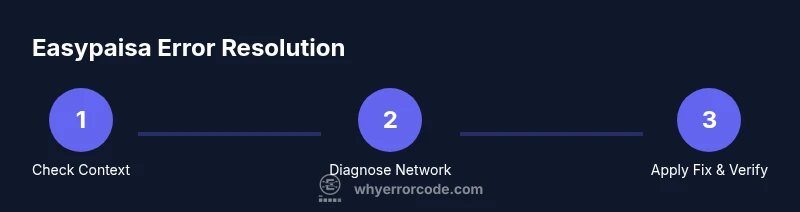
The troubleshooting flow combines quick checks with targeted actions. Start by confirming the error context and ensuring the basic prerequisites. Next, verify network reachability and service status with the provider. If the app is outdated, update or reinstall to rule out client-side issues. Finally, re-authenticate, test a small transaction, and gather logs or screenshots to share with support if needed. This approach keeps you focused and minimizes unnecessary steps.
How to verify the fix and prevent future errors
After applying fixes, re‑run the same action to confirm the error does not reappear. Check that you can complete a test transfer or payment, and review the app logs for any recurrent messages. To reduce future incidents, enable automatic updates, keep your device time synchronized, and avoid performing sensitive transactions on unstable networks. Consider setting up alerts or notes for the next time you encounter a similar code.
When to escalate and how to contact support
If the error persists after the action plan, escalate with a precise summary: the error code, when it occurred, device model, app version, and steps tried. Reach out through official Easypaisa support channels (in‑app help, website contact form, or helpline) and include screenshots and transaction IDs. If the issue appears to be systemic, document it in a shared channel with your team so others can reproduce. Timely escalation helps reduce payment delays and customer frustration.
Tools & Materials
- Smartphone or tablet with Easypaisa installed(Ensure the device supports the latest app version)
- Stable network connection(Wi‑Fi or mobile data; avoid public hotspots during troubleshooting)
- Latest Easypaisa app version(From official app store or Google Play / App Store)
- Active Easypaisa account credentials(Username, password, and OTP method (if enabled))
- Transaction details(Recent transfer ID, amount, recipient, date/time)
- Access to official support channels(In‑app help, official website, or helpline)
Steps
Estimated time: Total time: 15-25 minutes
- 1
Capture the error context
Record the exact error code, timestamp, device model and OS, app version, and the actions you were performing when the error appeared. Take screenshots if possible and note any OTP prompts or unusual screens.
Tip: A clear before/after capture helps both you and support reproduce the issue. - 2
Check network connectivity
Test basic internet access on the device and verify there’s no VPN or firewall interfering with the transaction. If you’re on mobile data, switch to a stable Wi‑Fi network and retry.
Tip: Try a quick page load from a browser to confirm connectivity is stable. - 3
Update or reinstall the app
Open the app store and install the latest Easypaisa version. If problems persist, uninstall and reinstall the app to clear corrupted data or stale caches.
Tip: Back up any locally stored data if needed before reinstall. - 4
Re-login and reauthenticate
Log out of the Easypaisa app and sign back in. Complete any OTP or biometric reauthentication prompts to reestablish a valid session.
Tip: Ensure device time is accurate to avoid OTP validation failures. - 5
Retry the transaction with minimal risk
Attempt a small test transaction or a low-value transfer to confirm the flow works after the fixes. Do not perform large transfers during troubleshooting.
Tip: If your policy allows, enable an audit trail for the test transaction. - 6
Collect logs and contact support
If the error repeats, collect logs, screenshots, and all contextual data. Contact Easypaisa support via official channels and provide the details you gathered.
Tip: Share the exact error code, time, device, app version, and the steps tried.
Frequently Asked Questions
What does an Easypaisa error code indicate?
Error codes indicate a failure in a specific part of the payment flow, such as connectivity or authentication. They guide troubleshooting and help you apply the right remediation.
Error codes point to where the failure happened, helping you troubleshoot faster.
What should I do first when I see an error code?
Start with basic checks: verify network connectivity, update the app, re-login, and note the exact error code and time. Use the diagnostic flow to isolate the issue.
Begin with network checks, app update, and re-login.
Will updating the app always fix the error?
Not always. Some issues are server-side or relate to authentication. Updates often fix client-side bugs but may require server-side remediation as well.
Update first, but if it persists, check for server issues too.
How long should I wait before retrying a failed transaction?
Wait at least 60 seconds between retries to avoid duplicate transactions and give servers time to recover.
Give it a minute before trying again.
How do I contact Easypaisa support effectively?
Provide the error code, time, device, app version, and screenshots. Use official channels such as in‑app help or the support portal.
Share the error code, time, and screenshots with support.
Can I avoid future errors?
Keep the app updated, maintain a stable network, ensure correct device time, and follow best security practices.
Keep your app updated and use secure networks.
Watch Video
Top Takeaways
- Update the app and verify network first.
- Capture code, time, device, and steps.
- Re-login and retry with a small transaction.
- Escalate with logs if unresolved.
- Enable updates and secure networks to prevent repeats.