SSL Handshake Failed Error 525 (AO3): Troubleshooting & Fix Guide
Urgent guide to diagnose and fix the SSL handshake failed error code 525 on AO3 and similar sites. Learn causes, quick checks, and step-by-step remediation to restore secure TLS connections.


An SSL handshake failed error code 525 indicates the TLS handshake between your client and the origin server couldn’t complete, blocking secure communication. Quick fixes focus on the origin’s TLS configuration: install a valid certificate chain, enable modern TLS versions, and verify the SSL mode used by your CDN. If AO3 or similar sites are involved, also verify DNS and proxy settings, then re-test the connection.
What the 525 error means for AO3 users and TLS basics
The message ssl handshake failed error code 525 ao3 signals a failure during the TLS negotiation phase before any HTTP data is exchanged. In practical terms, Cloudflare or another CDN could not establish a trusted, encrypted channel with the site’s origin. This is a security problem rather than a simple page error, and it usually requires changes at the server or CDN level rather than a client-side workaround. For developers and IT pros, treating 525 as a TLS health check helps prioritize fixes that strengthen certificate handling and protocol support. The root cause is often a mismatch between what the client expects and what the origin can offer. By aligning TLS versions, updating certificates, and ensuring correct chain delivery, you restore a secure handshake and resume normal traffic.
How Cloudflare and origin TLS interact (AO3 context)
When a visitor connects to AO3 behind Cloudflare, Cloudflare terminates its TLS session with the client but must trust the origin’s TLS session too. A 525 arises if the origin presents a certificate that Cloudflare cannot verify, or if the origin refuses modern TLS handshakes. This is particularly common after certificate renewals, server migrations, or misconfigured SSL settings. Understanding this flow helps you decide whether the problem is a misissued certificate, a chain problem, or a CDN configuration mismatch rather than a generic network error.
Common root causes you might be facing right now
The following causes are the most frequent culprits behind 525 errors, listed from highest to lower likelihood:
- Expired or invalid origin certificate, or incomplete chain. If the certificate chain is broken, Cloudflare cannot verify the origin, and the handshake fails.
- Outdated TLS versions or cipher suites on the origin. Modern clients require TLS 1.2 or TLS 1.3; servers that only support legacy protocols will fail the handshake.
- Mismatched SSL modes between Cloudflare and the origin. Using Full (Strict) with an invalid origin certificate creates a barrier to a successful handshake.
- Network devices or firewalls obstructing TLS traffic to the origin. Deep packet inspection or port filtering can interrupt the TLS negotiation.
- Incorrect SNI configuration on the origin or CDN, causing the server to present a certificate for the wrong host.
Quick checks you can perform from a user or operator perspective
- Run a TLS test against the origin (for example with openssl s_client -connect origin.example.com:443) to confirm the certificate chain and supported protocols.
- Verify that the origin certificate is valid, not expired, and includes all intermediate certificates.
- Check the Cloudflare SSL/TLS mode settings (Off, Flexible, Full, or Full (Strict)) and align them with the origin’s capabilities.
- Ensure DNS for AO3 points to the CDN without stale records and flush caches to force fresh resolution.
- Review server logs for TLS negotiation errors and look for handshake failure details such as protocol version or cipher mismatch.
Guidance for site operators: ensuring resilient TLS configuration
Begin with certificate health:
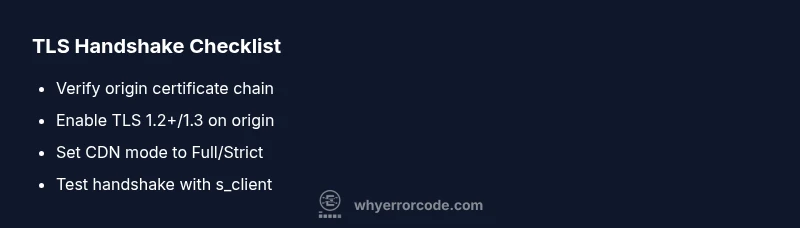
- Install the complete chain on the origin, including intermediates.
- Reissue or replace certificates if expiry or revocation is suspected. Use certificate transparency logs to verify issuance details. Next, tighten TLS settings:
- Enable TLS 1.2 and TLS 1.3 on the origin and disable deprecated protocols.
- Ensure the server supports modern cipher suites that Cloudflare accepts. Lastly, verify CDN alignment:
- Set Cloudflare SSL mode to Full or Full (Strict) and ensure the origin hostname is reachable and trusted.
- If using SNI, confirm that the host header matches the certificate's SANs. After changes, run TLS tests again to confirm a clean handshake.
Steps
Estimated time: 45-60 minutes
- 1
Validate origin certificate
Check that the origin’s TLS certificate is valid, includes intermediates, and matches the domain. Use a TLS check tool to confirm a complete chain.
Tip: If in doubt, fetch the certificate chain from the server and compare with the issuing CA's bundle. - 2
Enable TLS 1.2+ on origin
Ensure the origin supports TLS 1.2 or TLS 1.3 and disable legacy protocols. Modern clients will reject older ciphers.
Tip: Run a protocol scan to verify supported TLS versions. - 3
Configure CDN mode correctly
Set the CDN SSL/TLS mode to Full or Full (Strict) and verify that the origin hostname is correct and reachable.
Tip: Compare the DNS A/AAAA records to ensure the origin is resolvable by the CDN. - 4
Test with TLS tools
Use openssl s_client and online TLS test pages to confirm handshake success and identify remaining issues.
Tip: Look for verify return: 0 (ok) in s_client output. - 5
Revisit certificate chain after migration
If the site recently migrated servers, re-import the certificate bundle and recheck the chain.
Tip: Check for missing intermediates in the chain. - 6
Monitor and verify
After applying fixes, monitor TLS logs and re-test from multiple networks to confirm resolution.
Tip: Document changes and expected behavior for faster future troubleshooting.
Diagnosis: Error 525 TLS handshake failed when connecting to AO3 behind a CDN
Possible Causes
- highExpired or invalid origin certificate or missing intermediates
- highOutdated TLS versions or cipher suites on the origin
- mediumCDN origin mode misconfiguration (Full/Strict vs Flexible)
- lowNetwork firewall blocking TLS handshake to the origin
- mediumIncorrect SNI configuration on origin/CDN
Fixes
- hardUpdate origin certificate chain and reissue if needed
- easyInstall missing intermediate certificates and re-check chain
- easyEnable TLS 1.2+/1.3 on origin and disable deprecated protocols
- mediumAlign CDN SSL mode with origin settings (Full/Strict)
- mediumCheck firewall/ACLs allowing TLS to the origin
Frequently Asked Questions
What does error 525 mean in the Cloudflare context?
Error 525 indicates Cloudflare could not establish a TLS handshake with the origin server. The fix is typically on the origin TLS configuration and DNS/CDN alignment.
525 means Cloudflare couldn't complete the TLS handshake with the origin—fix the origin TLS and DNS setup.
Is 525 the same as a certificate mismatch?
Not always, but certificate mismatch is a common cause of 525. Check certificate validity, chain completion, and SANs.
Often caused by a certificate mismatch or chain problem; verify certs.
How do I test and validate the origin certificate?
Use openssl s_client to inspect the certificate chain and run SSL Labs tests to check for chain and protocol issues.
Run TLS checks with openssl and SSL Labs to verify the chain and protocols.
What should I do if the origin is behind Cloudflare Flexible SSL?
Avoid Flexible mode for 525; switch to Full or Full (Strict) and ensure the origin has a valid certificate.
Don’t use Flexible SSL with 525—use Full or Strict and fix the origin cert.
Can a firewall cause 525?
Yes, a firewall inspecting TLS or blocking port 443 can prevent a handshake. Check network devices and allow TLS traffic to the origin.
Yes. Firewalls can block TLS, so allow port 443 and inspect TLS handshakes.
When should I contact a security or hosting professional?
If TLS changes require server access you don't have, or if certification and CDN config are complex, seek professional help.
If you’re unsure or running in production, get professional help.
Top Takeaways
- Verify origin TLS promptly to restore secure access
- Install complete certificate chain on origin
- Align CDN SSL mode with origin capabilities
- Test TLS with s_client/SSL Labs and confirm handshake