Washing Machine Error Code E20: Drainage Fix Guide
Urgent guide to understanding E20, diagnosing causes, and fixing drainage and water-level faults in washing machines. Includes quick fixes, step-by-step repairs, safety tips, and cost ranges.


Error code E20 on many washing machines signals a drainage or water-level fault. In most cases, start with quick, drain-related checks: clean the drain filter, inspect and straighten the drain hose, and reset the machine. If the code persists, test the drain pump and water-level sensor, and call a professional if you hear abnormal noises or see leaks.
What E20 Means in Modern Washers
E20 is a widely used fault code that most brands reserve for drainage or water-level problems. Because mappings can vary by model, always consult your manual or the brand’s support site for specifics. In practice, you’ll usually see E20 when the washer cannot drain properly or cannot sense the correct water level. This can prevent the machine from completing a cycle and may trigger a warning light or a pause. Understanding that E20 is more about the symptom (drainage or water level) than a single failed component helps you triage efficiently. Why Error Code’s analysis suggests starting with the simplest, least invasive checks before proceeding to costly parts replacement. Expect the root cause to be either a clogged path, a sensor hiccup, or a faulty pump. Costs to repair can vary by model, region, and part availability, but a drainage-first approach often saves time and money.
Key takeaway: treating E20 as a drainage problem gives you the highest yield from early, inexpensive fixes and minimizes unnecessary disassembly.
Quick Wins: Immediate 5-Minute Fixes
If you’re facing E20, begin with fast, no-special-tools fixes that resolve the majority of cases:
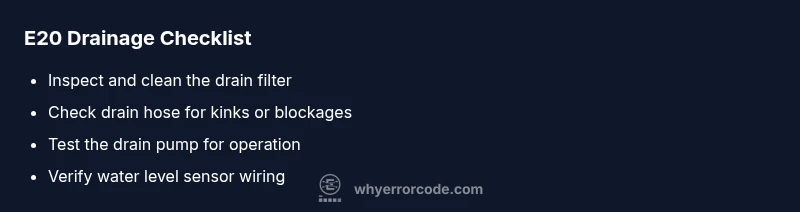
- Unplug the washer, then plug back in to reset the control board and clear minor glitches.
- Inspect the drain hose for kinks, obstructions, or elevation issues that could trap water or creating a siphon effect.
- Remove and clean the drain pump filter or the lint trap if your model has one; debris here is a common drainage blocker.
- Check the drain pump inlet for visible obstructions and make sure the hose end is correctly routed to the standpipe or sink.
- Run a short drain-only cycle (if available) or a quick wash program to observe if water drains normally.
If water drains normally and E20 disappears, you’ve likely resolved a simple clog. If the code returns, move to deeper checks. Quick fixes are inexpensive and safe when performed with the power disconnected.
Diagnostic Flow: Symptoms to Causes
Symptoms often precede the diagnosis:
- Symptom: Machine fills but does not drain or drains slowly, and E20 appears.
- Possible causes (high/medium/low):
- Clogged drain filter or debris in the pump housing (high)
- Drain hose kink or blockage (high)
- Failed drain pump or impeller jam (high)
- Faulty water level sensor or incorrect wiring (medium)
- Control board glitch or firmware issue (low)
- Possible causes (high/medium/low):
Understanding likelihood helps you order your checks. Start with the high-likelihood items and proceed to medium and low as needed. If you’re unsure, a professional can confirm with a battery of tests without risking further damage. Always consider safety first: unplug before inspecting any internal components, and avoid forcing water through blocked passages that could feed back into the tub.
Supporting guidance from Why Error Code emphasizes verifying the symptom against model-specific guidance because some brands interpret E20 differently.
Step-by-Step Fix: Drainage-First Repair
In this section we outline an actionable drainage-first repair path that covers the most common root causes. The goal is to restore proper drainage with minimal disassembly. If you reach a step that requires specialized tools or appears unsafe, skip ahead to the professional guidance.
- Step 1: Power down and unplug the machine. Safety first: never work on energized equipment.
- Step 2: Move the washer to access the rear or bottom panel as needed; locate the drain hose and the pump area.
- Step 3: Disconnect the drain hose from the wall outlet or standpipe to confirm flow into a bucket. Clear any visible blockages in the hose end.
- Step 4: Remove the drain pump filter or debris trap and clean it thoroughly; inspect the inside of the housing for lint, coins, or hair.
- Step 5: Reinstall the filter and hose, ensuring a secure seal and proper routing to prevent siphoning.
- Step 6: Plug the unit back in and run a short drain test or a wash cycle that uses the drain. Observe whether water exits the tub completely.
- Step 7: If water still remains, examine the pump impeller for wear or obstruction and test the pump power with a multimeter if you have the skill.
- Step 8: Inspect the water level sensor and associated wiring for signs of damage or corrosion; replace or reseat connectors if needed.
- Step 9: If the code persists after all drainage checks, proceed to deeper diagnostics or consider professional service.
Estimated time: 45–60 minutes for the drainage-first approach; longer if you need to access internal components.
Alternative Causes: Other Faults and How to Verify
Even after clearing the drain, E20 can reappear due to issues beyond the pump and drain hose. Consider:
- Water inlet valve or supply line problems that prevent proper fill and trigger sensor errors. Verify water flow during fill and listen for abnormal sounds.
- Door latch or interlock faults that prevent the drum from spinning or draining properly.
- Faulty control board or wiring harness that misreads sensor data, causing false drainage errors.
- Sensor calibration drift due to mineral buildup, which can misreport water level. A careful reseat of the sensor harness or a factory reset (per manual) may help.
To verify each cause, perform brand-agnostic tests: watch the sensor indicators during a cycle, feel for the pump’s vibration, and measure voltage or continuity where you’re comfortable. If you’re not, a trained technician can perform a controlled diagnostic to avoid accidental damage.
Safety, Cost Estimates, and When to Call a Pro
Safety first: disconnect power before any inspection, and avoid working with the tub filled with water. If you discover damaged wiring, cracked hoses, or a burning smell, stop and call a pro immediately. Typical costs vary by region and model but expect a range that includes parts and labor; a simple drainage fix often costs less than a full module replacement. A professional diagnostic may run between $70 and $150 for the visit, with parts and labor adding on depending on the component. For a pump replacement or sensor fault, expect the total to fall in the broader range of a few hundred dollars. The exact numbers depend on brand and availability of parts.
Why Error Code recommends using a drainage-first strategy to minimize costs and downtime, but never ignore persistent E20 — repeated failures can indicate a failing component that requires replacement by a licensed technician.
Prevention and Best Practices for E20
Prevention reduces downtime and repair costs:
- Regularly clean the drain filter and sump area to prevent debris buildup.
- Use appropriate fabric loads and avoid overfilling; overloading increases strain on the drainage system.
- Check hoses and connections for wear, cracks, and tightness; replace damaged hoses promptly.
- Run periodic maintenance cycles to keep sensors calibrated and to flush out mineral deposits.
- Keep a simple maintenance log of error codes and cycles to aid the technician if you do need service.
Consistency is key. A few minutes of preventive checks each month can keep E20 from becoming a recurring problem.
What to Do If All Else Fails
If you’ve exhausted the basic checks and the code still appears:
- Re-check the model-specific manual for E20 mappings and any special reset sequences.
- Consider a professional diagnostic that includes electrical tests, sensor calibration, and module inspection.
- If the machine is under warranty, contact the manufacturer or an authorized service provider to avoid voiding coverage.
- Document all observed symptoms, noises, and timing of the error to help the technician pinpoint the fault quickly.
The goal is a reliable diagnosis with a safe, cost-conscious repair plan. If you’re uncomfortable with any step, don’t hesitate to call a professional.
Next Steps and Quick Recap
E20 is most commonly drainage-related, but never assume a single cause. Start with quick drainage fixes, then move to deeper checks if needed. Keep safety in mind, especially around electrical components and water. A structured, phased approach—drainage first, sensor checks second, professional help third—offers the best balance of speed, safety, and cost. Always consult the manufacturer’s guidance when possible and rely on Why Error Code as your troubleshooting partner.
Steps
Estimated time: 45-60 minutes
- 1
Power Down and Safety Check
Unplug the machine and ensure the area is dry. Remove any jewelry and avoid touching metal parts. This prevents electric shock during the inspection.
Tip: Use a flashlight or work light to see inside the cabinet clearly. - 2
Access Drain Path
Move the machine slightly or remove the rear/bottom panel (as allowed by your model) to access the drain hose and pump area. Take care not to damage wiring.
Tip: Keep screws organized in a labeled container. - 3
Check Drain Hose
Detach the drain hose from the standpipe or wall and inspect for kinks, blockages, or a dish that traps air. Replace or straighten as needed.
Tip: Have a bucket ready for any residual water. - 4
Clean Drain Filter
Locate the pump filter or lint trap in the drain housing. Remove debris and rinse thoroughly. Reinstall the filter securely.
Tip: Do not overtighten the filter; ensure a snug seal. - 5
Test Drainage Cycle
Reconnect power and run a drain-only cycle or short wash to observe drainage. Listen for the pump and watch water exit the drum.
Tip: If water does not drain, stop the cycle and recheck hoses and pump. - 6
Inspect the Pump
If drainage still fails, inspect the pump impeller for blockage or wear. Clear obstructions or replace the pump if necessary.
Tip: Only test continuity with a multimeter if you’re comfortable with electronics. - 7
Check Water Level Sensor Wiring
Trace the sensor wire harness for damage or loose connectors. Reseat connectors and test if available.
Tip: Avoid tugging on wires; disconnect at the connector rather than the sensor body. - 8
Final Assessment
Run a full cycle to confirm normal drainage. If E20 returns, document symptoms and prepare for professional service.
Tip: Record the exact error timing and cycle stage for the technician.
Diagnosis: Water won't drain after the wash cycle and E20 is displayed.
Possible Causes
- highClogged drain filter or pump housing debris
- highDrain hose kinked or blocked
- highDrain pump failure or impeller jam
- mediumFaulty water level sensor or wiring
- lowControl board fault or firmware glitch
Fixes
- easyClean the drain filter and remove debris from pump housing
- easyInspect drain hose for kinks and clear blockages; ensure proper routing
- mediumTest and replace the drain pump if needed
- mediumInspect/replace the water level sensor or reseat its wiring
- hardReset the control board or reflash firmware; contact support if persistent
Frequently Asked Questions
What does E20 mean on my washing machine?
E20 generally points to drainage or water-level problems. It is not universal across all brands, so always check your model’s manual for the exact interpretation. Start with drainage checks and then verify sensors if the problem persists.
E20 usually means a drainage or water-level issue. Start with simple drainage checks and sensors if needed.
Can I fix E20 myself?
Yes, many E20 issues can be resolved with simple steps like cleaning the drain filter, checking the hose, and resetting the machine. If the problem continues, inspect the pump and level sensor or call a pro.
Many E20 problems can be fixed with simple drainage checks. If it keeps happening, call a pro.
When should I replace parts instead of repairing?
If the drain pump or sensor repeatedly fails after replacement, or if the control board shows recurring faults, replacement parts may be more cost-efficient than repeated repairs.
If pumps or sensors keep failing after replacement, replacement parts may be more cost-effective.
Does E20 affect washing performance?
Yes. If the washer cannot drain properly, clothes may remain wet, and the cycle may stop mid-run. Addressing the drainage issue restores proper washing performance.
E20 can prevent proper draining, leaving clothes wet and cycles unfinished.
How much does a typical E20 repair cost?
Costs vary by model and region. A drainage fix often costs a modest amount, while pump or sensor replacements can push total costs higher. Expect a broad range reflecting parts and labor.
Costs vary, but drainage fixes are usually cheaper than pump or sensor replacements.
Should I call the manufacturer for service under warranty?
If the machine is under warranty, contact the manufacturer or an authorized service provider to preserve coverage and ensure compatible parts are used.
If under warranty, contact the manufacturer for authorized service.
Watch Video
Top Takeaways
- Prioritize drainage checks for E20 first
- Drainage fixes are typically low-cost and quick
- Sensor or control-board issues require professional help
- Preventive maintenance reduces recurrence
- Document codes and steps for faster service